Data Led Decision Making for TikTok Shop Profit
data led decision makingTikTok Shop profitcontribution marginGMV Maxecommerce KPIs
A TikTok Shop sale can look profitable before its full costs arrive. Refunds may affect the final result for up to 90 days after delivery, so confidence in a scaling decision depends on whether sales, fees, commissions, ad costs, and returns have caught up.
The skill is knowing when the numbers are complete enough to justify more spending. Raw sales can rise while contribution margin shrinks, especially when attribution credits paid campaigns for organic or affiliate orders, or a small number of creators account for much of creator GMV. A confident decision accounts for those distortions before increasing stock, ad budgets, or creator spend.
Table of Contents
- What Data Led Decision Making Means on TikTok Shop
- Profit KPIs That Should Change the Next Order
- How Attribution and Creator Bias Skew the Call
- Gates That Keep Weak Numbers From Scaling Spend
- How to Run a Weekly Profit Review
- Three Shop Calls the Profit Math Changes
- Frequently Asked Questions
What Data Led Decision Making Means on TikTok Shop
A beauty SKU rises to the top of your sales report. You could reorder stock, raise its advertising budget, and increase support for its strongest creator. A confident decision starts by asking whether the sales reflect durable demand and whether the costs tied to them are clear.
That question matters because TikTok Shop orders can be attributed in ways that blur the source of demand. GMV Max may attribute organic and affiliate orders to paid activity, while creator GMV can be concentrated among a small number of partnerships. A strong sales figure may therefore overstate what a bigger budget or broader creator push will add.
Give every report a job
For an operator defending a budget, analysis should resolve a specific choice:
- Which SKU to scale: Will higher volume improve the money left after costs?
- Which creator to keep: Does the partnership justify its commission, samples, and support?
- Whether advertising adds demand: Are paid results distinguishable from organic and affiliate activity?
- When to wait: Could attribution or unsettled costs change the apparent result?
The examples of smarter choices for Shopify businesses illustrate a useful habit: connect each commerce measure to an operating choice, such as what to stock or promote. On TikTok Shop, that means checking what a sales report attributes to paid activity before increasing spend.
An analytics maturity model describes how businesses can build from access to information toward consistent use of it. The practical test is whether a report helps you make a repeatable call, and whether you know which parts of the result may still change.
Profit KPIs That Should Change the Next Order
A metric earns its place only if it can start, stop, or redirect spend. Read this table from net profit down, not from GMV up.
TikTok Shop KPIs and the decision each one should change
| Metric | What to net out or compare | Decision it should change | When it is safe |
|---|---|---|---|
| Net profit | GMV minus refunds, COGS, fees, shipping, commissions, and ad spend | Scale, hold, or cut a SKU | After refunds and commissions start posting; label earlier figures as estimates |
| Contribution margin | The operating profit above divided by net revenue | Set a floor before more stock or spend | Same maturity as the underlying profit |
| Product GMV | Gross product sales only | Check volume, never use alone as a scale trigger | Real time and provisional |
| GMV Max attributed sales | All orders on an advertised product, including organic and affiliate | Don't read as incremental paid ROI | Review daily, with organic and affiliate activity distinguished |
| New vs returning buyers | New-customer and existing-buyer orders, with follower conversion checked separately | Aim creative and stock at acquisition or repeat purchases | Use a weekly segment refresh |
| Creator contribution | Creator sales minus commission and sample cost, per post | Retain, renegotiate, pause, or test | After commissions post, with other order costs checked |
| Refund rate | Refunded or returned orders divided by orders | Pause a listing or hold a profit reserve | Watch the return window and extended damaged-item exposure |
Start with money left, then inspect the cause
Net profit belongs first because a sales increase can hide a deterioration in economics. Include costs the platform doesn't know automatically, such as your product purchase cost. Also distinguish this operating view from accounting net income: overhead, taxes, and other business expenses may still need separate treatment.
Contribution margin turns that result into a useful guardrail. Use net revenue after refunds as the denominator, keep definitions consistent, and don't compare a settled period with a fresh period as though they're equally complete. The YipSMS Inc. YipSMS guide to marketing ROI provides additional context for connecting marketing returns to the costs behind them.
Product GMV answers whether a SKU is moving. It doesn't answer whether you should buy more inventory. Likewise, a strong GMV Max column needs an attribution check before it can justify additional advertising.
Customer mix adds a different question: what kind of demand are you buying? TikTok's Customer Analytics in Data Compass supports analysis of customer acquisition, follower conversion, customer-group proportions, and transaction statuses. Followers and new customers aren't necessarily mutually exclusive, so don't force them into a single split that adds up neatly but misrepresents buyers.
Protect the result from omitted costs
Creator contribution is an initial comparison, not a fully loaded profit figure. After subtracting commission and sample cost per post, check product costs, fulfillment, fees, and refunds before approving more support.
Refunds require a reserve because eligible US purchases generally have a 30-day return window, according to TikTok Shop's US return policy. Count an order once when calculating an order-based refund rate, and track partial-refund value separately.
Use the TikTok Shop KPIs that actually matter to keep the review focused on action.
Spending floor: Add budget only when the expected additional contribution, after all additional costs, remains positive and clears your required profit buffer. Don't subtract the same investment twice.
How Attribution and Creator Bias Skew the Call
The top 10% of creators generated 58% of GMV in 2025, down from 65% in 2024, according to a Social Commerce Club analysis of TikTok Shop. Concentration eased, yet historical sales can still favor creators who received more posts, samples, or other support.
| Reading | What it counts | How it misleads | Fairer rule |
|---|---|---|---|
| Creator rank by GMV | Gross sales tied to the creator | Favors established reach, posting frequency, and prior sample access | Compare similar opportunities and review contribution after commission and sample costs |
| Sale-day profit | Order-date sales with little or no return reserve | Treats unsettled revenue as money you can safely reinvest | Hold a reserve and compare order groups at similar maturity |
A high rank shows where sales landed. It does not show what a creator would produce with the same opportunity as another creator. Compare similar products, posting opportunities, commission terms, and sample support. A smaller creator with fewer posts may merit a bounded test even when their total sales look modest.

Read attribution as a reporting rule
TikTok's Product GMV Max documentation says the solution optimizes total channel return and attributes every order for an advertised product to Product GMV Max in Seller Center, including orders generated through organic content and affiliate activity. The resulting total describes the channel's reported performance. It cannot, by itself, show how many orders the additional advertising created.
Subtracting visibly organic orders still leaves uncertainty. Customers may encounter several pieces of content before buying, and the reporting label does not resolve which interaction changed their decision. A carefully matched test or controlled change in spend provides stronger evidence. For a fuller explanation, see this guide to attribution modeling and how credit is assigned across touchpoints.
Refund timing adds another layer. Recently acquired orders have had less time to generate refunds than older ones, and eligible US purchases generally have a 30-day return window. Compare similarly aged order groups before judging a campaign's profit. Keep a bounded testing slice, define what would justify another test, and stop tests that repeatedly fail the profit floor.
Gates That Keep Weak Numbers From Scaling Spend
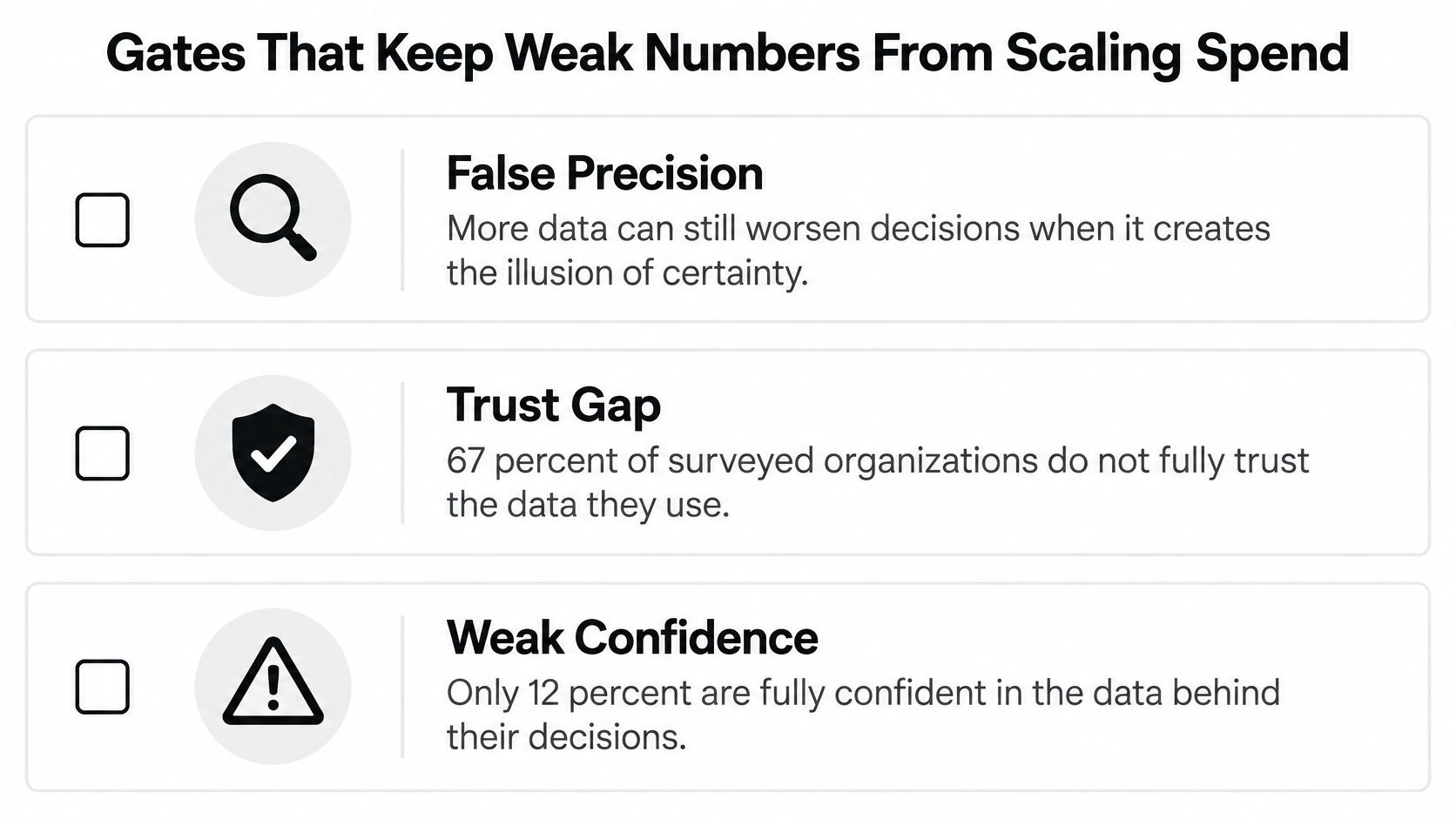
More data can worsen decisions when it gives incomplete numbers an appearance of precision. The Drexel LeBow and Precisely Data Integrity Trends report found that 67% of surveyed organizations don't fully trust the data they use, while only 12% consider their data AI-ready. Those findings describe different measures, not interchangeable levels of decision confidence.
For a seller, false precision might look like a profit figure displayed to the penny while product costs are missing. The arithmetic can be correct even though the underlying picture is wrong.
Translate data quality into shop checks
NIST's data quality framework identifies completeness, accuracy, integrity, consistency, timeliness, relevance, and fitness for purpose as core considerations. In shop language, that means checking whether every order has its costs, whether records refer to the same product, and whether the information is current enough for the proposed decision.
Affiliate sales, commissions, advertising charges, and refunds can arrive on different clocks. Match order IDs and reporting periods before combining them. Don't compare order-date GMV directly with a settlement payment without explaining the deductions and timing differences.
Apply these gates before changing a budget
- Ownership: Each metric has an owner, a source, and a written definition.
- Reconciliation: Dashboard GMV reconciles through fees, adjustments, and timing differences to Seller Center settlement within an agreed tolerance.
- Exceptions: Missing costs and unmatched creator IDs stay below the team's documented exception bar.
- Freshness: Every decision figure is labeled estimate or final, with a refresh time.
- Economics: Expected incremental contribution clears fully loaded investment and the required profit buffer.
Set tolerances before reviewing the result. Otherwise, a team eager to scale can relax its standards whenever a promising SKU fails them.
When sources disagree, reconcile before spending. Don't average conflicting figures: an average won't fix a missing fee, duplicated order, or mismatched date range. Record the difference, name the person responsible, and hold the affected decision.
These checks also help determine when to add paid ads to your TikTok Shop strategy. Advertising shouldn't become the experiment that reveals your cost records were incomplete.
A large-scale study discussed by McKinsey found approximately 5–6% higher productivity among firms using data and business analytics effectively than among comparable firms. For shop operators, the useful application is disciplined decision-making, not a promise that installing a dashboard produces the same result.
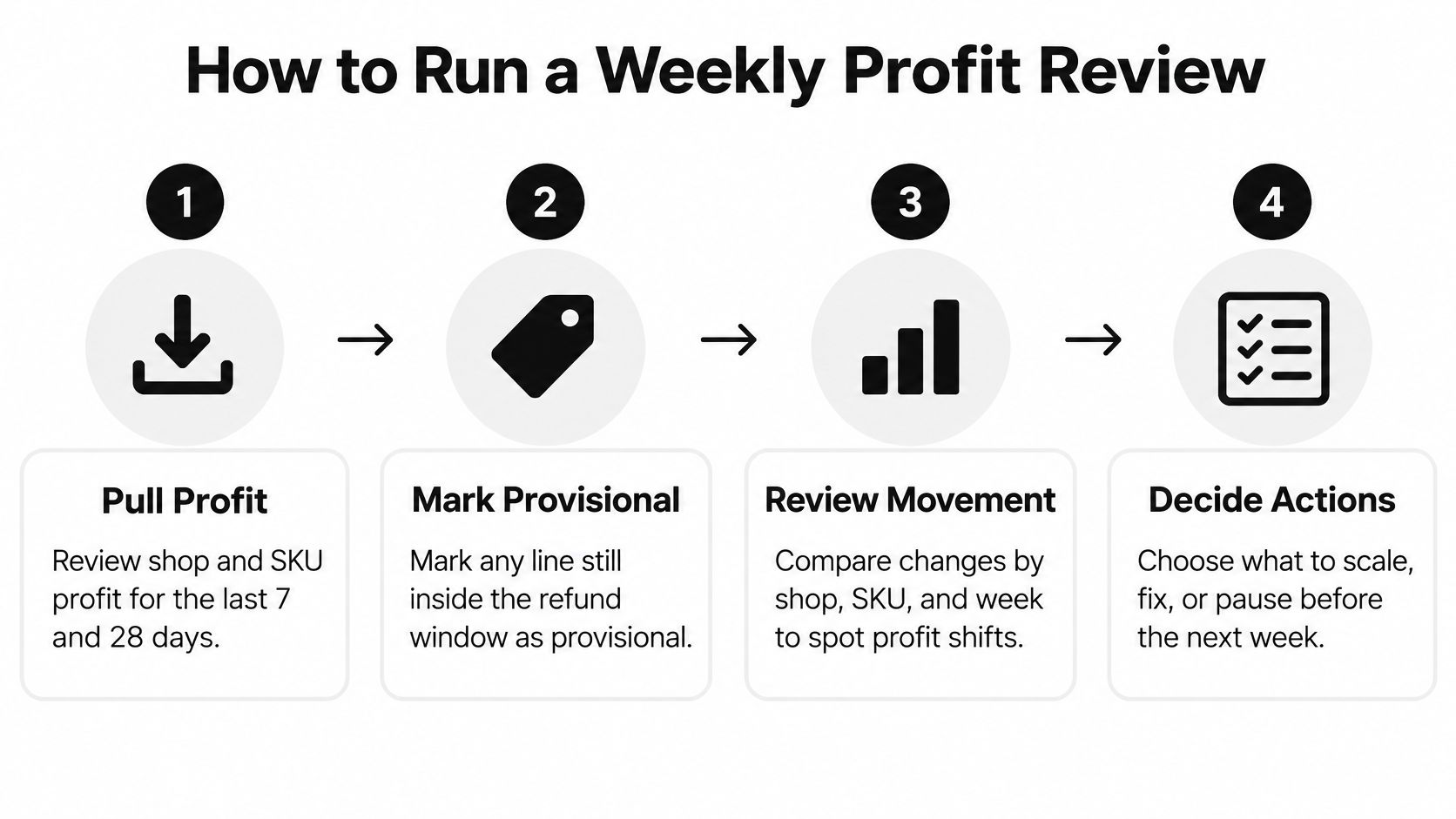
How to Run a Weekly Profit Review
Run the review yourself with a consistent reporting cut-off and a short decision log. Bring unresolved exceptions to the meeting rather than spending the meeting searching for them.
Prepare the figures and classify products
Pull shop and SKU profit. Use the last seven and twenty-eight days as practical review windows, not as proof that returns have settled. Mark recent order groups provisional and compare equivalent periods. This gives you a short-term operating view alongside a broader view of product performance.
Reconcile the records. Compare sales records with Seller Center and build a bridge to settlement amounts. List missing COGS, duplicate orders, unmatched creator IDs, and late commissions. Assign each gap to someone who can resolve it, and hold decisions materially affected by the gap.
Rank SKUs by contribution profit. Tag each product scale, hold, or fix. A product with strong sales but weak economics belongs in fix until you identify an actionable cause, such as costly shipping, misleading listing content, or unfavorable commission terms.
Check customer mix. Review whether the product attracts new buyers, converts followers, or serves existing customers. Don't describe a repeat-purchase favorite as an acquisition engine without evidence. Decide whether the next creative brief should introduce the product or encourage replenishment.
Allocate resources and write the decision
Review creators using profit per post and sample cost, with comparable posting opportunities where possible. Separate support for proven performers from a reserved testing slice. Use the results to plan your weekly social posts with Social Media Scheduler's practical planning guidance, rather than filling the calendar independently of commercial priorities.
Inspect products running GMV Max. Put channel GMV beside advertising spend, organic activity, and affiliate activity. Don't label the displayed return incremental without a defensible test. The resulting decision may be to maintain spend while you gather evidence, rather than increase or cancel it immediately.
Write a decision per line, with an owner and review date. Choose a primary decision metric instead of attaching several competing success measures to the same action. Keep supporting guardrails alongside it so the team can detect unacceptable returns, stock pressure, or cost changes.
Set the freshness condition. For example, require commissions and an initial read of refunds before raising a SKU's daily budget. State what evidence will reopen the decision. A temporary hold should have a clear release condition, not become an indefinite pause.
Keep TikTok Shop financial reporting tied to this operating routine. Your finance view and your growth decisions should use compatible cost definitions.
The meeting's output is a decision log: what changes, who owns it, why the evidence supports it, and when you'll check again. It isn't a larger dashboard.
Three Shop Calls the Profit Math Changes
The bestseller that shouldn't get a bigger reorder
A beauty SKU posts $80,000 GMV over twenty-eight days. Assume COGS is 28% of GMV, fees and shipping are 15%, advertising is 18%, and eventual refunds are 12%. Under those assumptions, $21,600 remains before creator commissions, samples, and other omitted costs.
That figure is a starting point for the reorder decision, not the whole margin calculation. Once commissions, sample support, and return-related handling are included, the next batch may fall below the shop's required margin. Check listing issues and return reasons before increasing stock or exposure.
Eligible damaged or defective purchases may be covered by TikTok Shop's US money-back guarantee for up to 90 days after the order status changes to Delivered. That delay means recent sales can still carry refund risk.
The leading creator who doesn't lead on profit
The top creator by affiliate sales may also require a high commission and substantial sample support. A smaller creator may post less often yet generate more contribution per post after comparable costs.
Compare the same product and similar posting opportunities. Count gifted stock as a cost, even when there is no unpaid invoice. Then renegotiate costly terms, pause unproductive sample shipments, or give the smaller creator a bounded test. Their audience, posting capacity, and product fit still limit how much support they can absorb.
Continue the test only if added support preserves acceptable contribution. A smaller creator's strong result is a reason to test carefully, not to transfer the full allocation.
The campaign with a flattering return
A campaign reports strong attributed sales while organic content and affiliate activity are also active. On TikTok Shop, GMV Max can attribute organic and affiliate orders to paid, so attributed sales alone do not establish how much demand the campaign created.
Compare the sales mix and use a carefully matched test to assess incremental demand. If the additional contribution before advertising is less than the added advertising cost, increasing spend weakens the case for profit, even when the reported return looks attractive. Keep the budget flat while improving creative or testing another product.
Frequently Asked Questions
Is data led the same as data driven?
Data-led decision making sets the commercial choice around evidence: whether to reorder, adjust spend, or change a creator partnership. Data-driven describes the method of using data to inform that choice. Experience helps identify causes and shape tests; cost and contribution figures show whether the proposed action makes financial sense.
Which single number should trigger a scale?
Use expected incremental contribution profit after the additional costs, with a buffer for uncertainty. GMV alone can't show whether the next unit of stock or advertising will improve profit.
Check what the calculation already includes. If advertising has already been deducted, don't subtract it again. A strong historical result also cannot guarantee that the next increase will perform as well.
How long before profit is trustworthy?
Treat fresh profit as an estimate until commissions, costs, and an initial pattern of returns appear. Eligible delayed damage or defect claims can still affect the result.
Confidence depends on the completeness of the record as well as its age. Older records with missing product costs may be less useful than newer records with complete costs and a sensible reserve. Match the size of the decision to the strength of the evidence.
Does GMV Max GMV equal incremental ad profit?
For how GMV Max attribution can affect the decision, see the attribution discussion above. To estimate ad profit, compare contribution before and after the spend change, then subtract the additional advertising cost and other costs tied to the extra orders.
If the result is uncertain, keep the decision provisional rather than treating attributed sales as proven incremental profit.
Try the self-serve Profit Dashboard from HiveHQ to review shop and product metrics, including profit estimates and product-level performance. Customer analytics, included in all Profit Analytics Suite plans, show customer behavior and purchase patterns. These views can help you assess the data behind a spending decision.