Dedicated Account Management for TikTok Shop: A Guide

dedicated account managementTikTok Shop account managemente-commerce client successHiveHQ Profit DashboardTikTok Shop KPIs
Dedicated account management for TikTok Shop is a profit and risk-control function, not a premium support contact. Its most valuable contribution may be preventing losses rather than generating sales, a distinction that matters when TikTok Shop reports declining 1.4 million seller-registration applications between January and June 2025 in its platform enforcement reporting.
A named manager doesn't solve fragmented ownership. Sellers need someone accountable for turning financial results, fulfillment problems, creator performance, and account-health signals into documented decisions. They also need access to the underlying numbers themselves.
Table of Contents
- What Dedicated Account Management Really Means
- Core Responsibilities of a Dedicated Account Manager
- KPIs and Service Levels to Measure
- Protecting the Shop From Compliance and Account-Health Failures
- Connecting Account Management to Real Profit on TikTok Shop
- Evaluating Providers and Onboarding Checklist
- How HiveHQ Supports Dedicated Client Success
What Dedicated Account Management Really Means
Dedicated account management means assigning a single accountable function to consolidate performance data, align internal decisions, and maintain a long-term plan for profitable growth. For TikTok Shop sellers, that function connects product economics, creator partnerships, advertising, fulfillment, and compliance.
The manager doesn't need to perform every task. They need to ensure that the right person acts, the decision has a deadline, and the seller can verify the result.
Why dedicated ownership exists
This isn't a recent customer-success invention. A bibliometric review of key account management traces “national account” to Roger M. Pegram in 1972 and the first article specifically featuring key account management to Stevenson and Page in 1979. The same review describes research expansion during the 1980s, as suppliers coordinated sales, marketing, service, and product resources around strategically important customers.
The relevant lesson isn't the terminology. It's the organizational design: important relationships need coordinated decisions rather than disconnected departmental responses.
Apply that logic to a shop. Marketing might recommend more spend, operations might flag inventory constraints, and finance might identify deteriorating margins. The account manager must reconcile those positions before approving the next move.
Operating principle: A dedicated manager owns the decision process, not just the conversation.
Establish the function before hiring the person
Start by defining decision rights and information access:
- Consolidate evidence. Give the manager access to financial reporting, shop performance, campaign activity, and unresolved operational issues.
- Define authority. Specify which changes they can approve and which require seller authorization.
- Maintain a decision record. Document the recommendation, rationale, responsible owner, and review date.
For the content-production side of this coordination, Mallary.ai's resource on how to build a scalable social workflow is a useful companion to the operating framework.
Keep the boundary clear. Content scheduling is a workflow. Dedicated account management is the accountable function that decides whether that workflow supports the shop's commercial priorities.
Core Responsibilities of a Dedicated Account Manager
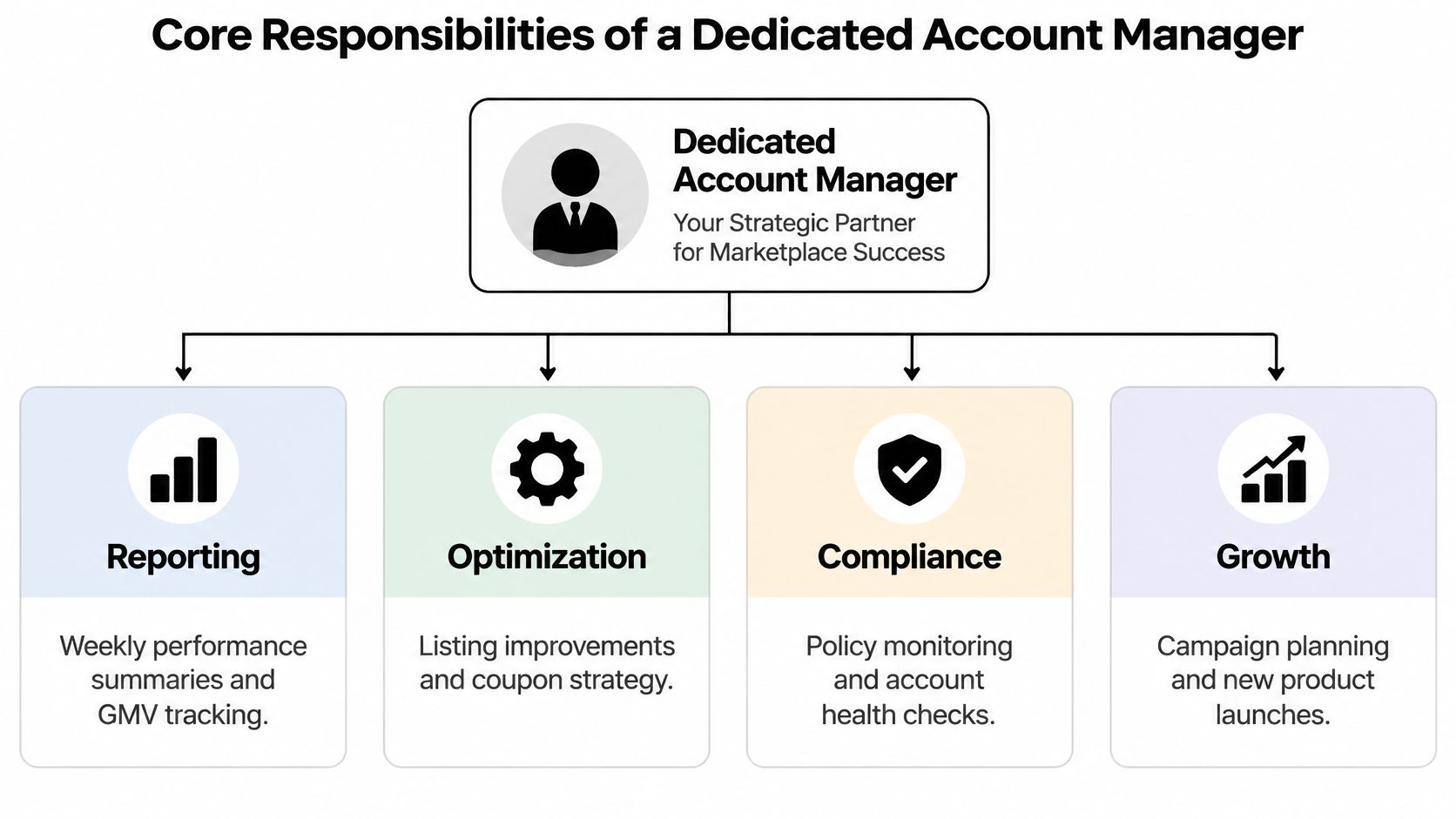
Judge the role by its deliverables. A full calendar and a responsive chat thread aren't evidence of commercial ownership.
The responsibilities should connect reporting and execution rather than sit in separate workstreams.
Require operating artifacts
The weekly profit review should reconcile GMV, COGS, advertising spend, commissions, refunds, and shipping. Require commentary on material changes, not a pasted chart. Each recommendation should identify the product affected, the proposed action, and the financial reason for taking it.
The creator and affiliate performance summary should connect partnership costs to contribution, while keeping observed sales separate from claims about incremental sales. A creator generating orders isn't automatically generating additional profitable demand.
The compliance and account-health checklist should identify missing evidence, unresolved notices, fulfillment exceptions, and the person responsible for each correction. The checklist needs supporting records, not merely a green status label.
Use a TikTok Shop Seller Center operating guide to establish where the team retrieves platform information. Then specify which records must be reconciled outside that view.
Make incident ownership explicit
A manager also needs an incident log and an escalation playbook. These aren't interchangeable: the log records what happened; the playbook tells people what to do next.
For every significant incident, require:
- Commercial exposure. Record affected products, orders, GMV, or margin where the team can substantiate the amount.
- Cause and correction. Separate the immediate workaround from the underlying process fix.
- Named ownership. Identify the person handling the next action and the escalation contact.
- Closure evidence. Record how the team verified recovery and whether further monitoring is required.
Research on B2B digital-service quality and responsiveness identifies responsiveness, personalized service, and clear internal communication as important to satisfaction. Translate that principle into a documented action plan with deadlines.
A late creator brief, unresolved attribution discrepancy, or stock mismatch shouldn't remain an unexplained item in a meeting. The manager must classify the issue and move it into the appropriate workflow.
Ownership means the seller never has to investigate who is investigating.
KPIs and Service Levels to Measure
Use a scorecard that distinguishes commercial results from execution quality. Otherwise, a manager can appear effective by responding quickly while leaving the underlying economics unchanged.
Net revenue retention belongs at the center of a recurring-revenue account portfolio, not as a substitute for shop profitability. For a seller evaluating its own TikTok Shop, contribution margin and net profit remain the relevant financial controls.
Dedicated Account Management KPI Shortlist
| Category | KPI | Formula or Definition | Target Direction |
|---|---|---|---|
| Financial | Net revenue retention | (Starting recurring revenue + expansion − churn − contraction) / starting recurring revenue | Higher; investigate below the retention threshold |
| Financial | Contribution margin | Revenue less the agreed variable-cost categories | Improve without hiding costs |
| Financial | Forecast variance | Actual result minus forecast, using an agreed reporting basis | Smaller unexplained variance |
| Operational | First-response time | Time from recorded issue receipt to initial response | Shorter, within agreed coverage |
| Operational | Resolution time | Time from issue receipt to verified resolution | Shorter without premature closure |
| Operational | High-severity ownership | Share of high-severity incidents with a named owner | Complete coverage |
| Creator-side | Partnership contribution | Attributed revenue less agreed partnership and order costs | Positive and sustainable |
| Creator-side | Agreed-action completion | Completed commitments relative to commitments due | Higher |
An NRR below 100% means expansion isn't offsetting churn and contraction; the account-management and renewal research supports tracking service performance and responsiveness over time. Don't apply this recurring-revenue metric to retail GMV and call it retention.
Set targets around consequences
Avoid universal response-time promises. A listing restriction affecting active sales needs a different escalation standard from a routine reporting question.
Agree on severity, coverage hours, and what constitutes a meaningful response. An acknowledgment without a responsible owner or next step shouldn't satisfy the operational intent.
- Pair speed with recovery. Review response time alongside resolution quality and commercial exposure.
- Pair growth with contribution. Require a financial explanation for additional spending.
- Pair forecasts with decisions. Investigate deviations that would change inventory or budget allocation.
For a broader financial lens, use AmbitionCFO on profit-changing KPIs. Keep the shop scorecard focused with the TikTok Shop KPIs that actually matter.
Protecting the Shop From Compliance and Account-Health Failures
More human attention won't protect a shop if nobody owns prevention. A manager who only forwards violation notices is handling correspondence, not controlling risk.
The registration-enforcement scale noted earlier is a reason to formalize evidence management. It isn't proof that an individual seller will face enforcement, and registration declines shouldn't be confused with active-shop suspensions.
Use a prevention-and-recovery checklist as the working standard.
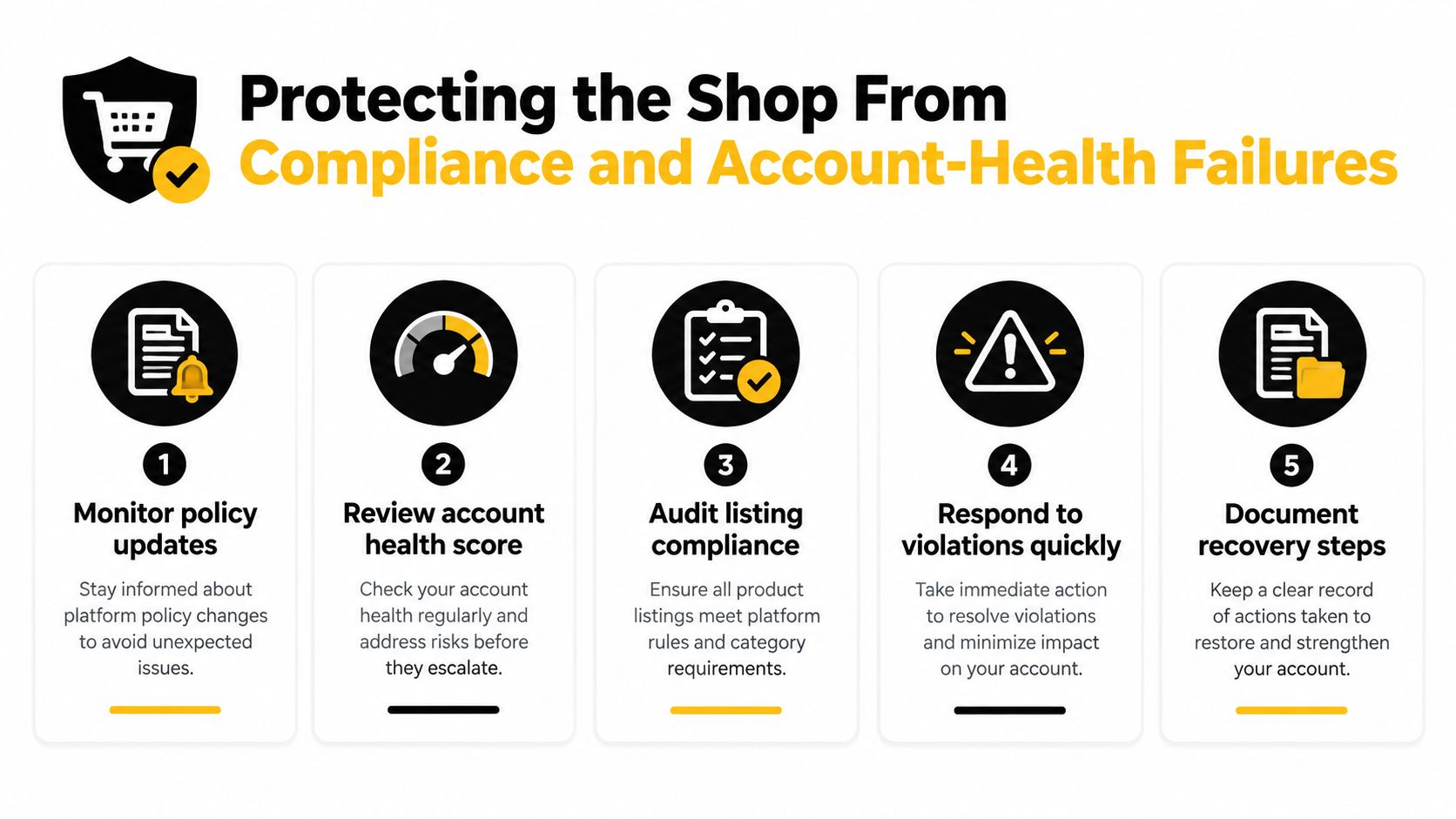
Monitor the indicators that expose execution failures
TikTok Shop assigns a Shop Performance Score after at least 30 qualifying delivered orders within the previous 90 calendar days; fake, sample, and gift orders don't qualify, according to its Shop Performance Score guidance. That guidance evaluates product satisfaction, fulfillment and logistics, and customer service, including these underlying metrics:
- Seller Fault Cancellation Rate. Covers seller-caused cancellations, including stockouts, late shipping, and pricing errors.
- On-Time Delivery Rate. Measures delivery against the designated deliver-by date.
- Instant Message Dissatisfaction Rate. Uses one- or two-star post-chat ratings from the previous 60 days, as defined in the same guidance.
Review these indicators alongside profit reporting. Rising sales aren't permission to ignore cancellations or deteriorating support.
For daily monitoring, assign checks for policy notices, listing changes, inventory discrepancies, fulfillment exceptions, and unresolved customer-service problems. Investigate the responsible process before approving further demand generation.
Prepare evidence before an appeal is necessary
Maintain an accessible evidence file for each shop. Include relevant identity records, product documentation, listing versions, order records, shipping evidence, and fulfillment correspondence.
The manager should control the process, while authorized staff retain responsibility for sensitive documents and platform submissions. Record what was submitted, when it was submitted, and which issue it addresses.
A named contact can't guarantee an appeal outcome. Demand reliable preparation and escalation, not promised influence over platform decisions.
Set explicit internal service levels for detecting risk, preparing evidence, assigning escalation, and recording recovery. Distinguish time spent waiting for the platform from delays caused by the seller's own team.
For multi-brand operators, standardize the checklist but isolate each store's records. Shared procedures are useful; copied assumptions about identity, products, or fulfillment aren't.
Before resuming normal activity after an incident, require a documented cause, corrective action, and verification step. Closing the ticket without changing the failed workflow leaves the operational problem unresolved.
Connecting Account Management to Real Profit on TikTok Shop
GMV divided by advertising spend is not a product P&L. Require the manager to explain what the shop retained after the costs associated with generating and fulfilling those sales.
Keep commercial reporting close to the decisions it supports.
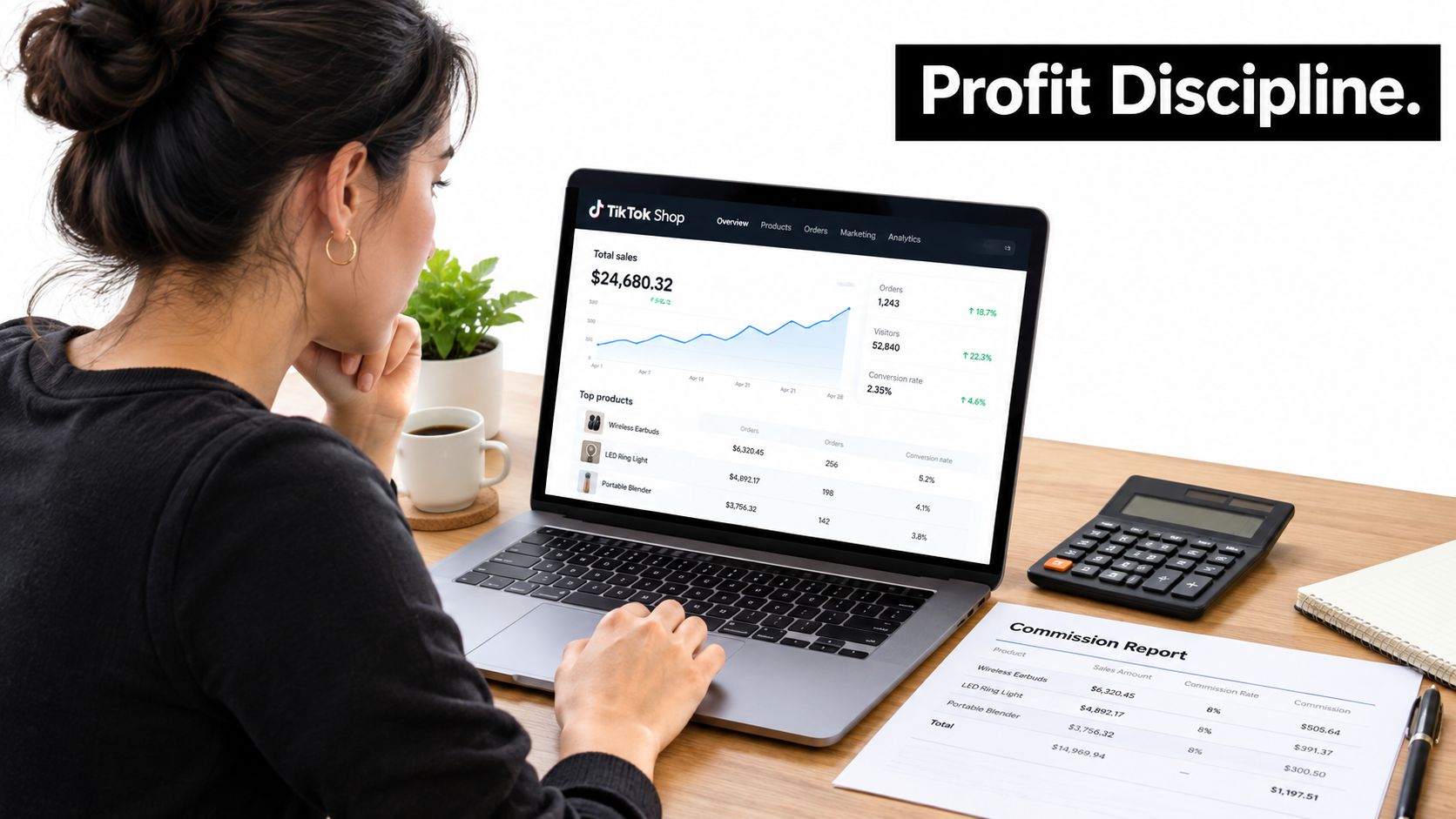
Reconcile GMV Max economics
TikTok's GMV Max explanation describes an automated campaign structure using available organic videos, advertisements, affiliate posts, livestreams, coupons, and commissions. Sellers select products or livestreams, set budget and ROI objectives, and the system directs delivery toward performing content; TikTok also describes incorporating affiliate commissions, coupons, and referral fees into broader ROI calculations.
That combination requires disciplined interpretation. Don't label all campaign-associated sales as paid incremental demand, and don't evaluate performance using media costs alone.
Build the product review around distinct reporting lines:
- Revenue treatment. Identify discounts, refunds, and the basis used to recognize sales.
- Acquisition costs. Separate advertising, commissions, samples, and retainers where applicable.
- Order economics. Include COGS, fulfillment, shipping, and relevant platform deductions.
- Accounting treatment. Reconcile taxes and platform co-funding without automatically treating every reported field as a seller expense.
TikTok's Seller Center advertising metrics documentation says the report includes advertising and non-advertising metrics across shop sales. Its broader metrics include returns, cancellations, shipping fees, taxes, and co-funded GMV, so field definitions matter before anyone calculates profitability.
Connect product performance to spending decisions
TikTok's Product analytics guidance provides visibility into GMV, orders, units, traffic, conversion, pricing, inventory, reviews, and performing content or creators. Use those signals to diagnose the sales change, then apply the agreed costs to judge whether the change was commercially worthwhile.
The HiveHQ Profit Dashboard provides a self-serve operating view for reviewing product performance alongside advertising costs, commissions, COGS, and net profit.
Use the accompanying video as a practical reference during the financial review.
Before approving more investment, establish a measurement contract covering the baseline period, attribution window, cost taxonomy, approval thresholds, and stop criteria. Observed attribution isn't proof of incrementality.
More samples, retainers, or discounts can worsen economics. Keep the partnership only when the evidence supports its contribution, or when the seller has explicitly approved a bounded learning investment.
Evaluating Providers and Onboarding Checklist
Ask candidates to walk through a difficult operating decision, not their presentation deck. Give them a generic scenario involving growing sales, deteriorating margin, and a fulfillment issue, then ask what they would investigate and who would act.
The useful distinction is whether they can explain their evidence, authority, and stopping conditions.
Compare operating models
| Approach | Appropriate use | Trade-off to accept |
|---|---|---|
| Seller-led management | The seller can review data and coordinate execution | Requires internal time and discipline |
| Internal dedicated manager | The operation needs continuous cross-functional ownership | Requires hiring, supervision, and backup coverage |
| External dedicated manager | The seller needs additional operating capacity | Requires explicit access, authority, and handover rules |
Use the agency-versus-in-house decision framework to clarify which responsibilities should remain internal. Next Point Digital's guide to selecting an Amazon marketing agency is also relevant background for Amazon sellers evaluating an external relationship.
Translate the preferred model into an onboarding checklist before granting decision authority.
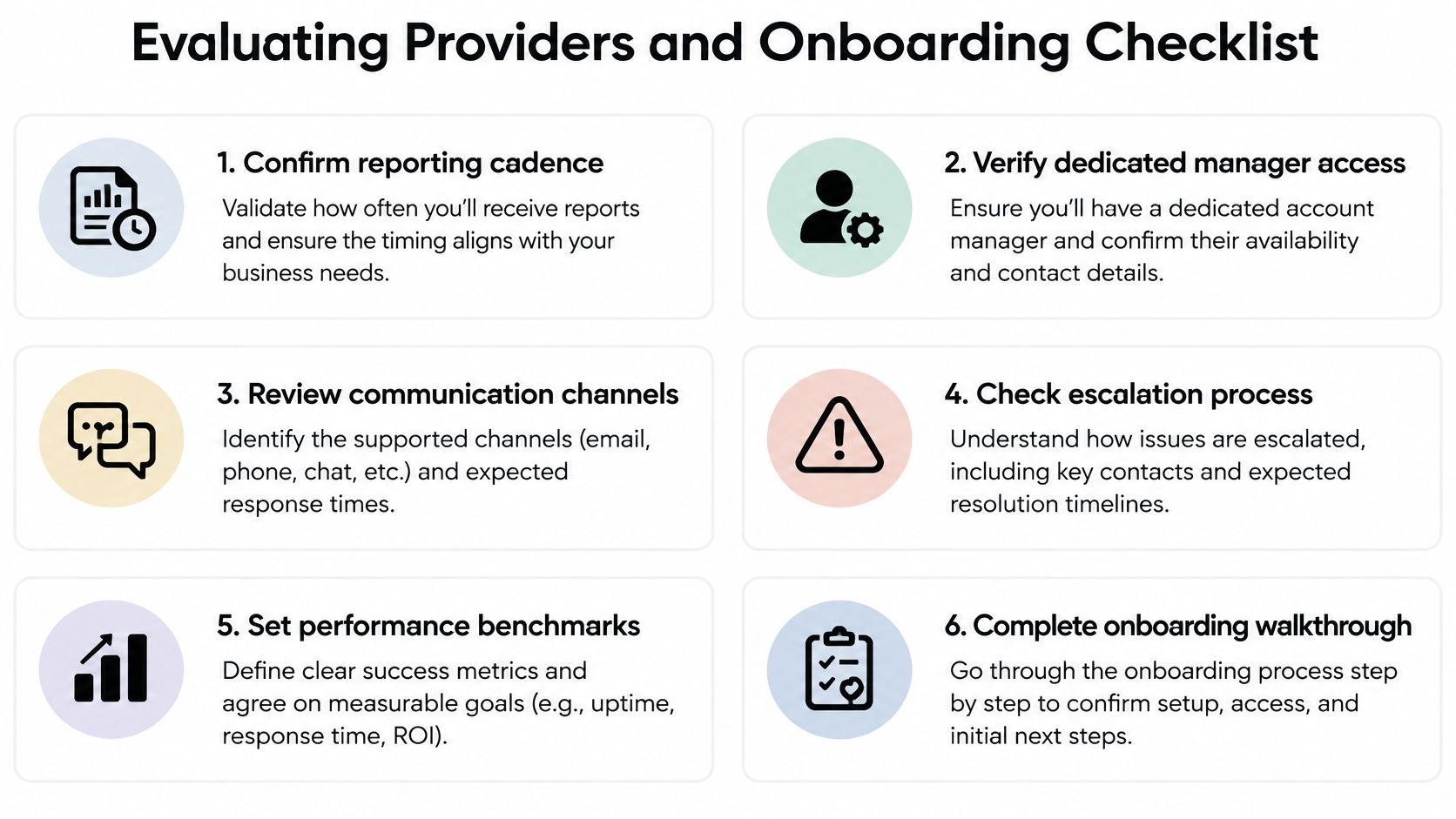
Require agreement before execution
- Reporting cadence and access. Specify review frequency, reporting ownership, seller access, and how discrepancies are resolved.
- Attribution and costs. Agree on the attribution window, baseline, and cost categories before judging performance.
- Approval thresholds. Define which budget, pricing, coupon, and partnership changes require authorization.
- Kill criteria. Document when an activity must stop, be restructured, or return for approval.
- Escalation ownership. Name the primary contact, backup, communication channels, and coverage limitations.
- Documentation standards. Require decision records, evidence storage, and an orderly handover process.
For multi-brand operations, add store-level permissions and brand-specific economics. Don't allow portfolio averages to hide an individual shop's losses.
Buying test: If the provider can't show what you'll receive, who owns exceptions, and how you'll verify decisions, you're buying availability rather than accountability.
Keep seller access independent of the relationship. Replacing a manager shouldn't mean losing the operating history or the ability to inspect performance.
How HiveHQ Supports Dedicated Client Success
HiveHQ is self-serve TikTok Shop profit analytics software that sellers run themselves. Its Profit Dashboard surfaces real-time net profit, product-level performance, and customer analytics, giving the seller an operating layer for the financial responsibilities described above.
Use net profit for commercial review, product-level results for allocation decisions, and customer analytics to investigate the customer activity behind shop performance. The seller retains responsibility for approvals, evidence quality, and execution.
For US and UK TikTok Shops, including single-brand and multi-brand operations, keep this division explicit: the software provides financial visibility; the accountable operator interprets it and coordinates action. Review Seller Center account-health information alongside that financial view rather than expecting a profit dashboard to replace compliance monitoring.
Frequently Asked Questions
Does dedicated account management mean one person does everything?
No. It means one accountable function coordinates specialists, resolves ownership gaps, and maintains the decision record.
Can a seller manage the shop without an external provider?
Yes. A seller can run the process internally using self-serve reporting, documented responsibilities, and a consistent review cadence.
Will a dedicated manager guarantee profitable growth?
No. Evaluate the manager on decision quality, execution, and verified commercial outcomes, not a promise of growth.
Does HiveHQ replace Seller Center?
No. Use its Profit Dashboard for financial analysis and retain Seller Center for platform operations, official notices, and account-health information.
Try the HiveHQ Profit Dashboard to review real-time net profit, product-level performance, and customer analytics yourself. Visit HiveHQ and talk to the HiveHQ team about using that financial visibility to support dedicated client success and accountable shop decisions.