How Often to Post on TikTok A Data-Driven Guide for Sellers
how often to post on tiktoktiktok posting frequencytiktok for businesstiktok shop strategyecommerce marketing
Let's cut right to it. The magic number for real, sustainable growth on TikTok Shop is somewhere between 3 to 5 high-quality videos every week. You'll see plenty of advice out there screaming "post three times a day!" but for a business focused on sales, that's often a recipe for burnout and mediocre content.
A more deliberate cadence keeps your brand visible and the algorithm happy, all without sacrificing the quality that actually convinces someone to click "add to cart."
Your Starting Point: A Realistic Posting Cadence
The pressure to post daily is real, I get it. But it's a trap that leads to rushed, uninspired videos that do nothing for your bottom line. The goal isn't just to show up; it's to make an impact.
Posting 3-5 times a week is the sweet spot. It's a manageable rhythm for most brands, whether you're a one-person shop or have a small team. This frequency gives you enough breathing room to script, shoot, and edit videos that are genuinely compelling and designed to drive purchases.
Here's why this approach just works:
- Keeps You Top-of-Mind: You stay on your followers' radar without overwhelming them.
- Feeds the Algorithm: Consistent posting gives TikTok's algorithm the data it needs to find your ideal customers.
- Gives You Room to Test: It provides a steady stream of content, so you can see what’s working and what’s not.
- Drives Actual Sales: Thoughtful, well-made videos are what convert casual viewers into paying customers.
Why a Steady Rhythm Crushes High Volume
The TikTok algorithm loves consistency, but it's not just counting your uploads. It's watching how people react to them. One killer video that racks up shares and saves is infinitely more valuable than five forgettable ones that get scrolled past. The 3-5 posts-per-week strategy is your foundation for making that happen.
The data backs this up. We've seen that creators who stick to this steady cadence often pull in 38% higher average view counts than those who post randomly. They build a more loyal following and get a better shot at landing on the coveted For You Page.
Sure, TikTok's official advice might nudge you to post daily, but the reality is that the average brand posts less than twice a week. This proves that a moderate, quality-first approach is not only realistic but highly effective. If you want to dive deeper into the numbers, research from Koanthic offers some great insights into TikTok posting frequency.
The real secret is finding a pace you can maintain long-term without letting creativity and strategy fall by the wayside. Your posting schedule should serve your business goals, not just be an item to check off a to-do list.
Think of this cadence as your baseline. It's the starting block from which you'll gather performance data and begin experimenting to discover the perfect rhythm for your shop. Once you have a solid foundation of engaging content, you'll have a much clearer picture of how reach is calculated and how to influence it.
Posting Frequency At-a-Glance
To help you visualize where to start, here’s a quick breakdown of different posting cadences and what they're best suited for. Most sellers will find their sweet spot in the "Growth & Sales" tier.
| Posting Cadence | Primary Goal | Best For |
|---|---|---|
| 1-2 Posts/Week | Brand Maintenance | Established brands with a loyal following, or those with very high-production content. |
| 3-5 Posts/Week | Growth & Sales | The ideal starting point for most TikTok Shop sellers aiming for consistent growth and sales. |
| 1 Post/Day | Rapid Testing & Reach | Brands with a dedicated content team who can maintain high quality while testing many ideas. |
| 2+ Posts/Day | Viral Acceleration | Aggressive growth phase, typically creator-led, requiring significant resources to avoid burnout. |
Use this table as a guide. Start with 3-5 posts per week, measure everything, and then adjust based on what the data (and your sales numbers) tell you.
Tying Your Posting Cadence to Real Business Goals
Figuring out how often to post on TikTok is just the start. A winning strategy isn't about simply feeding the algorithm; it’s about making every single video work toward a real business result. Think of each post as a calculated investment designed to grow your TikTok Shop's bottom line.
The question isn't just "how many videos?" It's "what is each video doing for my business?" This simple shift moves you away from surface-level metrics like views and focuses your attention on what actually matters: Gross Merchandise Value (GMV), conversion rates, and the ROI from your affiliates. Your posting schedule has to be a direct reflection of your current business goals.
For instance, if you're launching a brand-new product, your main objective is to create a massive wave of excitement, and fast. An aggressive schedule—maybe one to two posts every single day for that first week—can build the hype and urgency you need. The goal here is all about rapid awareness and kicking off that initial sales velocity.
Match Your Cadence to Your Financial Targets
Now, contrast that with a more established brand. Their goal might be less about initial buzz and more about maximizing profitability through their creator network. For them, the focus shifts from sheer volume to creating fewer, but more impactful, pieces of content.
A schedule of three to four highly strategic posts per week, where each one is meticulously crafted to support affiliate sales, could be wildly more effective. In this model, every video has a job to do. One might be an in-depth product demo, another a powerful testimonial, and a third could be a viral trend that expertly funnels traffic to creator storefronts.
This mindset forces you to think like an investor and start calculating your Content ROI.
Your content calendar should operate like a financial plan. Treat each post as an asset with an expected return—whether that return is measured in direct sales, affiliate commissions, or audience growth that fuels future conversions.
To get started, assign a primary goal to every single video before you even hit record. Is this post designed to drive immediate click-throughs to your shop, or is it about building the long-term trust that keeps customers coming back?
- For Direct Sales: Your content needs clear calls-to-action, limited-time offers, and direct links to your TikTok Shop. You'll likely need a higher frequency here to test which offers and hooks resonate most.
- For Affiliate Growth: Create videos that make your affiliates' jobs easier. Think high-quality user-generated content (UGC) that provides undeniable social proof, or a "how-to" video that creators can easily stitch or duet.
- For Brand Building: Post behind-the-scenes glimpses or share your founder's story. These might not spike your GMV overnight, but they build the loyalty that leads to a much higher customer lifetime value.
How to Calculate Your Content ROI
So, how do you know if your cadence is actually working? You have to measure its financial impact. Trying to track this manually is a one-way ticket to spreadsheet hell and a lot of guesswork.
This is exactly where a tool like the HiveHQ Profit Dashboard comes in. It closes the loop, directly connecting your content efforts to your shop's financial performance.
Instead of just seeing views and likes, you can see the GMV generated per video or the precise profit attributed to a specific creator's post. This kind of data is gold. It empowers you to make sharp, informed decisions—doubling down on what works and refining a posting schedule that consistently grows your bottom line. Without that clarity, you’re just posting and hoping for the best.
How to Find Your Shop's Optimal Posting Rhythm
Forget about finding a magic number for how often to post on TikTok. It doesn't exist. Your shop's perfect cadence is a moving target, influenced by your products, how fast you can create good content, and, most importantly, what your audience actually wants. The only way to figure it out is to ditch the guesswork and start running structured, data-driven tests.
This all starts with a clear, testable hypothesis. Instead of a vague goal like "post more to get more sales," you need to frame it like a real experiment.
A good hypothesis sounds like this: "Increasing our posting from three to five times per week for the next two weeks will boost affiliate-driven GMV by 15% without tanking our overall engagement rate."
That single sentence gives your experiment a purpose, a timeline, and a finish line. You’re no longer just throwing content at the wall; you're running a strategic test with a measurable business goal. Of course, this assumes you're creating content that actually connects with people. If you need a refresher, there are great guides on filming TikTok videos that go viral.
Designing Your Two-Week Testing Sprint
Once you have your hypothesis, it's time to put it into action with a short, focused test. I've found a two-week sprint is the sweet spot—it’s long enough to collect real data but short enough to pivot if things aren't working out.
During this sprint, you'll stick to your new, higher posting frequency without fail. The whole point is to connect your actions (posting) directly to the numbers (metrics) that impact your bigger picture (goals).
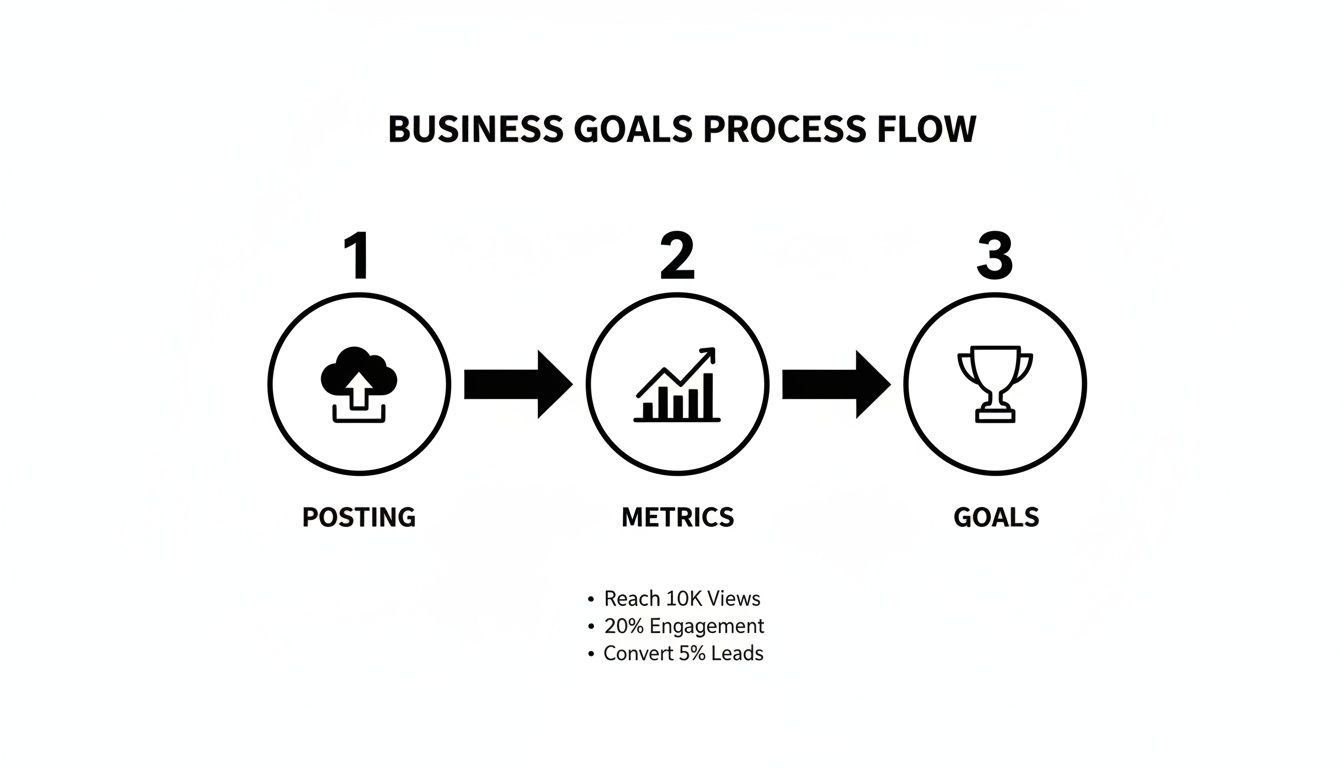
This process makes it clear: every video you post is a data point. It’s feeding you information that tells you whether you're getting closer to your target. The trick is to track the right metrics to prove or disprove your hypothesis.
Don't get distracted by vanity metrics. Views are nice, but they don't pay the bills. You need to be watching a mix of engagement and sales-focused Key Performance Indicators (KPIs).
Here are the essentials to keep an eye on:
- Engagement Rate: Are likes, comments, and shares holding steady, or are they dropping as you post more? A big dip can be a red flag for audience burnout or a drop in content quality.
- Click-Through Rate (CTR): What percentage of people who watch your video are actually clicking the link to your TikTok Shop? This tells you how well your call-to-action is working.
- Conversion Rate: Of all the people who land on your shop page from a video, how many actually buy something? This is the ultimate measure of your video's sales power.
- GMV Per Video: Track the gross merchandise value (total sales) from each specific post to see its direct dollar contribution.
To keep this organized, you can use a simple tracking template. Here’s a basic structure to get you started.
Two-Week Posting Frequency Test Template
Use this template to plan your actions and stay focused on the metrics that matter during your two-week sprint.
| Day | Action Item | Key Metric to Track |
|---|---|---|
| Day 1 | Post Video #1 (New Frequency), record baseline KPIs | Engagement Rate, CTR |
| Day 2 | Post Video #2 | GMV from Day 1 Video |
| Day 3 | Post Video #3, analyze early engagement trends | Comments/Shares on first two videos |
| Day 4 | Rest Day (or creative planning day) | Track cumulative GMV from the week |
| Day 5 | Post Video #4 | CTR and Conversion Rate |
| Day 6 | Post Video #5 | Audience retention on recent videos |
| Day 7 | Week 1 Review: Compare against baseline metrics | All KPIs - note any significant changes |
| Day 8 | Post Video #6 | Engagement Rate |
| Day 9 | Post Video #7 | GMV from Day 8 Video |
| Day 10 | Post Video #8, check affiliate performance | Affiliate-specific GMV and Conversions |
| Day 11 | Rest Day | Monitor overall shop traffic from TikTok |
| Day 12 | Post Video #9 | CTR and Conversion Rate |
| Day 13 | Post Video #10 | Final push, check overall engagement trends |
| Day 14 | Final Data Pull & Analysis | All KPIs - compare sprint vs. baseline |
This isn't about just filling a spreadsheet; it's about creating a disciplined routine for measuring what you're doing.
Analyzing the Results to Find Your Rhythm
At the end of the two weeks, it's decision time. Pull all the data and compare your sprint KPIs against your baseline from the two weeks prior.
Did you hit your goal? Did GMV jump by that 15% you were aiming for? Did your engagement rate stay solid, or did it fall off a cliff?
If your hypothesis proved correct and sales rose without sacrificing engagement, you’ve likely found a new, more effective cadence. Lock it in and make it your new standard. But if the results are mixed—maybe views went up but your conversion rate went down—it’s not a failure. It’s a sign that you need to adjust your content strategy, not just your frequency. Maybe your rushed videos weren't as compelling.
This is the process. Test, measure, learn, and repeat. It's how you build a profitable TikTok Shop based on real data, not just hope.
Posting Templates for Different TikTok Shop Stages
Your posting schedule can't be a one-size-fits-all plan. A brand-new startup is working with completely different resources and goals than a big multi-brand operator, so your content cadence needs to match your business's reality.
It helps to think about your shop's maturity, much like the different stages of the product life cycle. This lets you pick the right starting point for your content strategy.
Below are three different templates I’ve seen work for shops at various stages. Think of them as a baseline—a place to start building a posting rhythm that actually gets results without burning out your team. I’ve also broken down the "why" behind each schedule so you can tweak it to fit your exact situation.
The Scrappy Startup Building Traction
When you're just starting out, the mission is simple: get seen. You need to build that initial flicker of awareness, figure out who your audience is, and land those first few critical sales. This template is all about making a big impact with limited resources, focusing on consistency over just pumping out tons of videos.
- Frequency: Aim for 3-4 high-quality posts per week. This is a sweet spot—manageable enough to not feel overwhelming but frequent enough to build momentum.
- Content Mix:
- 2x Product Showcase Videos: These are your bread and butter. Get straight to the point. Show what your product does, why it's great, and include a clear call-to-action that sends people right to your shop.
- 1x Trend-Based Video: Jump on a trending sound or format and find a creative way to connect it to your product. This is your best bet for getting in front of people who aren't actively searching for you.
- 1x Educational or Behind-the-Scenes Post: This is how you build trust. Show the faces behind the brand or the process of how your product is made. A quick "how-to" tip related to your niche works wonders here, too.
Think of this schedule as planting seeds. You're consistently feeding the TikTok algorithm clues about your target audience while building a library of content that shows potential customers you're the real deal.
The Scaling Brand Balancing In-House and Affiliate Content
Okay, so you’ve got consistent sales trickling in. The game changes now. Your focus shifts from just getting noticed to scaling that growth, and the best way to do that is by mixing your own content with the power of creators. The goal is to be everywhere without your internal team having to do all the heavy lifting.
- Frequency: Let's bump it up to 5-7 posts per week. You can hit this higher volume by strategically weaving affiliate content into your calendar.
- Content Mix:
- 2x In-House "Hero" Posts: These are your polished, brand-led videos that anchor the week. Think well-produced tutorials, announcements for new drops, or an in-depth video answering common customer questions.
- 3-5x Affiliate Creator Posts: This is where the magic happens. Let user-generated content (UGC) from your affiliates do the talking. These posts offer authentic social proof and tap into entirely new audiences. Your job becomes curating, scheduling, and amplifying their best stuff.
The Multi-Brand Operator Leveraging Retainers
For the established players managing multiple brands or a single high-volume shop, it's all about efficiency and predictability. At this stage, you’re not just winging it; you’re running a system. This means relying on a structured network of creators on retainer to guarantee a steady, high-quality stream of content that fuels your sales engine.
This approach flips content creation from a reactive scramble into a predictable part of your operations.
- Frequency: You’re now posting 7-14+ times per week. This firehose of content is sustained almost entirely by your network of paid creators.
- Content Mix:
- 90% Creator-Led Content: The bulk of your content is produced by your retained creators. They work off clear briefs to create a variety of video styles—testimonials, unboxings, problem/solution formats, you name it.
- 10% Brand-Led Posts: Your in-house team steps back from daily production and focuses on the big picture: major campaigns, brand-level announcements, and identifying the absolute best-performing creator videos to pour ad spend into with Spark Ads.
Scaling Your Content Production with Creators

Let’s be honest: trying to film, edit, and post multiple high-quality TikToks every day by yourself is a surefire path to burnout. It's just not sustainable. Once you’ve figured out your ideal posting cadence, the real challenge becomes an operational one. How do you actually make all that content?
The answer isn't to work harder; it's to build a system. Specifically, a reliable system for managing content creators. This is how you solve the content bottleneck that stalls so many promising TikTok Shops. It turns the vague goal of "posting more" into a concrete, repeatable process.
The trick is to build a network of collaborators. You'll want a mix of creators you work with for one-off campaigns and a core group on retainer who provide a steady, predictable stream of on-brand videos.
Fine-Tuning Your Creator Workflow
If your current process involves a messy spreadsheet and a bunch of back-and-forth DMs, you're going to hit a wall fast. To manage a whole team of creators and hit a daily posting target, your entire workflow—from finding them to getting the final video live—needs to be airtight.
This is where automation becomes your secret weapon.
Imagine a system that takes care of the most tedious, time-sucking parts of creator management. That's a system that lets you focus on high-level strategy instead of drowning in admin tasks.
Here's what that can look like:
- Automated Discovery & Outreach: Instead of manually scrolling for creators, the system finds and contacts thousands of relevant affiliates for you.
- Trigger-Based Communication: The moment a product sample ships, a creative brief is automatically sent to the creator. No more forgetting.
- Scheduled Follow-Ups: Gentle reminders are sent to creators when their content is due, keeping your content calendar full and on track.
Getting this organized is absolutely critical. Without a solid system, you're constantly chasing people down for content, missing your posting deadlines, and killing the momentum you worked so hard to build. For a deeper dive, our guide on how to find content creators is a great place to start.
By systemizing your creator management, you turn content creation from a reactive scramble into a predictable, scalable operation. You always know where your next dozen videos are coming from.
From One-Off Gigs to Retainer Partnerships
As your shop grows, your creator strategy needs to grow with it. One-off collaborations are perfect for testing new creators and styles, but the real key to a consistent, high-frequency schedule is building a core team of creators on retainer.
A retainer agreement is simple: a creator agrees to produce a set number of videos each week or month for a fixed fee. It's a win-win. You get a guaranteed volume of content, and they get a reliable source of income. It creates stability on both sides.
This is where having a dedicated creator management platform becomes non-negotiable. With a tool like the HiveHQ Creator Tracker, you can see all your performance data in one place. You can track who’s posting, how often they're posting, and—most importantly—the direct GMV their content is driving.
This data empowers you to make smart, informed decisions. You can double down on your top performers and cycle out the ones who aren't delivering a clear return. It’s how you scale content production without letting your workload or your budget spiral out of control.
Common Questions About TikTok Posting Strategy
Even with a solid framework, you're bound to run into questions as you dial in your TikTok strategy. It's easy to get stuck on the details, like the eternal debate of quality versus quantity, or figuring out how to wrangle a dozen creator schedules. Let's dig into some of the most common hurdles I see TikTok Shop sellers face when trying to lock down their posting frequency.
What Is More Important: Quality or Quantity?
For a TikTok Shop, the real answer is strategic consistency. This isn't a simple choice between one or the other—they're completely intertwined.
Quality is your non-negotiable baseline. A shoddy, low-effort video just won't turn viewers into customers, no matter how many times you post it. But quantity—or more precisely, frequency—is what feeds the algorithm and gives you enough data to actually figure out what’s working.
The goal isn’t to churn out five mediocre videos a week. It’s to build a system that allows you to produce 3-5 high-quality, on-brand videos weekly that are designed to drive sales.
Start with a cadence you can realistically maintain at a high standard. Then, as you bring more creators into the fold, you can ramp up the frequency without your brand's quality taking a nosedive. The sweet spot is always the highest frequency you can sustain while keeping quality top-notch.
How Do I Know If My New Posting Frequency Is Working?
You have to look past the vanity metrics. Sure, a spike in views and a flood of likes feel great, but they don't pay the bills. The real test of your posting schedule is its impact on your bottom line.
When you tweak your posting cadence, these are the Key Performance Indicators (KPIs) to get obsessed with:
- Gross Merchandise Value (GMV) per video
- Affiliate-driven sales and commissions
- Click-Through Rate (CTR) from your videos to product pages
- Conversion rate on your TikTok Shop
If posting more gets you more views but your GMV per video starts to drop, that’s a red flag. It could mean your audience is getting tired of your content or the quality is slipping. A successful frequency change will show a clear, positive lift in these revenue-focused metrics. If you're looking for a wider view of platform best practices beyond just frequency, you might find a general TikTok how-to guide helpful.
Should My Creator Affiliates Follow My Brand Schedule?
Not necessarily. In fact, it's often more powerful to have them post on a different schedule entirely. Think of your brand account as the anchor, setting the core narrative. Your creator affiliates are there to provide authentic, diverse perspectives that amplify that message from all angles.
The idea is to create a constant "drumbeat" of content.
For example, your brand might post on Monday, Wednesday, and Friday. You could then orchestrate different creators to post on Tuesday, Thursday, and Saturday. This approach keeps your product popping up on the For You Page all week long without burning out any single audience. The key here is coordination, not just duplication.
Turning this strategy into a smooth, manageable workflow requires a central command center. With the HiveHQ Creator Tracker and Affiliate Bot, you can build a master content calendar, automate your creator outreach, and schedule posts to make sure you’re dominating the conversation every day of the week. Learn how HiveHQ streamlines your creator management and boosts your GMV.