How to Automate Repetitive Tasks for TikTok Shop

tiktok shop automationrepetitive tasksautomation roihivehqtiktok shop profit
Automate repetitive tasks by auditing the work, checking data readiness, rolling out controlled workflows, and measuring results, not by buying software first. If you're copying product sales into a spreadsheet while another tab shows campaign spend and someone asks whether yesterday was profitable, start by delegating that reconciliation, not the financial decision that follows.
Table of Contents
- A Practical Framework for Automating Repetitive Tasks
- Auditing the Repetitive Work in a TikTok Shop
- Choosing the Right Automation Approach
- Getting Your Data and Processes Ready First
- Implementing Automations With Human Approval Built In
- Measuring Real ROI Beyond Hours Saved
- Common Questions and Your Next Step
A Practical Framework for Automating Repetitive Tasks
Automation is controlled delegation. You decide what software can do, which evidence it must check, and when it must stop for approval. That's a more useful operating model than trying to make your entire TikTok Shop run unattended.
For a shop operator, the starting point should be recurring profit reconciliation, product reporting, campaign-status checks, and routine tracking updates. These workflows have observable inputs and outputs. Budget allocation, disputed commissions, and policy-sensitive decisions need a different level of authority.
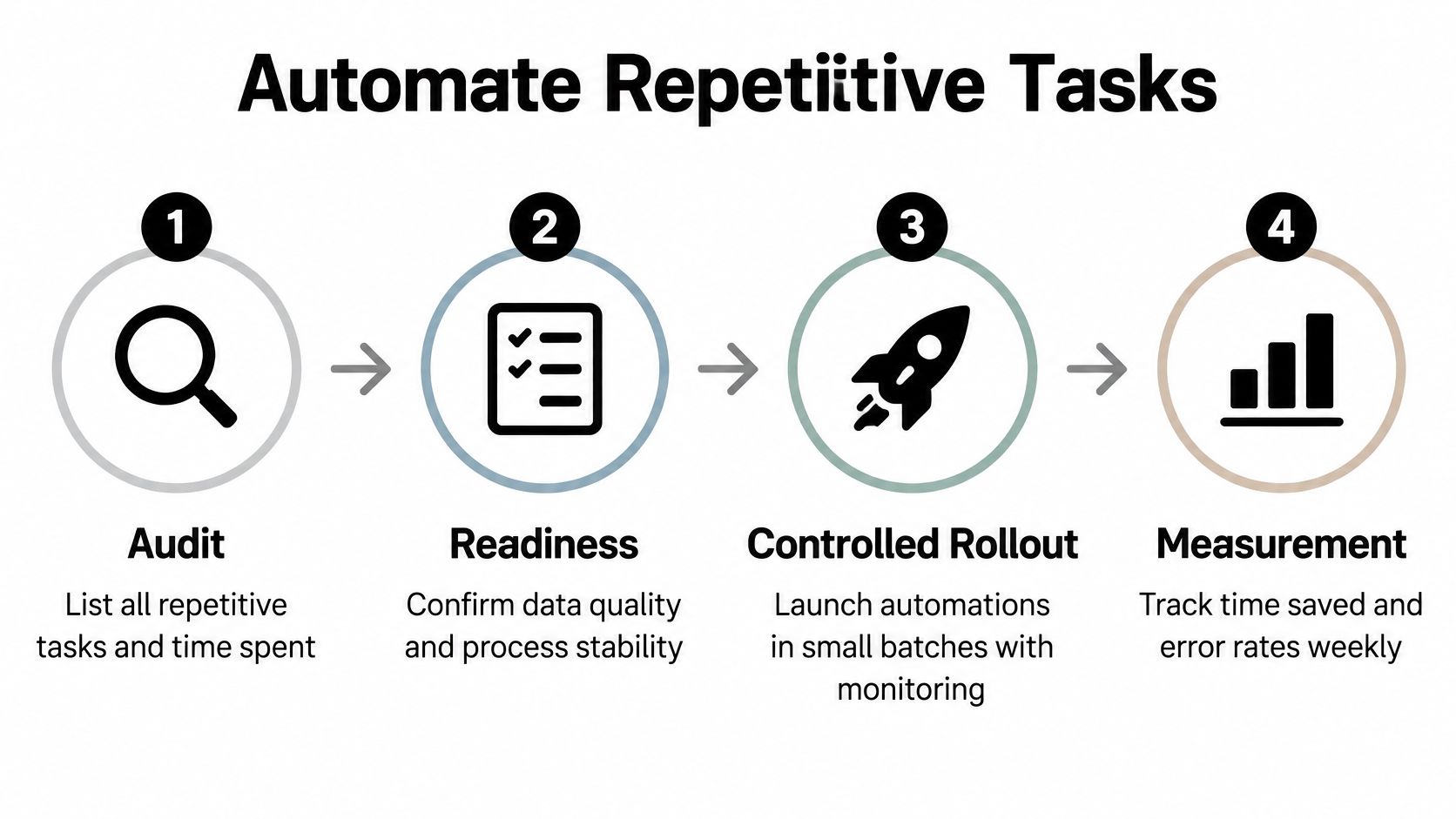
Use a repeatable operating cycle
- Audit the activity. Describe the actual work, such as matching product revenue to costs, rather than writing a broad department label like finance.
- Confirm readiness. Establish consistent definitions, an accountable owner, and a documented response to missing or contradictory information.
- Roll out with limits. Run a narrow workflow alongside the manual process before allowing it to publish trusted outputs.
- Measure the result. Check accuracy, review effort, and financial usefulness, not just how many tasks executed.
Don't let the software purchase become the project. When nobody agrees on what counts as a completed order, a current product cost, or an actionable exception, connecting systems won't settle the disagreement.
Practical rule: Delegate a task only when you can explain what a correct result looks like and who handles an incorrect one.
Keep the first implementation close to reporting. A workflow that prepares a reviewable product-profit summary gives you a useful test of data quality without immediately changing spending or customer-facing activity.
Apply the same discipline outside finance. If asset preparation is another recurring bottleneck, Bulk Image Generation's guide to save time on creative tasks is a useful companion resource. Treat creative production as its own workflow, with its own acceptance criteria, rather than attaching it to an already complicated reporting project.
The question isn't whether you can automate an activity. It's whether you can delegate it responsibly and recognize when it fails.
Auditing the Repetitive Work in a TikTok Shop
Audit activities, not job titles. In January 2017, McKinsey Global Institute estimated that approximately 49% of paid activities worldwide, representing about $15.8 trillion in wages, had technical automation potential using existing technologies, while fewer than 5% of occupations consisted entirely of automatable activities, according to its task-based automation analysis.
That distinction matters operationally. Preparing a profitability report and deciding whether to discontinue a product belong to the same business process, but they aren't the same kind of work.

Break each workflow into observable actions
Write down each handoff: pull product GMV from Seller Center, match orders to product IDs, attach COGS, reconcile advertising spend, check commissions, and assemble the reporting view. Separately record campaign-delivery checks and creator-performance updates.
Evaluate each activity using codifiability, repetitiveness, verification ease, and reconfiguration effort, dimensions described in McKinsey's automation feasibility framework:
- Codifiability. Can you express the action as a clear rule? Matching identical product identifiers is straightforward; deciding whether a creator suits your brand isn't.
- Repetitiveness. Does the same operation recur with different records? Scheduled profit pulls qualify.
- Verification ease. Can someone compare the result with source records? A matched order is easier to verify than a subjective performance explanation.
- Reconfiguration effort. Must you rebuild the process first? Inconsistent spreadsheet layouts make even simple reporting harder to delegate.
For sample-related updates, use a documented sample tracking system as the process boundary. Record a shipment-status change automatically; don't assume that status proves a creator has fulfilled a content commitment.
Build a usable audit worksheet
For every activity, capture its trigger, inputs, output, frequency, manual effort, owner, and failure consequence. Add a qualitative assessment for each feasibility dimension and identify the evidence a reviewer would need.
A daily profit pull should finish with matched records and flagged gaps. A disputed commission review should finish with a human decision. Put those activities on separate worksheet rows so an easy data-transfer task doesn't become an excuse to automate a consequential judgment.
Choosing the Right Automation Approach
Choose an operating model before evaluating software. My recommendation is to buy self-serve reporting for standard financial visibility, build only unusual workflows, and consider managed execution when you deliberately want to delegate operational responsibility.
Don't make GMV alone the deciding factor. A growing shop with clean processes may need less customization than a smaller business with complicated cost allocation and multiple reporting owners.
Automation approaches for TikTok Shop operations
| Dimension | DIY scripts | Self-serve software | Managed service |
|---|---|---|---|
| Setup time | Depends on development and testing scope | Depends on supported connections and data readiness | Depends on onboarding and agreed responsibilities |
| Ongoing maintenance | Your team owns fixes and changes | Seller manages configuration; provider maintains the product | Partner manages execution within the agreement |
| Customization depth | Suitable for unusual logic you can maintain | Bounded by supported features | Depends on contracted scope |
| Data control | You design access and storage | Review permissions, exports, and retention terms | Define partner access and ownership explicitly |
| Seller and GMV fit | Complex operations with technical capacity, regardless of GMV | Emerging through high-GMV shops with standard reporting needs | Shops whose complexity warrants delegated execution |
| Main trade-off | Flexibility requires internal ownership | Standardization limits bespoke behavior | Less direct control over day-to-day execution |
These are decision criteria, not guarantees about implementation speed or results. For broader background on the approach category, consult Applied's IPA market analysis, then return to your own workflow requirements.
Match the approach to the work
Profit reporting is usually a buy-and-self-serve problem. HiveHQ's Profit Dashboard is one option for sellers who want to run their own TikTok Shop analytics, with real-time net profit, product-level performance, and customer analytics rather than commissioning a custom reporting system.
Use embedded analytics for campaign monitoring where the required fields are available. Reserve custom development for gaps you can describe precisely, such as a business-specific allocation rule with a named maintenance owner.
For creator administration, separate recordkeeping from relationship management. Software can prepare reminders and track posting commitments; a person should approve sensitive messages and partnership changes.
If recruitment is also on your operational map, document it separately using a creator recruitment workflow. Don't let that broader project delay a practical improvement to profit visibility.
Getting Your Data and Processes Ready First
Your first automation project may need to be cleanup rather than execution. In a 2025 survey of 285 automation practitioners, 73.2% reported increased investment, yet 61.3% said fragmented strategies and siloed implementation left tools underused; only 36.6% reported cost reductions of at least 25%, according to CPA Practice Advisor's survey coverage.
For TikTok Shop reporting, start with the meaning of revenue. TikTok states that Product GMV Max attributes all orders from promoted products to the campaign, including organic and affiliate orders, and calculates same-day GMV using a one-day attribution window, as explained in its Product GMV Max documentation.
That reported GMV isn't proof of incremental paid-media revenue. Don't feed it into a profitability calculation without reconciling the relevant costs and avoiding duplicate revenue.
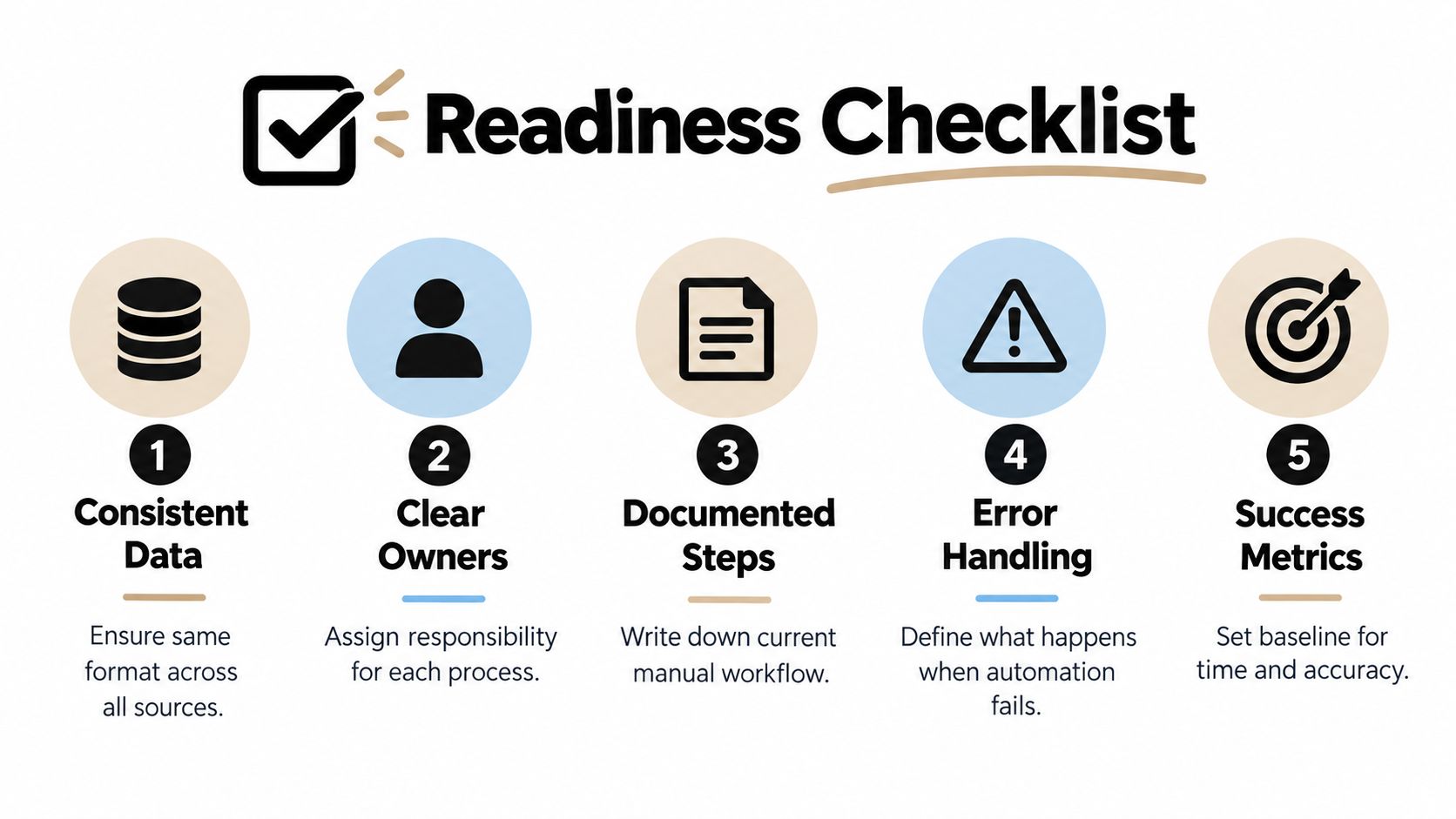
Check the fields that can break the result
- Product identity. Map the same product consistently across sales, inventory, advertising, and cost records.
- Cost accuracy. Confirm COGS, commission fields, effective dates, and how refunds or other deductions enter the calculation.
- Reporting alignment. Match periods, time zones, currencies, and order states before comparing totals.
- Status definitions. Define creator stages explicitly so shipment, delivery, posting, and approval aren't interchangeable.
- Duplicate prevention. Use stable record identifiers and make retries update existing records rather than create new ones.
- Ownership and exceptions. Name who resolves missing costs, conflicting totals, expired permissions, and failed imports.
Faster reporting is useful only when the operator can explain what the numbers include.
Mark each checklist item ready, incomplete, or blocked. Prioritize unresolved gaps that could change a financial decision, especially missing costs and duplicate revenue, before cosmetic reporting improvements.
Apply the same product mapping to inventory forecasting for TikTok Shop brands. A stock recommendation and a profit report should not refer to different versions of the same product.
Release the workflow only when its owner can demonstrate the expected result from the underlying records.
Implementing Automations With Human Approval Built In
Start each rollout in read-only mode. The examples below are implementation patterns, not claims about completed deployments or built-in product features.
Keep AI-generated explanations separate from deterministic calculations. MIT research covering more than 17,000 worker evaluations across over 3,000 text-based tasks found roughly 50% success in 2024-Q2, rising to approximately 65% in 2025-Q3, for tasks taking humans around 3 to 4 hours, according to its research on the last-mile problem in job automation.

Begin with the daily profit snapshot
Pull sales records, product costs, advertising spend, and commissions into a staging view. Validate required fields, product matches, duplicate identifiers, and reporting periods before publishing anything.
Set financial review tolerances with the finance owner, based on the shop's normal reconciliation differences. Route missing COGS, unexplained adjustments, and differences outside those tolerances to an exception queue.
Record input identifiers, output identifiers, timestamps, retry counts, and approvals in an immutable event log. If validation fails, retain the last approved snapshot with a visible freshness label; don't replace it with an apparently current but incomplete report.
Add tracking without delegating relationship decisions
A creator tracker can ingest posting records and agreed deliverables, flag overdue content, and prepare a reminder. Verify that a post hasn't already been recorded and that the commitment hasn't changed before sending.
Keep first-time or sensitive communication behind approval, using a documented content approval workflow. Route disputed deliverables to the partnership owner, and stop queued reminders when a record is challenged.
For rollback, cancel unsent messages and restore the last approved status. A sent message can't be unsent reliably, so prevention matters more than correction.
Audit campaign state before recommending action
TikTok's GMV Max guidelines limit access to the shop's primary ad account; changing that account revokes the former account's access and pauses its campaigns. The guidelines also describe pauses affecting overlapping Video Shopping Ads and state that earlier campaigns don't automatically restart after a GMV Max campaign ends.
Build the audit around authorized account settings, campaign status, and product history. Validate that a pause is an actual state change rather than missing access, then send the evidence to an operator.
Require approval for campaign changes. Preserve prior settings for recovery, but never assume restarting an old campaign is a safe automatic rollback.
Measuring Real ROI Beyond Hours Saved
Hours saved is an incomplete headline. A report that takes less time to prepare but creates more reconciliation work hasn't earned expansion.
Measure whether operators can use the output, how much intervention it requires, and whether resulting decisions improve financial outcomes. Don't book recovered staff time as cash savings unless spending falls.
A 2025 Stanford-led study of 1,500 workers found that 69.4% welcomed AI for higher-value work, while 45.2% preferred an equal human-AI partnership, 35.6% wanted human oversight at critical points, and 45% questioned accuracy and reliability, according to Stanford's report on worker preferences. Adoption and trust belong in your evaluation.
Track outcomes from the operating records
- Error rate. Compare incorrect outputs with reviewed outputs, using audit findings rather than counting only system failures.
- Exception volume and escalation rate. Track unresolved cases and the share requiring human intervention. Separate genuine business exceptions from avoidable data defects.
- Cost per successful outcome. Include software, maintenance, review, and correction costs, divided by outputs that meet the acceptance criteria.
- Attributable profit. Record the action taken from an alert and evaluate the financial result against a suitable baseline or controlled comparison.
- Creator response quality. Where reminders are involved, review whether replies resolve the issue, create confusion, or require repair.
Don't label all subsequent profit as automation-driven. A report can inform a decision without being the sole cause of its outcome.
Decision test: Would finance approve expanding this workflow if you removed the hours-saved figure from the presentation?
Run a quarterly expansion review
For each automation, document the original problem, baseline, accepted outputs, defects, review effort, maintenance effort, and resulting decisions. Assign an explicit disposition: expand, hold, or retire.
For a profit-reporting pilot, faster publication is only the opening result. Expand when reconciliations remain dependable and operators use the output; hold when missing cost records dominate the queue; retire or redesign when maintaining the workflow exceeds its operational value.
The goal is dependable delegation, not the largest possible automation count.
Common Questions and Your Next Step
Frequently Asked Questions
Which repetitive task should I automate first?
Start with a read-only product-profit snapshot or recurring report. Choose an activity whose output you can verify without changing budgets, commissions, or customer communications.
How do I handle skepticism from the team?
Let operators inspect the source records, challenge outputs, and stop the pilot. Ask them to approve acceptance criteria before launch, not after something goes wrong.
Does GMV Max remove the need for reporting checks?
No. Automated advertising still needs independent financial interpretation. Treat campaign-reported revenue as an input to reconciliation, not permission to skip it.
Can I automate without a developer?
Choose self-serve software when its supported workflow fits your needs. Get technical help when you need custom integrations, unusual calculations, or recovery behavior your team can't maintain.
Learning how to automate repetitive tasks means building a repeatable discipline: audit the activity, prepare the data, delegate within boundaries, and measure the result. Start with a workflow your team can explain and verify, then expand on evidence.
Try the HiveHQ Profit Dashboard for self-serve access to real-time net profit, product-level performance, and customer analytics for TikTok Shop. Visit HiveHQ and talk to the HiveHQ team about using that financial view to identify reporting work you can delegate while keeping consequential decisions with your operators.