How to Sell on TikTok Shop Without Inventory in 2026
TikTok Shop no inventoryTikTok dropshippingTikTok Shop sellingaffiliate sellingno inventory ecommerce
The popular advice is too simple: yes, you can sell on TikTok Shop without holding inventory, but only through specific models with strict fulfillment and compliance requirements. The profitable approach isn't “list anything and let a supplier figure it out,” it's choosing a stockless model you can control, then tracking real net profit instead of celebrating gross merchandise value.
Table of Contents
- Can You Really Sell on TikTok Shop Without Inventory
- Comparing the Five No-Inventory Models
- Setting Up Your Shop and Choosing Suppliers
- Pricing for Real Margin and Tracking the Numbers That Matter
- Running Creator-Led Demand Without Holding Stock
- Common Pitfalls and How to Fix Them
- Frequently Asked Questions and Next Steps
Can You Really Sell on TikTok Shop Without Inventory
“No inventory” means you do not buy, store, pack, or ship the product yourself. On TikTok Shop, that can still cover several different setups, a supplier can hold stock and fulfill each order, a print-on-demand partner can make the item after purchase, a third-party logistics provider can ship inventory you already own, or you can promote another seller's products as an affiliate.
The most common seller-run version is dropshipping. You list the product in TikTok Shop, and a legitimate third-party supplier handles inventory, packaging, and fulfillment. You still own the listing, customer experience, refunds, and account health. TikTok's seller guidance on dropshipping lays out the same basic structure and makes the compliance point plain, use legitimate suppliers, meet dispatch requirements, and provide valid tracking.
That difference matters for sellers moving from other channels into social commerce. A stockless shop can reduce upfront capital needs and remove the pressure to rent warehouse space before demand is proven. Practical setup costs vary widely, depending on samples, content, returns, platform charges, and fulfillment. The point is not that stockless selling is cheap in every case, it is that you can test demand without tying cash into inventory first.
The opportunity is large enough to justify that test. Global TikTok Shop sales have been estimated at about $33 billion in 2024, with projections at $64.3 billion in 2025 and $112.2 billion in 2026. Treat those figures as market context, not a promise of your own performance. They show why stockless selling has moved past the experimental stage.
The decision you actually need to make
Your first question should not be, “What product can I list?” It should be, “Which fulfillment path can stay reliable enough to protect my shop?”
Use this sequence:
- Choose the model. Decide whether you are a seller using outsourced fulfillment, a print-on-demand operator, an affiliate, or a pre-order business.
- Validate the supplier. Test delivery time, product quality, packaging, tracking, and return handling before you publish aggressively.
- Launch a tight catalog. A few dependable products are easier to monitor than a broad catalog with uneven suppliers.
- Price for the complete order. Include supplier cost, shipping, commissions, returns, discounts, samples, and paid traffic.
- Measure net profit. GMV can rise while refunds, commissions, and fulfillment costs erase your margin.
Affiliate selling is a separate path, not a variation of dropshipping. If you create content for another seller's product and earn a commission, you do not control fulfillment or carry product liability in the same way. A practical guide to affiliate marketing on TikTok Shop covers that model, but it should not be confused with running your own seller account.
Comparing the Five No-Inventory Models
The five no-inventory models shift risk rather than remove it. Dropshipping limits stock exposure but leaves dispatch, tracking, and returns dependent on a supplier. Print-on-demand avoids pre-purchased goods, while production quality and delivery still affect buyer satisfaction. Affiliate selling removes fulfillment responsibility, but earnings depend on content performance and another seller's offer.
| Model | Upfront Cost | Fulfillment Control | Margin Potential | Compliance Risk |
|---|---|---|---|---|
| Dropshipping | Low to moderate | Low to medium, depending on supplier | Medium to high | Medium to high |
| Print-on-demand | Low to moderate | Medium | Medium | Medium |
| Affiliate and creator partnerships | Low | None over fulfillment | Commission-based | Low when promoting compliant listings |
| Pre-orders | Low | Medium, if timelines are clear | Medium to high | Medium to high |
| Third-party fulfillment | Moderate | High when the partner is reliable | Medium to high | Medium |
Dropshipping can work when the supplier ships through the required TikTok Shop workflow, provides valid tracking, and handles returns. The operating risk is concentrated in the supplier. A late dispatch or invalid tracking event can damage the customer experience and your shop metrics. Dropshipping fails when a seller forwards an order to another consumer marketplace or uses a shipping benefit for an order that originated elsewhere.
Print-on-demand suits original designs and products that do not require physical stock before purchase. You trade inventory risk for production and quality-control risk. Order samples before scaling a design. A convincing mockup cannot confirm the finished product's materials, print quality, packaging, or fit.
Affiliate and creator partnerships are the cleanest option for selling without running your own fulfillment process. You promote an existing listing and earn a commission when your content generates a sale. The seller remains responsible for inventory, shipping, returns, and service. For the distinction between creator-led commerce and broader influencer activity, read this comparison of creator commerce and influencer marketing.
Pre-orders work only when buyers see and accept the expected delivery window before payment. They become high risk when an unavailable product is presented as ready to ship. Manufacturing or supplier delays can then exceed the promised timeline, creating cancellations, refunds, and customer-service pressure.
Third-party fulfillment gives you operational control when you own or arrange inventory but have another party store and ship it. That makes the operation stockless for the seller, not inventory-free financially. Someone still has to purchase and hold the goods, so include storage, handling, shipping, and return costs in the margin calculation.
Digital or information products are an adjacent route that avoids physical fulfillment. You can use taap.bio to sell digital products on tiktok. The same test applies: the offer must comply with TikTok Shop rules and provide a reliable buyer experience.
TikTok's seller guidance makes fulfillment compliance a model-selection issue, not only a cost issue. Dropshipping is not permitted when a seller uses platform shipping subsidies or services to fulfill an order that did not originate on TikTok Shop. Examples include placing an order on another platform for a customer or routing an off-platform sale through TikTok shipping benefits. TikTok's seller guidance on dropshipping restrictions should be checked before choosing a supplier workflow. Track fulfillment deadlines, SPS exposure, refunds, and actual net profit for whichever model you select.
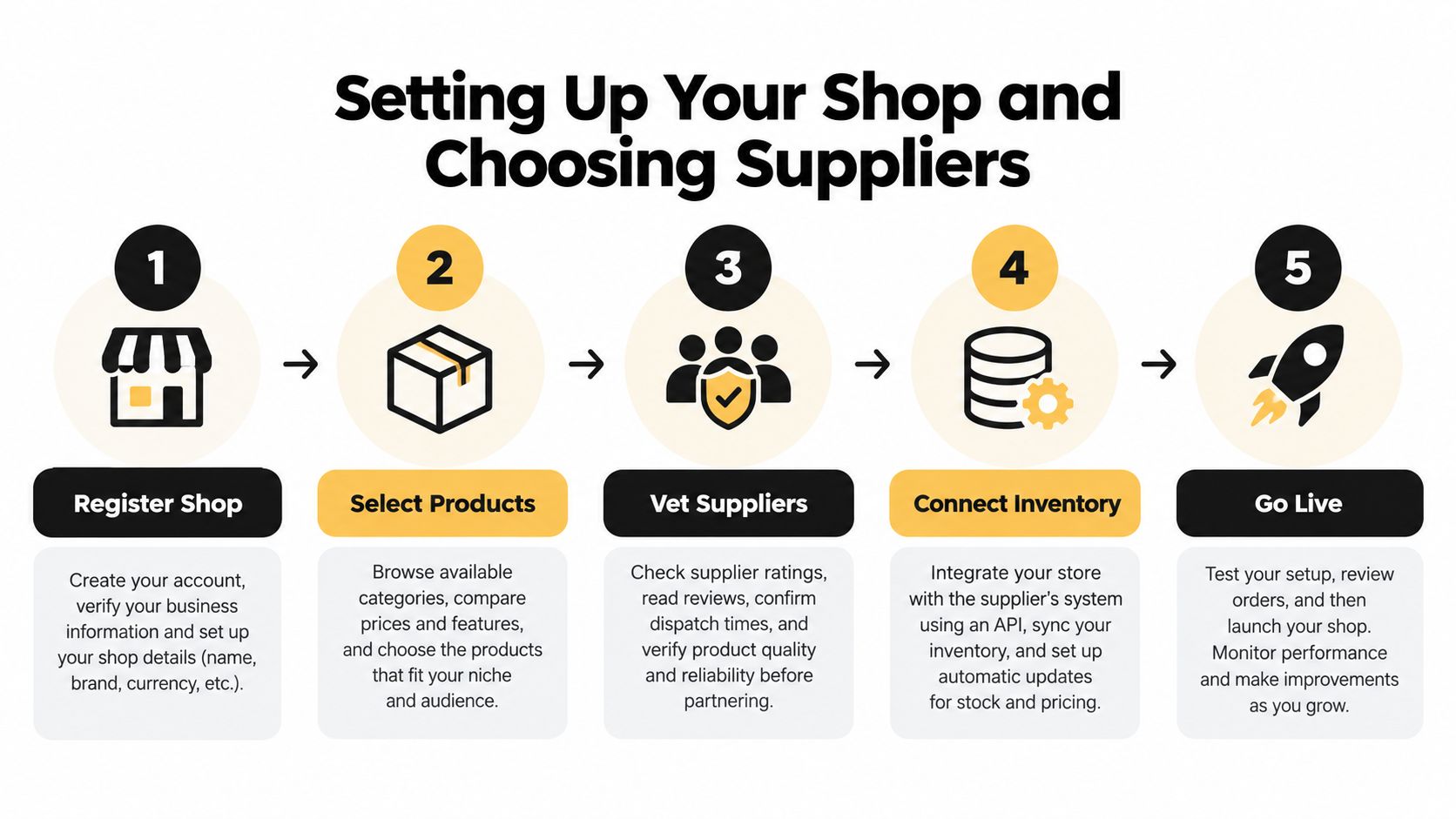
Setting Up Your Shop and Choosing Suppliers
Open the shop only after you've decided who owns each operational responsibility. You need a seller account, a compliant product listing, a payment and payout setup, a shipping path, and a supplier or fulfillment partner that can meet the promised service level.
A lean launch sequence looks like this:
- Register and verify the shop. Provide the business and identity information required in Seller Center, connect the appropriate TikTok account, and configure payouts.
- Select products that demonstrate well. Favor items that can be shown in use, solve a visible problem, and don't create unnecessary sizing or interpretation risk.
- Vet the supplier before publishing at scale. Place test orders to your own address and assess dispatch, packaging, tracking, product quality, and support response.
- Connect the inventory or order workflow. Confirm that stock status, shipping settings, order routing, and tracking updates remain accurate.
- Launch with a narrow offer. Give each product enough content and operational attention to identify whether the problem is demand, conversion, fulfillment, or margin.
Build around the first delivered orders
TikTok grants a Shop Performance Score, or SPS, only after 30 delivered orders within 90 days. The score combines product satisfaction, fulfillment and logistics, and customer service, with newer orders receiving greater weight. TikTok's SPS policy details also identify the program thresholds: a score of 2.5 qualifies sellers for Flash Deals, 3.5 enables affiliate and campaign eligibility plus 5-day settlement, and 4.0 enables 1-day settlement and Star Seller eligibility. Benefits can be paused when the score falls below 3.0.
Those thresholds change how you should launch. Don't upload a huge catalog and hope volume hides weak suppliers. Start with products that can reach the first 30 delivered orders without late dispatches, invalid tracking, preventable refunds, or unanswered customer messages.
Practical rule: Your first product test is also a logistics test. A product that converts well but ships inconsistently is not a winner.
Use a supplier checklist
Before scaling, verify:
- Dispatch behavior: Ask how quickly orders are handed to the carrier, then test whether actual behavior matches the promise.
- Tracking quality: Confirm that tracking is valid, updates correctly, and corresponds to the parcel shipped.
- Product consistency: Order samples from different batches when possible and compare materials, dimensions, labeling, and packaging.
- Returns handling: Establish where the buyer sends a return and who pays the associated cost.
- Stock synchronization: Make sure the product doesn't remain available after supplier stock runs out.
- Support ownership: Identify the person responsible for urgent order, refund, and tracking issues.
Strong product pages also reduce operational friction because buyers understand what they're purchasing. If you need better visual assets without holding physical stock during early testing, this guide to how AI transforms fashion visuals offers useful creative context. Visual polish can't compensate for a late parcel, but unclear visuals can increase avoidable returns.
For the account and catalog workflow, use this TikTok Shop setup guide for businesses as a reference, then confirm current requirements in your own Seller Center because regional policies can change.
Pricing for Real Margin and Tracking the Numbers That Matter
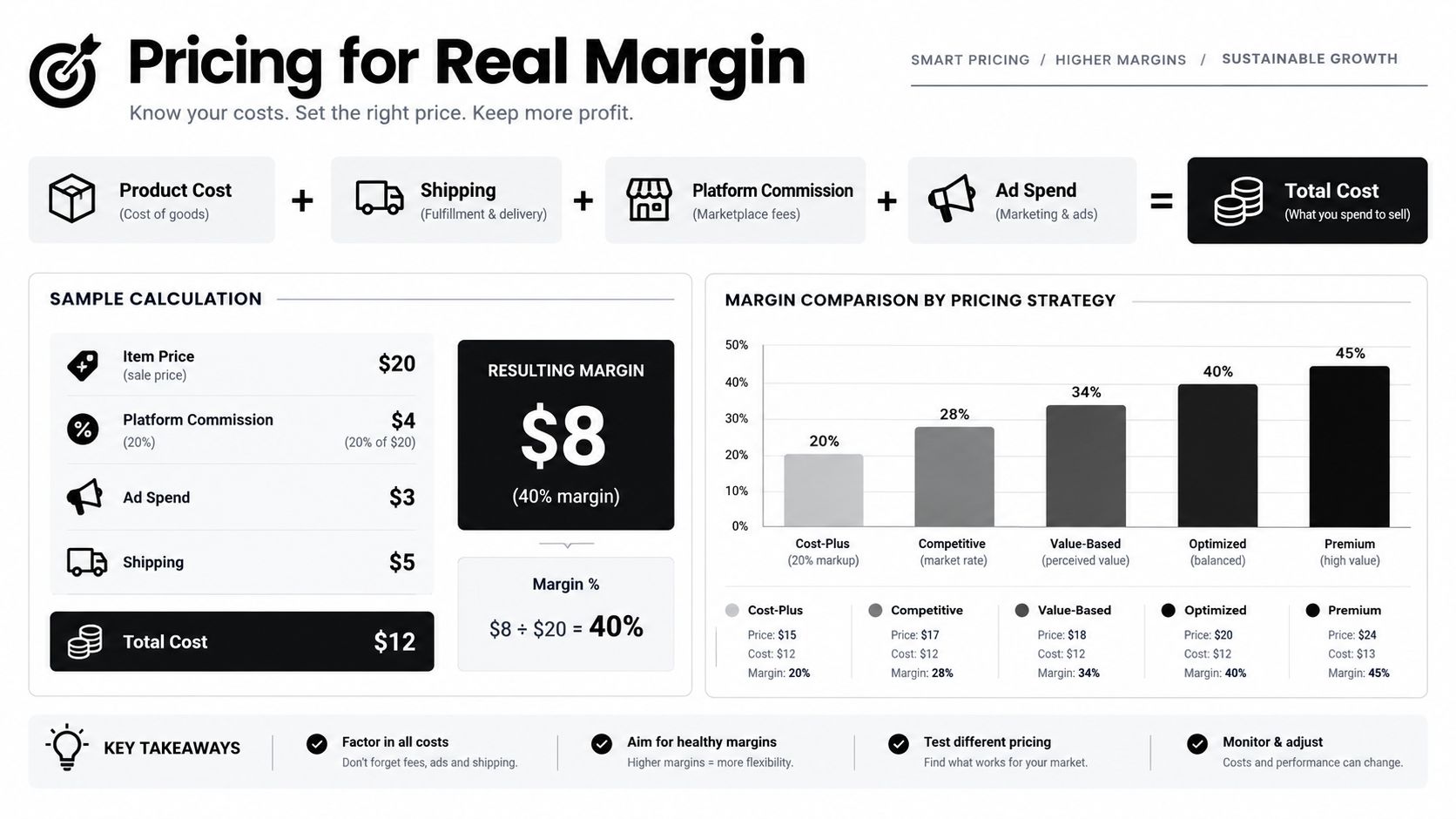
A product does not become profitable because its selling price looks high. Stockless operations lose margin through supplier charges, shipping changes, commissions, refunds, samples, and late-order problems. Use this calculation for every SKU:
Selling price minus product cost, shipping, platform commission, creator commission, discounts, refunds, samples, and ad spend equals net profit.
A benchmark set for TikTok Shop sellers reports a 20% median TAP commission, a 6% return rate, a $32 average order value, a 0.05% view-to-purchase conversion rate, and 3.8x peak GMV Max ROAS. The same benchmark research reports affiliate conversion rates from 1% to 8%, with short clips at 1% to 3% and product demonstrations or live streams at 3% to 8%. Reported return rates range from 4% to 18%, depending on category complexity and sizing risk. Treat these figures as reference points, not targets or guarantees.
Use the numbers to test assumptions, then replace them with your own product-level results. A low-ticket item can convert well while leaving little contribution after shipping and commissions. A higher-priced offer can produce more contribution per order, yet bring more objections, refunds, and support work. Fulfillment speed also belongs in the calculation. Late parcels can affect customer experience and SPS, turning an apparently profitable product into an account risk.
Watch cash flow, not just margin
Settlement timing matters when you do not hold inventory. The business still needs cash for samples, supplier charges, refunds, replacement orders, and content production. The SPS thresholds described earlier can affect settlement timing, so account health directly affects working capital.
Track these fields for each product:
- Net profit per order, after every direct cost.
- Contribution margin, before fixed overhead.
- Refund and return cost, including shipping and lost product value.
- Creator commission, separated from other marketing spend.
- Ad-attributed profit, rather than attributed revenue alone.
- Customer value, including repeat purchases and support burden.
- Fulfillment exception cost, including late shipments, replacements, and cancellations.
Review the figures by order and by supplier. That split helps identify whether margin is disappearing through pricing, product cost, returns, content conversion, paid traffic, or fulfillment failures. GMV alone can hide a product that loses money on every sale.
The HiveHQ Profit Dashboard gives TikTok Shop sellers a single view of real-time net profit, product-level performance, and customer analytics. Use it to reconcile GMV with COGS, commissions, ad spend, refunds, and other costs instead of relying on platform revenue totals. For the calculation method, use this step-by-step guide to calculating TikTok Shop profit.
Running Creator-Led Demand Without Holding Stock
Creator-led demand can outperform broad paid reach for a stockless shop because creators show the product in use, answer objections naturally, and give shoppers a reason to click. A product listing rarely provides enough context for an unfamiliar item. The trade-off is operational: creator content can increase orders quickly, but weak fulfillment can also increase late shipments, refunds, and pressure on your SPS score.
Select products that are easy to demonstrate and unlikely to create sizing or expectation disputes. A short clip showing a visible problem and its solution usually gives shoppers more useful evidence than a polished catalog image. Demonstrations and live streams often provide stronger buying context, but only when the product, offer, and fulfillment process can support the demand they create.
Treat samples as an operating process
Free samples create deadlines and measurable obligations. TikTok says sellers must review free-sample requests within 7 days, then ship approved samples within 7 days after approval. Sellers can monitor creator content and performance through Sample Requests and Affiliate Center. TikTok's sample-request workflow outlines the relevant requirements.
Use a fixed weekly workflow:
- Review requests: Approve creators whose audience, format, and content history fit the product.
- Confirm the sample: Record the product, variant, address, and intended content context.
- Ship promptly: Apply the same dispatch discipline used for customer orders.
- Evaluate content: Track publication, clicks, orders, returns, and net contribution.
- Renew selectively: Continue with creators whose content produces profitable customer behavior.
A large affiliate list does not equal a productive program. One benchmark set reports a 2,000-affiliate program at 200 active creators, or a 10% activation rate, while Open Collaboration averages 12% to 18% in that dataset. The creator and affiliate benchmark source supports a practical expectation: many approved creators will not publish, and published content may still produce unprofitable orders. Use a defined recruitment, briefing, review, and follow-up process. See this guide to building a creator infrastructure that scales.
Plan paid traffic around GMV Max
GMV Max became the default and only supported TikTok Shop Ads campaign type in July 2025. TikTok says advertisers using the Sales objective with TikTok Shop as the destination can no longer create, edit, or duplicate the former LIVE Shopping Ads, Product Shopping Ads, or Video Shopping Ads formats. TikTok's GMV Max migration guidance explains the change.
Start paid distribution only after organic content shows acceptable conversion, customer response, fulfillment reliability, and net profit. Advertising can increase volume. It cannot fix weak product pages, late dispatches, poor SPS performance, or negative unit economics.
Common Pitfalls and How to Fix Them
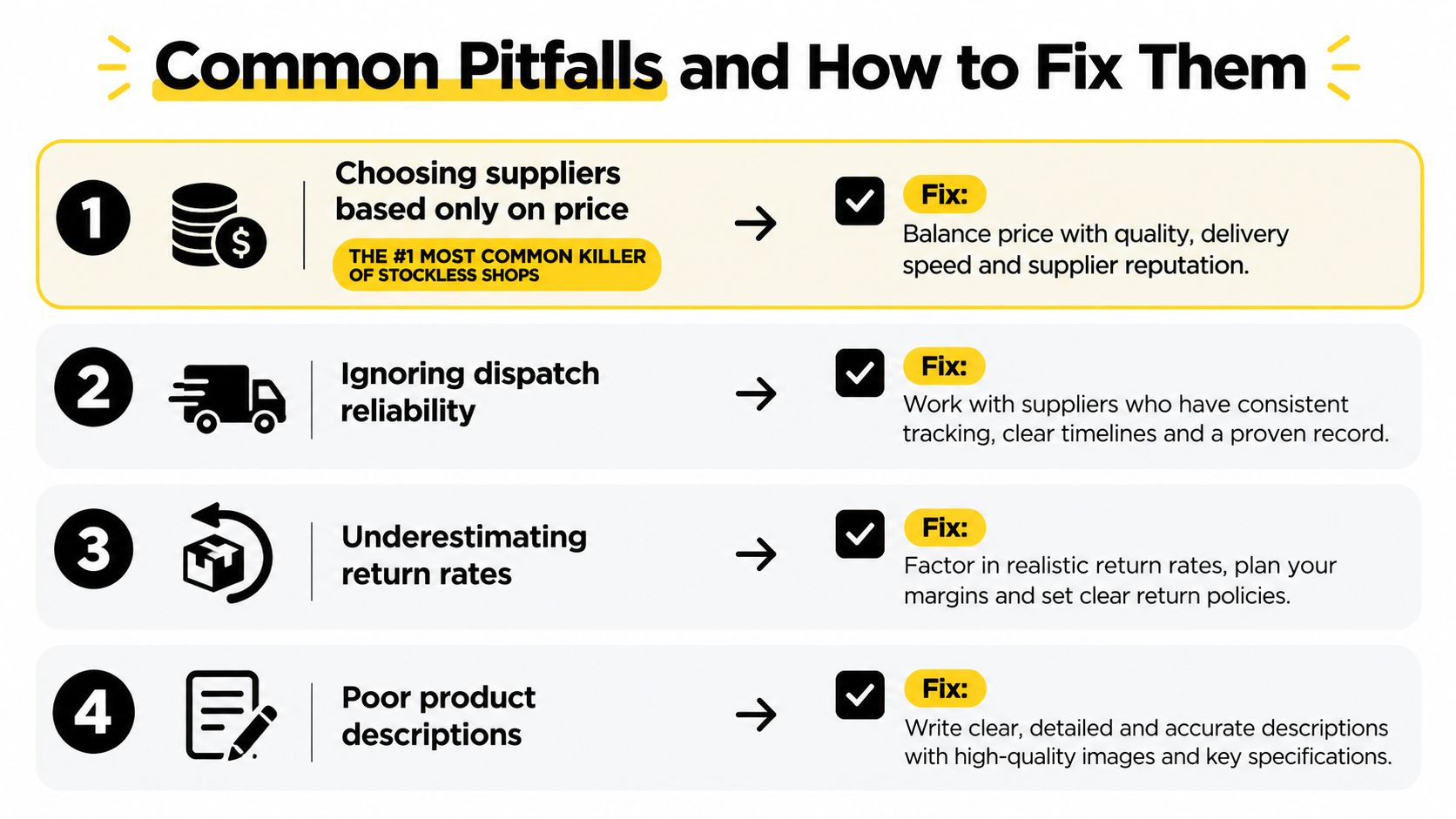
A low supplier price can make a stockless product look profitable while dispatch failures erase the margin. Refunds, support tickets, delayed payouts, order limits, and account restrictions turn a small fulfillment problem into an account-level cost.
Dispatch delays
Recent fulfillment guidance indicates that orders often need to move to “In Transit” within 2 business days. Late dispatch can lead to penalties, order limits, delayed payouts, and per-order fines. Current fulfillment coverage shows why supplier response time belongs in the product decision, not only in customer support.
Symptom: Orders remain in processing while the supplier waits for a batch, payment confirmation, or manual instruction.
Root cause: You chose for price or catalog breadth without testing the supplier's actual handling process.
Fix: Place test orders, set a clear supplier cutoff time, keep a permitted backup source, and pause listings when the promised timeline cannot be met. A no-inventory model is compliant only when its fulfillment process can meet the Shop's deadlines. Otherwise, the apparent convenience becomes a suspension risk.
Invalid or stale tracking
A tracking number has little value if it belongs to another parcel, receives no carrier scan, or updates after the dispatch deadline. Sellers without physical stock may find the issue only after buyers complain.
Diagnostic: Match the order record, tracking number, carrier acceptance, and promised dispatch date. Escalate missing scans as soon as they appear. Do not wait for the buyer to identify a shipment that your process should have verified.
Return spikes
Returns usually expose a gap between the listing and the delivered product. Unclear sizing, weak images, exaggerated claims, and inconsistent supplier batches can overwhelm otherwise effective content.
Repair: Describe measurable product attributes, show the item in use, disclose limitations, and inspect samples before increasing traffic. Record return reasons by SKU. Shop-level averages can hide one product that is consuming the margin from every other order.
Margin erosion
Orders do not prove profitability. Creator commissions, shipping increases, discounts, refunds, and paid traffic can turn positive revenue into negative net profit. Calculate contribution after every variable cost, then compare that result with fulfillment reliability and SPS performance.
The cheapest fulfillment path is not always the most profitable. The path you can control usually produces the safer margin.
Run this diagnostic before scaling a listing:
- Check the service clock: Are orders entering transit within the required window?
- Check the evidence: Does each tracking record show legitimate carrier movement?
- Check buyer expectations: Do reviews and returns reveal unclear product information?
- Check contribution: Does each order remain profitable after all variable costs?
- Check account health: Are fulfillment, satisfaction, and service issues lowering SPS?
If several answers are negative, adding SKUs will increase exposure rather than solve the problem. Fix the supplier, pause the offer, or choose a model with greater fulfillment control.
Frequently Asked Questions and Next Steps
How much money do you need to start without inventory?
A stockless TikTok Shop can start with a relatively small budget because you are not buying warehouse quantities. A 2026 industry guide estimates startup costs as low as $150 to $1,500 or more. Supplier platforms may be available at no cost, but samples, test orders, content, returns, and fulfillment still require working capital, as explained in TikTok dropshipping cost guidance.
Reserve enough cash to test products, cover an early refund, and pay suppliers before your sales proceeds settle. The lowest starting budget leaves little room for supplier mistakes or delayed payouts.
Do you need a registered business to open a TikTok Shop?
Requirements vary by market and account type. During verification, TikTok may request business, identity, address, taxpayer, and payout information. Check the current Seller Center requirements for your region before building a catalog.
An individual registration path in one country may not apply elsewhere. Your legal structure, tax obligations, product category, and shipping location can affect eligibility.
What happens if your supplier ships late?
Late dispatch can hurt customer satisfaction, fulfillment metrics, payouts, order limits, and account benefits. Orders may need to move to “In Transit” within 2 business days, according to recent industry coverage. The fulfillment guide cited above describes the operational consequences.
Contact the buyer when appropriate, record the supplier failure, and correct the workflow. Pause the affected listing if the problem continues. A supplier that repeatedly misses the deadline can erase the margin from otherwise successful sales and lower your SPS score.
Do pre-orders count as no-inventory selling?
They can. You may accept an order before purchasing or producing the item, provided the listing states the expected delivery timing and your process can meet that commitment. Presenting an unavailable product as ready to ship creates customer-experience and compliance risk.
The practical sequence is simple: choose the no-inventory model that gives you the most fulfillment control you can afford, keep the initial catalog tight, test suppliers before scaling, and track net profit from the first order. Revenue and order volume do not show whether a product remains profitable after commissions, shipping, refunds, discounts, and fulfillment costs.
Use the HiveHQ Profit Dashboard to monitor net profit, product-level performance, and customer analytics for a stockless TikTok Shop. A self-serve workflow can show which products are worth scaling after their real variable costs are included.