How to Sell Stuff on TikTok Shop the Smart Way
tiktok shoptiktok shop guidetiktok shop profithivehqcreator selling
Selling stuff on TikTok Shop is a content-plus-margin operation, not a listing exercise. You need a product people can understand in seconds, content that creates demand, fulfillment that survives volume, and product-level profit tracking that tells you when sales are worth scaling.
You may already have products listed, a few videos published, and revenue coming in. The problem is that revenue can look healthy while platform fees, shipping, commissions, returns, and paid promotion consume the contribution margin. TikTok Shop is now large enough to punish casual execution. By 2025, global GMV had reached an estimated $64.3 billion, while U.S. GMV reached about $15.1 billion, up 68% year over year from roughly $9 billion in 2024. (SmartScout's TikTok Shop statistics)
Table of Contents
- What It Really Takes to Sell Stuff on TikTok Shop
- Setting Up Your Shop the Right Way
- Listings, Pricing, and Shipping That Protect Margin
- Driving Sales With Content, Creators, and Paid Amplification
- Running the Operations Behind the Sales
- Tracking Profit and Scaling With Confidence
- Common Questions and Your Next Step
What It Really Takes to Sell Stuff on TikTok Shop
A product can generate orders all week and still lose money. The seller sees rising GMV, while commissions, shipping, refunds, discounts, and advertising spend reduce the contribution margin. Treat TikTok Shop as a profit system, with every operating stage connected to a measurable product-level result in the HiveHQ Profit Dashboard.
The channel grew from its U.S. launch in September 2023 into a high-volume marketplace in under three years. In 2025, U.S. buyers reached 53.2 million, up 13.6% from the prior year, and TikTok Shop represented a substantial share of global social shopping GMV. (SmartScout's TikTok Shop statistics) That scale demands disciplined execution. Your shop needs a clear acquisition plan, reliable fulfillment, and a margin threshold for every SKU.
The five operating stages
- Setup: Register the correct seller entity, verify the business, connect payouts, and confirm approved categories. Track approval status and product readiness before publishing.
- Listings: Build accurate product pages with useful attributes, clear pricing, compliant claims, and available stock. Monitor conversion and stock-related losses by SKU.
- Content engines: Publish short-form demonstrations, merchant-led livestreams, and creator content that explain the product quickly. Measure which content produces profitable orders, not just views.
- Operations: Sync inventory, dispatch orders, upload valid tracking, process returns, and monitor shop health daily. Product-level fulfillment costs and refund rates belong in the profit view.
- Profit tracking: Load COGS, shipping, commissions, platform fees, discounts, returns, and advertising into a SKU-level calculation. Scale only when the resulting contribution margin supports more volume.
Creators matter because product discovery and trust drive purchases on TikTok Shop. Independent retail reporting found that 70% of TikTok Shop consumers had purchased a product recommended by a creator, while 67% said they use TikTok Shop to discover new products and brands. (Modern Retail's TikTok Shop reporting)
Operator rule: GMV is a demand signal, not a scaling decision. Increase volume only when each order remains profitable after every variable cost.
Review this analysis of TikTok Shop's changing e-commerce economics before setting prices or commission rates. Platform fees, creator commissions, and advertising spend commonly reduce gross margin, with shipping and refunds adding further pressure.
Setting Up Your Shop the Right Way
A shop can generate orders and still lose money on every sale. Set up the account, fulfillment path, and SKU economics before publishing content or inviting creators. Each stage should produce a number the HiveHQ Profit Dashboard can surface at product level, from verified costs to contribution margin.
Build the account in the right order
Follow this sequence:
- Choose the operating role. The seller account belongs to the business that owns inventory, receives orders, and handles customer responsibility. A creator account publishes content, while an affiliate account promotes another seller's products. Keep demand generation separate from order ownership and returns.
- Prepare identity and business documents. Use the same legal names, addresses, tax details, and identity documents throughout the application. Inconsistent information and missing verification commonly cause review delays or rejection.
- Select categories carefully. Assign every SKU to the category that accurately describes it. An incorrect category can trigger approval problems, compliance requests, or restrictions after publication.
- Connect the payout account. TikTok requires a bank account for seller payouts. The account holder should match the verified business or individual details.
- Confirm logistics before publishing. Add the warehouse or pickup address and define who ships each order. TikTok's Seller Center identifies the warehouse or pickup address and bank account as part of seller setup.
Complete the registration workflow with this TikTok Shop setup guide for businesses. Do not publish products until the account, payout details, and shipping responsibility are clear.
U.S. affiliate access also has a performance gate. TikTok Shop requires a Shop Performance Score of at least 3.5 for seller qualification for Affiliate Marketing. SPS uses average performance over the previous 90 days, and a shop receives an SPS only after delivering at least 30 orders during that period, excluding samples. Review the TikTok Shop SPS requirements before planning affiliate campaigns.
Map costs before the first order
Create a SKU master file before uploading products. Record:
- Product cost: Landed COGS, including manufacturing or wholesale cost.
- Fulfillment cost: Pick, pack, shipping, storage, and per-order handling.
- Platform deductions: Commission and transaction rules for the relevant market.
- Creator payout: The commission rate assigned to the product or campaign.
- Promotion cost: Discounts, samples, and paid amplification.
- Refund exposure: The expected cost of returns and refunds.
Connect these fields to order data so the HiveHQ Profit Dashboard shows net profit per unit from the first order. A product-level view should expose contribution margin, creator payout, fulfillment cost, and refund impact before you increase traffic.
Waiting until a product goes viral creates avoidable accounting work. You will be reconstructing costs from invoices and payout reports while deciding whether to scale. Treat setup as a profit-control task, not an administrative checklist. A shop that cannot explain its unit economics before launch is not ready to buy traffic.
Listings, Pricing, and Shipping That Protect Margin
A TikTok Shop listing must win two decisions quickly: whether the platform can classify the product correctly, and whether the buyer understands why it deserves the asking price. Pricing and shipping then decide whether that conversion produces contribution margin or only adds fulfillment and refund work.
Treat every SKU as a profit model. In the EU, the standard Commission Fee is 9% on settled orders from 8 January 2026. Eligible Electronics and Beauty and Personal Care products can receive an effective 7% rate under the stated policy. Review the TikTok Shop EU commission policy before setting prices or creator commissions.
The fee base matters as much as the rate. TikTok calculates the EU commission from the order amount after refunds and platform discounts, plus customer shipping, multiplied by the applicable rate. The policy also includes applicable taxes such as VAT in the commission. Use the TikTok Shop EU fee calculation policy when checking your own payout math.
How Pricing and Shipping Choices Affect Unit Margin
The table below uses a £19.99 selling price, £4.20 landed COGS, and £3.10 shipping. Net margin is shown before creator payouts, promotions, refunds, and applicable taxes beyond the commission calculation.
| Pricing Scenario | Platform Fee | COGS + Shipping | Net Margin Per Unit | Margin % |
|---|---|---|---|---|
| UK-style 6% commission | £1.20 | £7.30 | £11.49 | 57.5% |
| EU standard 9% commission | £1.80 | £7.30 | £10.89 | 54.5% |
| Eligible EU category at 7% | £1.40 | £7.30 | £11.29 | 56.5% |
| Same order after a discount | Recalculate from the reduced order amount | £7.30 | Recalculate before launch | Recalculate before launch |
The calculation is simple: selling price minus platform fee, landed COGS, and shipping. Then subtract creator commission, paid promotion, refunds, and any other per-order cost. Feed those values into the HiveHQ Profit Dashboard so product-level reporting shows whether a SKU is producing contribution margin after the costs that rise with volume.
Use landed cost multiplied by 2.5 to 3 as an initial pricing guardrail. It is a screening rule, not a profit forecast. Reject products that cannot absorb platform deductions, creator payouts, shipping, discounts, and refund exposure before publishing them.
Make the Product Page Easy to Buy
Write a keyword-relevant title without turning it into a string of search terms. Complete every relevant attribute, state accurate dimensions, show variants clearly, and put the strongest product benefit in the opening line. The first seconds of the product video should show the item in use. A logo animation does not explain value.
Shipping needs the same discipline. Set handling times your operation can meet, keep parcel data accurate, and include customer shipping, discounts, refunds, and creator costs in the promotion model. Use this guide to TikTok Shop shipping and fulfillment costs to convert headline price into a realistic product-level contribution figure. If the margin disappears after shipping or a modest discount, change the offer before buying traffic.
Driving Sales With Content, Creators, and Paid Amplification
A product can earn attention, generate orders, and still lose money. Treat TikTok Shop as a profit system, not a listings exercise. Organic creator content, merchant-hosted livestreams, and paid amplification each solve a different problem, carry different costs, and need separate product-level reporting in the HiveHQ Profit Dashboard.
Internal benchmark data shows affiliate creator content can drive 42% of U.S. TikTok Shop GMV. The same benchmark records that the top 0.5% of creators generate 38% of affiliate revenue, while median view-to-purchase conversion is 0.05%. Those figures support a broad testing program, not dependence on a few famous creators. Recruit enough partners to test product fit, measure profitable orders, and cut relationships that fail to repeat.
Match the engine to the problem
| Channel | Typical GMV Share | Cost Model | Time to First Sale | Best For |
|---|---|---|---|---|
| Organic creator content | A major contribution, with affiliate content benchmarked at 42% of U.S. GMV | Commission or negotiated content cost | Variable, dependent on creator fit | Trust, product discovery, and social proof |
| Merchant-led livestreams | Variable and dependent on session quality | Host time, samples, discounts, and fulfillment capacity | Can be immediate during a strong session | Demonstration, objections, bundles, and urgency |
| Paid amplification | Variable, based on campaign delivery and conversion | Paid media spend against sales objectives | Faster testing when conversion data exists | Scaling proven products and creatives |
Write a creator brief that states the product angle, demonstration, permitted claims, required product tag, and desired conversion action. Judge creators by product fit, content quality, order profitability, and repeat performance, not follower count alone. This TikTok Creator Rewards analysis also clarifies why creator monetization differs from seller-side affiliate economics.
Merchant-led livestreams deserve a defined role in the sales plan. A seller who knows the product can answer objections, demonstrate variants, and adjust the offer based on viewer questions. Schedule a live session when the product needs explanation, comparison, or a bundle presentation. Use paid amplification after a product and creative combination has already produced profitable conversion data.
TikTok search and shopping behavior support discovery-led content. Buyers use the platform to research products and find answers before purchasing, so build videos around specific questions, objections, use cases, and comparisons. Brand announcements alone rarely give viewers enough reason to click.
Attribution discipline: Capture the creator ID, product ID, video ID, live-session ID, and campaign ID with every order. If those fields disappear between the order system and your profit report, you cannot identify which content generated profitable customers.
Review organic posts quickly, then make a clear funding decision. Do not pay to distribute every video. Promote posts that produce product clicks, add-to-cart behavior, and orders with acceptable contribution margin. The TikTok Shop paid amplification reference explains the format, but the HiveHQ Profit Dashboard should determine whether a post earns more budget at product level. Views are an input. Contribution margin is the decision metric.
Running the Operations Behind the Sales
Operations decide whether a viral spike becomes a durable profit channel or an account-health problem. Run one daily operating view for inventory, orders, tracking, returns, and product-level contribution margin. The HiveHQ Profit Dashboard should connect those events to each product, so you can see whether a sales surge creates profit or only fulfillment work.
Start every morning with inventory
Sync available stock from your store system, inventory system, or fulfillment partner before content distribution accelerates. A creator video can keep generating orders long after publication. If the inventory feed lags, the video continues selling products you cannot ship, causing cancellations, refunds, and poor customer feedback.
Choose the fulfillment model that matches your control requirements. TikTok supports seller-shipped operations and platform-fulfilled options, with different responsibilities for warehouse execution. Neither model removes your accountability for product availability, listing accuracy, or customer experience.
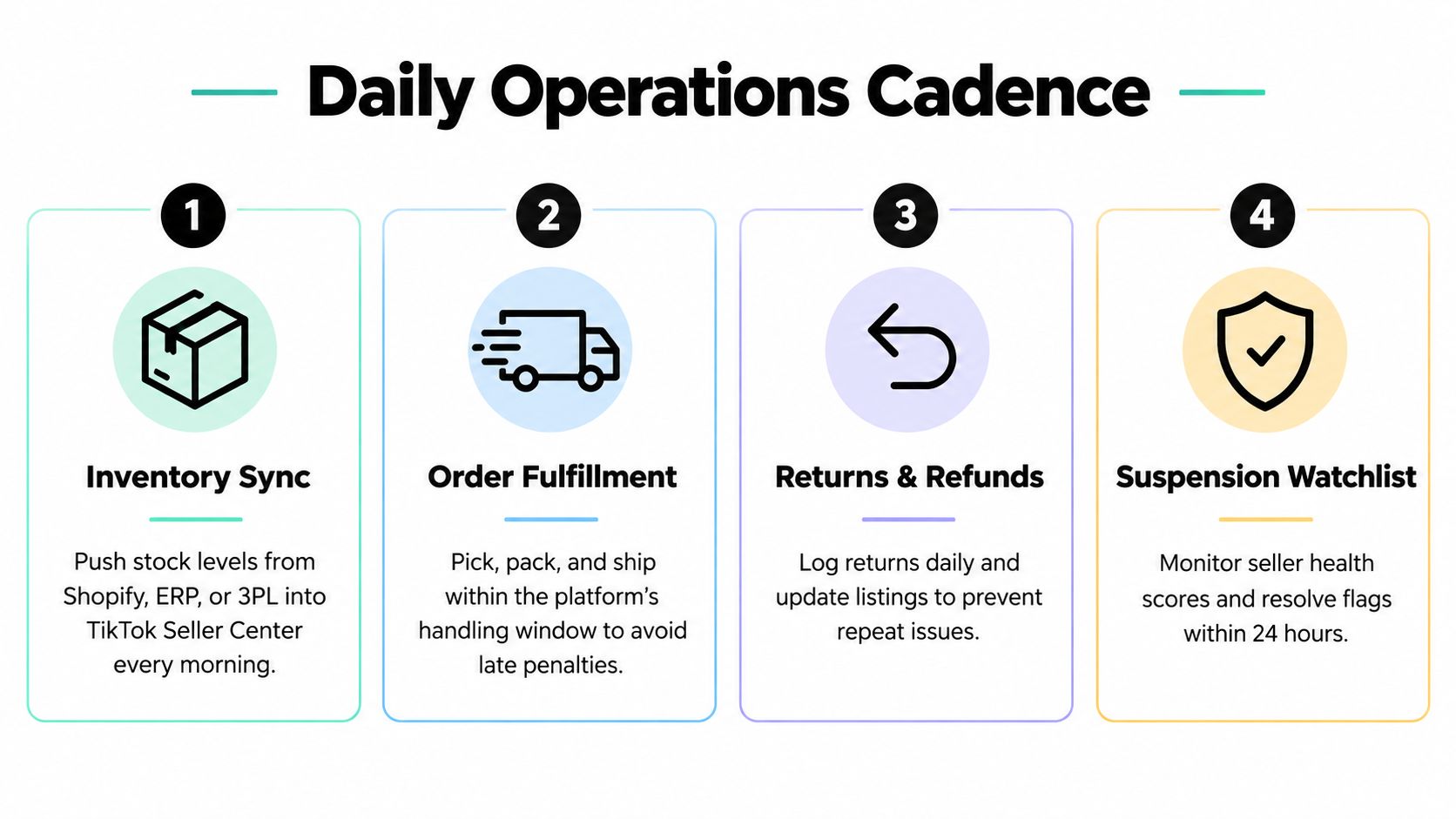
Use a daily health checklist
- Inventory sync: Push current stock levels to the shop and investigate any SKU with unusual order velocity.
- Order fulfillment: Pick, pack, and dispatch within the required handling window. Upload valid tracking and reconcile exceptions.
- Returns and refunds: Log every return, identify the product or claim behind it, and update the listing or quality process.
- Suspension watchlist: Review shop health, cancellation, dispatch, tracking, and refund signals before they become account restrictions.
TikTok's fulfillment performance tracking includes On-time Delivery Rate, Late Dispatch Rate, Valid Tracking Rate, Seller-fault Cancellation Rate, plus unshipped-order and out-of-stock cancellation rates. (TikTok fulfillment performance policy) Assign an owner to every exception and resolve it the same day. Feed those outcomes into the product view, because a SKU with strong demand can still lose money through failed delivery.
Control refund exposure as closely as revenue. Industry benchmarks place the Seller Fault Return and Refund Rate threshold below 1%, while other operating benchmarks report a 6% return rate and 20% creator commission. (industry operations analysis) Model those costs before judging a product's contribution margin. A product that looks profitable on gross sales can become unprofitable after returns and commissions.
For broader process automation context, see this ultimate e-commerce growth guide. Automate routine data movement, then keep a named operator accountable for exceptions.
The Shop Performance Score is another operating gate. Monitor the score and its underlying drivers, then pause added volume when performance slips. Fix the SKU, carrier process, warehouse workflow, or customer-service response before sending more traffic.
A short video can reinforce this cadence when several people share operational responsibility.
Tracking Profit and Scaling With Confidence
GMV is a demand signal, not a scaling signal. It tells you that customers are buying, but it doesn't tell you whether the product still makes money after COGS, platform deductions, shipping, returns, creator payouts, discounts, and advertising.
Build a product-level P&L with one row per SKU and one order-level source for the underlying transactions. Your dashboard should answer five questions without manual spreadsheet work:
- Which products generate net profit?
- Which creators generate profitable orders rather than expensive volume?
- Which traffic sources produce repeat customers?
- Which refunds or shipping outcomes erase contribution?
- Which products should receive more inventory or paid distribution?
Use cohorts, not averages
A store-wide margin average hides the products and customers that need attention. Break performance down by SKU, creator, campaign, and customer cohort. One creator may drive first-time buyers who purchase again, while another may generate one-time orders that depend on aggressive discounts. Those outcomes shouldn't be blended into one affiliate average.
The same principle applies to paid traffic. A campaign can look efficient at the campaign level while one SKU absorbs the spend and another loses money. Load ad spend back to the product and, where attribution allows, to the content or creator that caused the order.
HiveHQ's Profit Dashboard connects TikTok Shop orders, ad spend, and creator payouts to show real-time net profit, product-level performance, and customer analytics. It is self-serve software, so sellers can run the analysis themselves rather than waiting for a custom finance report. The useful output is not another revenue chart. It's a decision view that shows which products and acquisition sources deserve more capital.
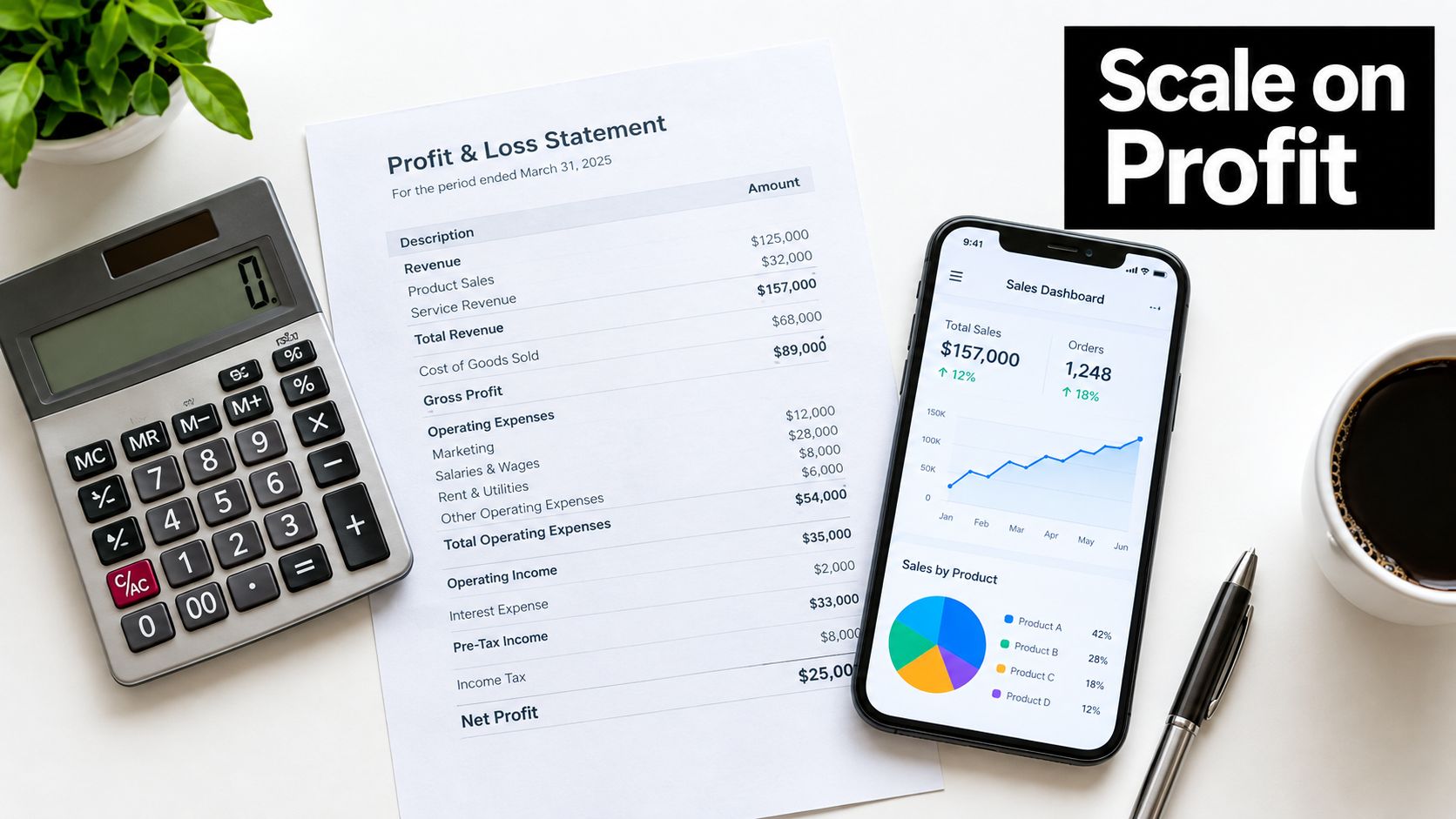
Use the TikTok Shop profit dashboard guide to define the metrics your team should review daily and weekly. Daily reviews catch margin leaks while there's still time to change the offer. Weekly reviews help you decide which SKUs to restock, which content to amplify, and which campaigns to stop.
Scale only what survives a full-cost calculation. A product that wins on views and GMV but loses money after commissions and returns is not a winner. It's an expensive source of information.
Common Questions and Your Next Step
Can an individual sell on TikTok Shop without an LLC?
Eligibility depends on the seller's market, account type, identity verification, category, and the information TikTok requests during registration. Don't assume that forming an entity solves approval issues. Consistent identity, tax, payout, warehouse, and product information matters more than the label you use for the business.
How long does it take to make a first sale?
There isn't a reliable universal timeline. Approval, product fit, content quality, stock availability, and distribution all affect the result. Prepare several product-led videos before the shop goes live, tag the exact product shown, and review clicks, carts, orders, and contribution margin together.
Should I use a spreadsheet or a profit dashboard?
A spreadsheet works for a small catalog with low order volume and stable costs. It becomes fragile when orders, creator payouts, returns, shipping charges, and ad spend arrive in separate reports. A dedicated profit dashboard is more useful when you need product-level net profit and customer-level analysis without manually joining files.
How do I know whether to scale a product?
Scale only after the SKU remains profitable with realistic shipping, commission, return, discount, and advertising assumptions. Then increase inventory and distribution gradually while monitoring cancellation, dispatch, tracking, refund, and customer signals.
What should I review every day?
Review available inventory, unshipped orders, late or invalid tracking, cancellations, refunds, product-level net profit, and content or campaign attribution. The faster you identify a bad SKU or broken fulfillment workflow, the less expensive the correction will be.
Pull your TikTok Shop transaction data into a profit dashboard now, and make unit economics the default lens for every pricing, creator, and paid distribution decision.
Try HiveHQ for real-time TikTok Shop net profit, product-level performance, and customer analytics that you can run yourself. Visit HiveHQ to try the Profit Dashboard, then talk to the HiveHQ team about making profitable scaling part of your daily operating routine.