How to Sell Things on TikTok Shop Profitably
tiktok shoptiktok sellingecommerce profittiktok adshivehq
Selling things on TikTok Shop requires integrating your product catalog, maintaining a Shop Performance Score above 3.5, and tracking true net profit after platform fees and returns. A shop that generates orders but loses money through commissions, shipping, refunds, or weak fulfillment isn't a profitable TikTok Shop business.
That's the counterintuitive part. A viral product can create operational risk faster than it creates cash, especially when active affiliate plans can be terminated after performance falls below the platform's threshold. TikTok Shop is a content-led sales channel, but sustainable growth depends on the less glamorous work: accurate listings, reliable fulfillment, disciplined unit economics, and fast decisions based on net profit rather than gross sales.
Table of Contents
- Account Setup and Performance Requirements
- Mastering Unit Economics and Profit Tracking
- Optimizing Listings and Running GMV Max Ads
- Managing Creator Partnerships and Commissions
- Navigating Returns and Operational Compliance
- Frequently Asked Questions About TikTok Shop
Account Setup and Performance Requirements
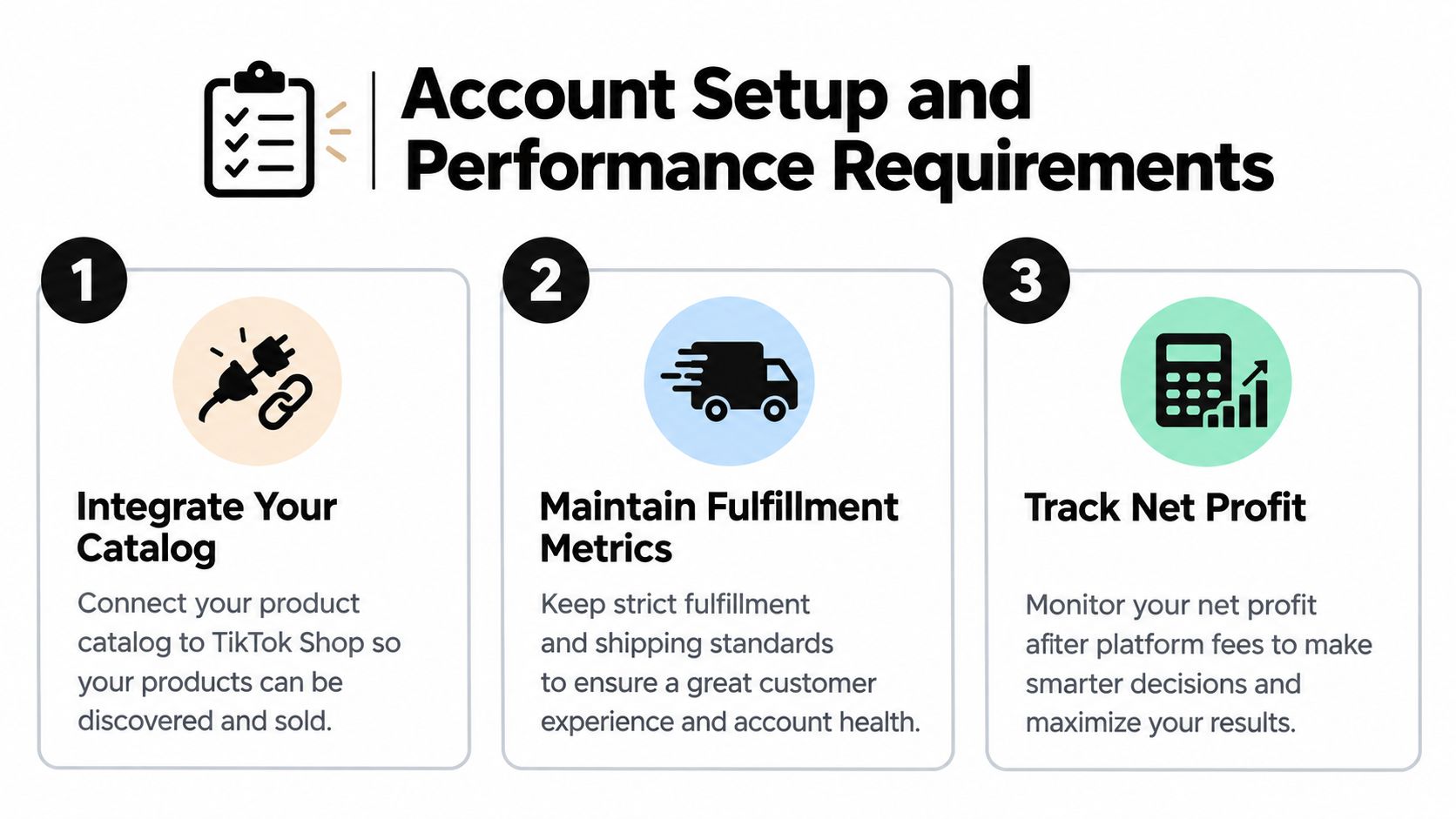
The practical answer is simple: connect your catalog, configure shipping and customer-service processes before publishing, and monitor profitability from the first order. Registration is only the entry point. Your ability to participate in affiliate campaigns and platform promotions depends on the quality of the buyer experience you deliver after checkout.
TikTok's seller guidance describes the Shop Performance Score, or SPS, as a 0–5 score calculated from average performance over the previous 90 days. Sellers need an SPS of 3.5 or above for affiliate and campaign participation. If the score falls below 3.0, TikTok can terminate active affiliate marketing plans and remove products from campaigns. TikTok's seller guidance explains the SPS thresholds and calculation period.
Build the operational baseline first
Start with the catalog, not the content calendar. Connect the products you can fulfill, confirm titles and variants, upload accurate images, and check that inventory and shipping settings match your real warehouse process. A product that sells out immediately, ships late, or arrives differently from its listing can damage shop performance even if the video that promoted it performed well.
Use a short prelaunch checklist:
- Catalog connection: Confirm that each product has the correct price, inventory, variant information, and shipping configuration.
- Fulfillment ownership: Decide who picks, packs, ships, and uploads tracking information when demand rises.
- Customer support: Assign responsibility for buyer questions, refund requests, disputes, and delivery problems.
- Profit tracking: Record product cost, platform charges, shipping, discounts, commissions, ad spend, and refund exposure.
- Policy review: Check current seller rules before expanding into new categories, regions, or fulfillment arrangements.
The full TikTok Shop seller requirements guide can help operators turn those checks into a repeatable setup process. The important principle is that performance management starts before the first campaign. If your team only reviews SPS after a problem appears, it's already reacting too late.
Treat SPS as a growth metric
SPS isn't merely a compliance score. It determines whether you can access commercial activities that help turn content into consistent sales. That makes fulfillment, returns, and service quality part of acquisition strategy.
A practical operator reviews order and service indicators on a fixed schedule, then looks for causes rather than isolated symptoms. A delivery issue might originate in inventory synchronization, a warehouse handoff, an incorrect address, or a product page that created the wrong expectation. Fixing the cause protects both the customer experience and the traffic investment behind the order.
Practical rule: Never scale demand faster than your team can pack, ship, answer, and resolve issues without lowering the buyer experience.
TikTok Shop rewards the seller who can repeat a reliable transaction, not just the seller who can attract attention once. Build that reliability into the account from day one.
Mastering Unit Economics and Profit Tracking
Gross merchandise value is not profit. It only shows order value before the costs that decide whether those orders help or hurt the business.
TikTok says there's no setup fee, but sellers still need to account for commissions, fulfillment, refunds, returns, promotions, and advertising. In the UK, TikTok charges a 6% commission, and sellers receive payment after orders are completed and applicable refund windows have passed. TikTok's seller information outlines setup costs, UK commission, and payout timing.
Calculate the sale that cleared all costs
For each order, separate revenue from the costs attached to delivering it. A useful profit view includes:
- Collected product revenue: The amount the customer paid for the item, after any seller-funded discount.
- Cost of goods sold: The landed product cost, including the components required to make the item ready for sale.
- Platform charges: TikTok commissions and other transaction-related deductions that apply to your market and category.
- Fulfillment expense: Pick and pack labor, packaging, outbound shipping, and any operational handling cost.
- Marketing cost: GMV Max spend and any other paid acquisition cost assigned to the order or product.
- Creator commission: The commission owed when an affiliate-driven order is attributed to a creator.
- Returns and refunds: The revenue reversal, shipping liability, restocking impact, and product loss associated with the order.
The resulting number is your true net profit. The GMV at the top of a performance report never reflects it. A product can still convert well and remain a weak scaling candidate if its margin cannot absorb paid traffic, creator commissions, and return behavior.
TikTok's 2026 trend forecast points toward more intentional buying. The forecast points to a need for stronger product justification and clearer value. That means your product page and creative need to answer a buyer's question, why this item is worth purchasing now, at this price, after delivery and return considerations.
Use product-level visibility, not shop-level averages
Shop-wide profitability can hide weak products. One hero item may generate most of the revenue while another consumes ad spend, attracts returns, or requires costly support. Review contribution at the product level, then segment by traffic source, creator, campaign, and customer behavior.
HiveHQ's TikTok Shop Profit Dashboard gives sellers a self-serve way to view real-time net profit, product-level performance, and customer analytics. The useful workflow is not just opening another report. It is connecting the report to a decision:
- Identify the margin floor: Establish the minimum net contribution required before you increase ad spend or commissions.
- Separate traffic quality: Compare organic, paid, and affiliate-attributed orders instead of treating all revenue as equivalent.
- Flag return-heavy products: A high-return listing may need better sizing information, clearer demonstrations, improved packaging, or a different offer.
- Review costs at the same time as revenue: Rising GMV means little if COGS, commissions, and advertising grow faster.
- Pause with discipline: If a product cannot produce acceptable net profit after a reasonable testing period, change the offer or stop funding it.
For sellers expanding from another marketplace, this discipline matters even more. Different channels can make the same product appear profitable because their fee structures, customer expectations, traffic costs, and return patterns differ. Price for the TikTok Shop transaction you deliver, including the expensive parts a spreadsheet tends to exclude.
Optimizing Listings and Running GMV Max Ads
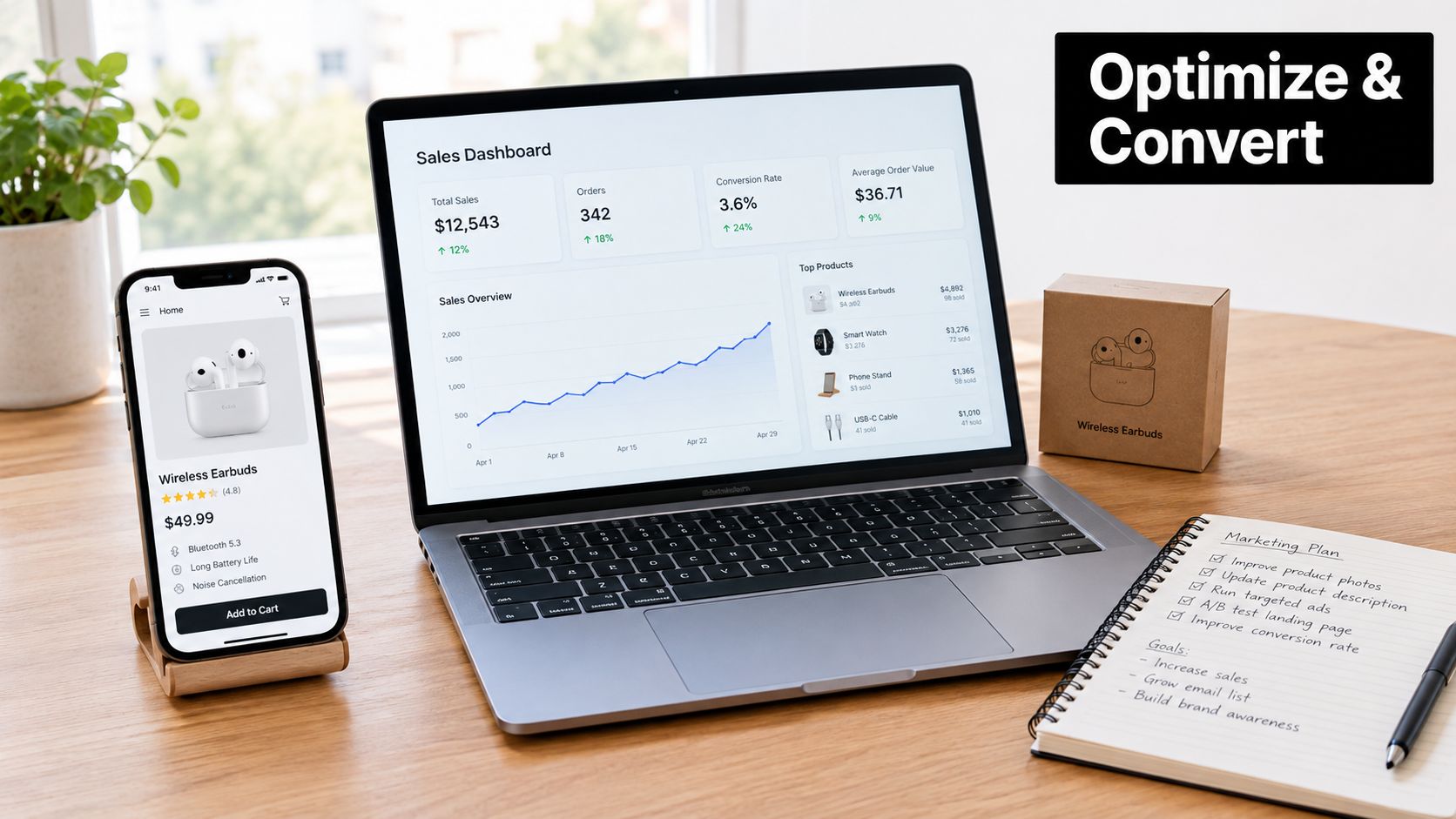
TikTok Shop listings convert intentional buyers when the product page makes the decision easy. Show the product in use, explain the problem it solves, state what the buyer receives, and remove uncertainty around size, compatibility, materials, delivery, and returns.
Make the listing earn the click
A strong listing and a strong video do different jobs. The video earns attention and demonstrates relevance. The listing confirms the details and gives the buyer enough confidence to complete checkout.
Prioritize these elements:
- Specific first image: Show the item clearly, at a useful scale, without forcing the buyer to interpret a lifestyle scene.
- Benefit-led title: State what the product is and the practical outcome it supports.
- Proof through demonstration: Show setup, use, comparison, texture, dimensions, or the result the buyer can reasonably expect.
- Variant clarity: Explain differences between sizes, colors, bundles, or models before the buyer chooses.
- Objection handling: Answer the questions that would otherwise create comments, refunds, or abandoned carts.
- Consistent offer: Make sure the price, discount, product shown in the video, and product linked at checkout all match.
Don't use creative volume as a substitute for positioning. If every video uses a different promise, the audience and the algorithm receive mixed signals, while your team can't identify which value proposition produced profitable orders.
For teams that need faster creative testing, a resource such as the ShortGenius TikTok ad generator can support the production of video concepts and ad variations. Treat generated creative as a starting point. A human still needs to verify the product claims, footage, offer, and landing experience.
Run GMV Max against a margin boundary
GMV Max can help automate delivery and bidding decisions, but automation doesn't know your acceptable net profit unless your team defines it. Start with a product that already has a clear offer, sufficient stock, accurate fulfillment settings, and creative that demonstrates the product without depending on unexplained hype.
Set the campaign up around a measurable question:
- Can this product acquire a first order at a contribution level the business can support?
- Does paid traffic create incremental sales, or does it claim demand that would have arrived organically?
- Which creative angle produces the strongest product-level net profit?
- Does additional spend remain profitable after discounts, refunds, and fulfillment?
The explanation of why GMV can be a vanity metric on TikTok Shop is useful when reviewing campaign performance with finance and growth teams. GMV is a valuable volume indicator, but it shouldn't be the final scale decision.
Give each winning creative a clear job. One video may explain the problem, another may demonstrate the product, and a third may address a common objection. Then compare them using net contribution, not only views, clicks, or revenue. If the campaign finds customers who return the product or require expensive support, the apparent win may be a margin loss.
Managing Creator Partnerships and Commissions
Affiliate sales work best as a commercial system with clear economics. Broad outreach can create activity, but it will not show whether a creator can produce content that converts for your product at a commission rate your margin can support.
TikTok allows commission rates from 1% to 80%. Practical benchmarks place typical video conversion at 3% to 6% and LIVE conversion at 5% to 12%. Products priced below $30 generally convert above 5%. Open Collaboration activation commonly falls between 12% and 18%, and programs below 10% often point to onboarding or commission-structure problems.
Those figures are planning benchmarks, not guarantees. Product category, offer strength, creator-audience fit, content quality, delivery experience, and refund rate can push actual performance well outside the range. For a useful framework on tiering rewards by performance, see the guide to structuring affiliate commission tiers.
Compare partnership models by economics
| Format or Type | Expected Conversion Rate | Activation Benchmark |
|---|---|---|
| Standard affiliate video | 3% to 6% | Use as a baseline for product demonstrations and short-form reviews |
| LIVE shopping | 5% to 12% | Evaluate host quality, session structure, and ability to answer objections |
| Products under $30 | Generally above 5% | Lower purchase friction can support stronger conversion |
| Open Collaboration | Not a conversion format | 12% to 18% activation is a practical benchmark |
| Open Collaboration below benchmark | Not a conversion format | Below 10% usually warrants an onboarding or commission review |
Open Collaboration gives you access to a broader creator pool, but you give up some control over who chooses the product and how it is presented. Targeted partnerships take more selection work, yet they often align better with audience fit, product knowledge, posting expectations, and content rights.
A paid retainer can make sense when you need predictable content volume, but it adds fixed cost before sales are proven. A commission-only structure protects cash flow, though a creator may prioritize products with stronger offers or easier conversion. The right model depends on contribution margin and the kind of content your product needs.
Measure net contribution per creator
Give each creator a clear brief, commission terms, sample requirements, posting expectations, and a definition of acceptable content. Then evaluate the partnership using:
- Attributed GMV: The sales value connected to the creator.
- Net contribution: Attributed revenue after product cost, commission, fulfillment, refunds, and paid support.
- Content output: Whether the creator delivers the agreed content in the required format and timeframe.
- Return behavior: Whether creator-led customers return at a materially different rate.
- Repeat potential: Whether the creator introduces customers who can buy again.
High GMV at an unsustainable commission does not make a creator a top partner. The commercial balance has to work after fulfillment costs, refunds, and support are included. Keep that logic visible to the team, so decisions do not drift toward vanity numbers.
Use a centralized creator tracker for posting schedules, retainer performance, commission obligations, and GMV contribution. Review partners on a consistent cadence, and adjust the brief or offer before increasing payout.
Navigating Returns and Operational Compliance
Getting orders is often easier than keeping the margin attached to them. Returns, refund requests, shipping disputes, and inaccurate reverse-logistics details can turn a strong sales day into an expensive service backlog.
TikTok Shop's U.S. return policy allows eligible items to be returned for any reason within 30 days. Buyers can use a free prepaid label or QR code, and TikTok Shop may apply a restocking fee, partial refund, or retrocharge when a return arrives damaged, used, or incomplete for reasons not caused by TikTok Shop or seller error. The U.S. return policy defines the buyer window and possible outcomes for problematic returns.
Put response deadlines into the workflow
A refund queue needs an owner, not a general inbox. TikTok's U.S. seller guidance gives sellers 2 business days to review refund-only requests for items priced at $100 or less, 4 business days for items priced above $100, and 4 business days to respond to return requests. Customers generally have the checkout-specified return window or the default 30 calendar days from delivery to file a return or refund request. TikTok's seller policy guidance lists these review and response periods.
Create a daily exception queue that separates:
- Refund-only requests: Review evidence, product price, seller fault, and the response deadline.
- Physical returns: Track label creation, carrier movement, delivery, inspection, and resolution.
- Delivery disputes: Confirm tracking, address data, warehouse handoff, and buyer communication.
- Damaged or incomplete items: Record condition, missing parts, packaging, and responsibility.
- Repeat failure patterns: Connect individual cases to a product, warehouse, carrier, or listing issue.
TikTok's refund guidance says the seller must refund the exact amount the customer paid for the product. For seller-fault returns, the seller pays return shipping. For Change of Mind returns, the seller is responsible for two-way shipping fees, while the platform covers buyer-paid shipping fees only up to 2 returns per customer per month before subsequent fees are paid by the platform. TikTok's refund guidance explains refund amounts and shipping responsibility.
Verify reverse logistics before demand spikes
A return address isn't an administrative detail. It determines where inventory goes, who can inspect it, and whether the seller can recover resale value.
A TikTok Shop policy update effective August 5, 2026 requires sellers to use return addresses they own, are authorized to use, and that are affiliated with their business operations. Fake or incorrect seller addresses make the seller liable for return-to-sender cases. If reverse logistics remains stagnant with no update for 10 or more days, the logistics partner can become liable and an immediate buyer refund can be triggered. The policy update details return-address requirements and stagnant reverse-logistics consequences.
Audit every address, warehouse instruction, and escalation path before scaling a winning product. The TikTok Shop shipping and fulfillment cost guide can support that review. Growth is operationally resilient only when the team knows where each order goes, who owns each exception, and how the financial impact enters the profit report.
Frequently Asked Questions About TikTok Shop
Is it free to start selling on TikTok Shop?
TikTok says there's no setup fee, but a seller still pays transaction-related costs, fulfillment expenses, commissions, returns, and any advertising costs that apply. In the UK, TikTok charges a 6% commission, so pricing should be built around the seller's actual region and category rather than a universal fee assumption.
How should I calculate TikTok Shop profit?
Start with collected product revenue, then subtract product cost, platform charges, outbound shipping, discounts, creator commissions, advertising, refunds, return shipping, and other order-level costs. Use product-level net profit rather than GMV alone, because a high-revenue item can lose money when returns or acquisition costs are fully loaded.
Who pays for shipping when a customer returns an item?
The responsibility depends on the reason for the return. Seller-fault returns place return shipping responsibility with the seller, while Change of Mind returns can create two-way shipping exposure for the seller under TikTok's refund rules.
What happens if my shop performance falls?
TikTok's seller guidance says an SPS of 3.5 or above is required for affiliate and campaign participation. Falling below 3.0 can terminate active affiliate marketing plans and remove campaign products, so fulfillment and customer service need daily ownership.
How can I improve product and content decisions?
Track content, campaigns, creators, customers, returns, and net profit together. For creative planning that connects product education with sales content, using Viral.new for sales can provide another practical resource, but every idea should still be judged by the net contribution it produces.
Try the HiveHQ Profit Dashboard to monitor real-time TikTok Shop net profit, product performance, customer analytics, commissions, ad spend, and return impact in one self-serve workspace. Visit HiveHQ to test the dashboard, then talk to the HiveHQ team about building a more reliable profit-tracking process for your shop.