How to Set Up a TikTok Shop for Profit
tiktok shop setuptiktok seller centerecommerce profit trackingtiktok shop guidegmv max ads
To set up a TikTok Shop, register in Seller Center, verify your legal entity and tax documents, link a matching bank account, and configure fulfillment before listing any products. Treat the launch as a compliance and profitability project first, then upload the catalog.
You may be looking at a product spreadsheet, a few draft videos, and an assumption that the next step is clicking “Add product.” That approach creates avoidable problems. TikTok Shop approval depends on who owns the shop, where the seller operates, which documents match the account, how orders will ship, and whether each sale can produce a contribution profit.
The practical question isn't only how to set up a TikTok Shop. It's how to build an account that can receive payouts, fulfill orders, survive cross-border checks, and show its real profit after fees, refunds, advertising, and fulfillment.
Table of Contents
- Account Registration and Compliance Requirements
- Modeling Unit Economics and Platform Fees
- Designing Fulfillment and Tracking Governance
- Configuring Advertising and GMV Max Campaigns
- Implementing Real-Time Profit Analytics
- Launch Checklist and Frequently Asked Questions
Account Registration and Compliance Requirements
TikTok Shop setup begins inside Seller Center. You create an account, choose whether the shop belongs to an individual or a corporation, submit identity or business documents, connect a bank account, and configure the shop before publishing products. TikTok's Seller Center setup guidance lists Seller Center availability across 12 markets, including the United States, United Kingdom, Spain, Ireland, Mexico, Malaysia, Singapore, Thailand, Vietnam, Indonesia, and the Philippines.
Choose the correct legal entity
An individual seller may need the front and back of a passport, national ID, or driver's license. A corporation generally needs government-issued identification for its legal representative, director, or person with significant control, together with a business license, registration document, or comparable proof of eligibility.
The bank account must support the same legal identity. For a corporation, TikTok requires the bank-account name to match the company name. A mismatch between the submitted business record and payout account can delay approval or create payment problems after launch.
US individual sellers face additional checks. They must be 18 or older, reside in the United States, provide matching identity and address information, submit tax details, and connect relevant bank information. TikTok also requires a W-9 for tax purposes. The account must use an email address and phone number that haven't already been used for another TikTok Shop.
UK sellers need a market-specific review rather than a copied US workflow. A sole trader must be at least 18 years old, provide a valid passport or driving licence, show a domestic address, and submit relevant proof of address. A corporate applicant must be legally incorporated in the country where it registers. Imported goods also bring customs, import VAT, and customs-duty responsibilities when goods first enter the UK, as described in TikTok's UK seller requirements.
Prepare credentials before starting
TikTok requires a phone number or email address not already associated with another Shop account. The registration password must contain numbers, letters, and special characters and be between 6 and 20 characters. Sellers must also reside in the country selected for the shop, and politicians can't register as sellers, according to TikTok's registration requirements.
Create a market-by-market launch matrix before you submit anything:
- Entity: Individual, sole trader, or corporation.
- Identity: Accepted ID and proof of address.
- Tax: Taxpayer information, VAT or sales-tax obligations, and required forms.
- Banking: Account ownership and legal-name matching.
- Logistics: Ship-from address, return address, carrier responsibility, and dispatch SLA.
- Invoices: Whether you must issue formal tax invoices in that market.
For wider context on the commercial role of the channel, this overview of TikTok for ecommerce is useful, but it shouldn't replace the Seller Center requirements. Operators moving from Amazon often assume one legal profile and one fulfillment process can serve every market. Cross-border TikTok Shop expansion doesn't work that way. Read the detailed TikTok Shop seller requirements before investing in inventory or content production.
Modeling Unit Economics and Platform Fees
Opening a TikTok Shop has no setup fee, but each order carries a platform commission. TikTok's official Seller Center states that the commission is 6% of each sale, so a product can generate attractive GMV while producing weak or negative contribution profit. The relevant TikTok Seller Center fee information provides the basis for the launch model below.
Practical rule: Never approve a product for launch because its revenue potential looks strong. Approve it only after every variable cost still leaves the required contribution profit.
Build the product model before publishing
For each SKU, calculate:
Selling price minus COGS, TikTok commission, creator commission, discounts, shipping subsidy, packaging, returns allowance, and paid-media spend.
That result is contribution profit. It's more useful than GMV because it shows what remains after the costs directly tied to the transaction.
TikTok Shop Unit Economics Breakdown
| Metric | Amount | Percentage of GMV |
|---|---|---|
| Setup fee | $0 | 0% |
| TikTok commission | 6% of sale | 6% |
| Example GMV | $100,000 | 100% |
| Commission on $100,000 GMV | Approximately $6,000 | 6% |
| Commission on a $30 product | Approximately $1.80 | 6% |
The table excludes product cost, fulfillment, returns, creator payouts, advertising, discounts, and taxes. A product priced at $30 doesn't produce $28.20 of profit after the commission. It produces $28.20 before every other variable expense is deducted.
That distinction matters for Amazon sellers expanding into TikTok Shop. A familiar retail price may not support the same margin once TikTok commission, content-led acquisition, promotional discounts, and shipping subsidies enter the model. Don't copy the marketplace price and hope creative volume will solve the economics.
Set launch thresholds by SKU
Build a simple decision rule for every product:
- Margin floor: Define the minimum contribution profit required after all variable costs.
- Promotion ceiling: Set the maximum discount that still preserves the floor.
- Acquisition ceiling: Calculate the maximum paid-media and creator cost the product can absorb.
- Refund allowance: Reserve for refunds and returns instead of treating every attributed order as final profit.
- Inventory gate: Increase stock only when refund-adjusted contribution profit supports the additional working capital.
A spreadsheet can establish the model, but it becomes fragile when costs arrive at different times or product data changes across channels. Use the TikTok Shop fee breakdown as a reference while building the SKU-level calculation, then connect the model to daily operating data.
Designing Fulfillment and Tracking Governance
Fulfillment is part of account health, not a back-office detail. TikTok requires sellers to confirm, pick, pack, and provide valid tracking within the selected order-handling time. Seller-shipping merchants remain responsible for delivery performance, so the warehouse workflow must produce evidence at every handoff.
Assign ownership before the first order
Write down who owns each event:
- Order confirmation: Who checks payment and inventory status?
- Picking: Who confirms the correct SKU and variant?
- Packing: Who records package weight and dispatch readiness?
- Carrier handoff: Who captures the timestamp and tracking number?
- Exception resolution: Who contacts the warehouse, carrier, or customer?
- Returns: Who receives the item and updates the financial record?
Create a daily exception queue for unfulfilled orders, invalid tracking, inventory mismatches, late dispatches, cancellations, and returns. A queue is more useful than a weekly review because a late order can become difficult to correct after the permitted correction window has passed.
Reconcile physical and digital events
The most common tracking failure is incomplete governance. A warehouse may mark an order packed while the carrier has no acceptance scan, or a tracking number may be entered against the wrong order. Timestamp warehouse scans and carrier handoffs, then reconcile them every day.
Tracking isn't complete when a label exists. It's complete when the order, package, carrier event, and customer-facing tracking record agree.
Keep inventory synchronized with the fulfillment source. If stock data lags behind actual availability, the shop can accept orders for products that can't ship. That creates cancellations, refunds, support work, and pressure on contribution profit at the same time.
Market responsibility can vary. TikTok may assign carriers and handle tracking updates in some US workflows, while sellers remain responsible for labels, tracking, and return-to-sender costs in other arrangements. Confirm the selected workflow before setting shipping promises, and document the owner for every cost.
Use a written sample tracking system to define the fields your team reconciles each day. At minimum, track order ID, SKU, inventory status, promised dispatch time, pick time, pack time, carrier handoff, tracking validity, cancellation status, and return status.
Configuring Advertising and GMV Max Campaigns
Paid media should come after the shop can explain its product-level economics. Advertising can increase order volume while reducing contribution profit if spend is attached to products with weak margins or high refund rates.
Since July 2025, GMV Max has been the default and only supported campaign type for TikTok Shop Ads. When TikTok Shop is selected as the sales destination under the Sales objective, advertisers can't create, edit, or duplicate LIVE Shopping Ads, Product Shopping Ads, or Video Shopping Ads. TikTok's GMV Max migration guidance sets out the current campaign structure.
Assign the primary ad account correctly
TikTok limits GMV Max access to one ad account per shop. That account must be designated as the shop's primary ad account in Seller Center.
Complete this configuration before launching campaigns:
- Select the account: Choose the ad account that finance and operations can access.
- Assign primary status: Designate it in Seller Center before campaign creation.
- Confirm permissions: Make sure the people responsible for spend, product data, and reporting can work in the account.
- Connect product economics: Map campaign spend back to the SKU or product group being promoted.
- Set a stop rule: Pause campaigns when refund-adjusted contribution profit falls below the approved threshold.
The account decision is operational, not merely administrative. If the wrong account becomes primary, campaign ownership and reporting can become fragmented. Correcting access after launch can also delay budget decisions.
Judge advertising by profit
Don't optimize on views or unadjusted GMV alone. Compare products and campaigns using selling price, discounts, TikTok commission, COGS, fulfillment, refunds, creator payouts, and advertising spend. GMV Max spend belongs in the same product-level model as every other variable cost.
A product with strong creative engagement may still be a poor paid-media candidate if its shipping subsidy or refund rate consumes the available margin. Conversely, a less dramatic product can deserve more budget when it converts consistently and retains positive contribution profit after all deductions. Treat content performance as a signal, not as the final financial decision.
For seasonal promotions and event planning, review the commercial mechanics before committing spend. A resource on TikTok Shop deals and promotion planning can support that review, but the final decision should come from the SKU economics.
Implementing Real-Time Profit Analytics
Manual spreadsheets are useful for setting assumptions, but they become unreliable as the shop adds products, refunds, ads, discounts, and fulfillment costs. Finance may see revenue immediately while COGS, commission deductions, advertising spend, and refunds arrive on different schedules. That delay can make an apparently successful launch look profitable until the month closes.
A dedicated profit layer should answer three questions every day:
- What did the shop sell?
- What was the cost of each product?
- What contribution profit remains after deductions and refunds?
Track the operating truth
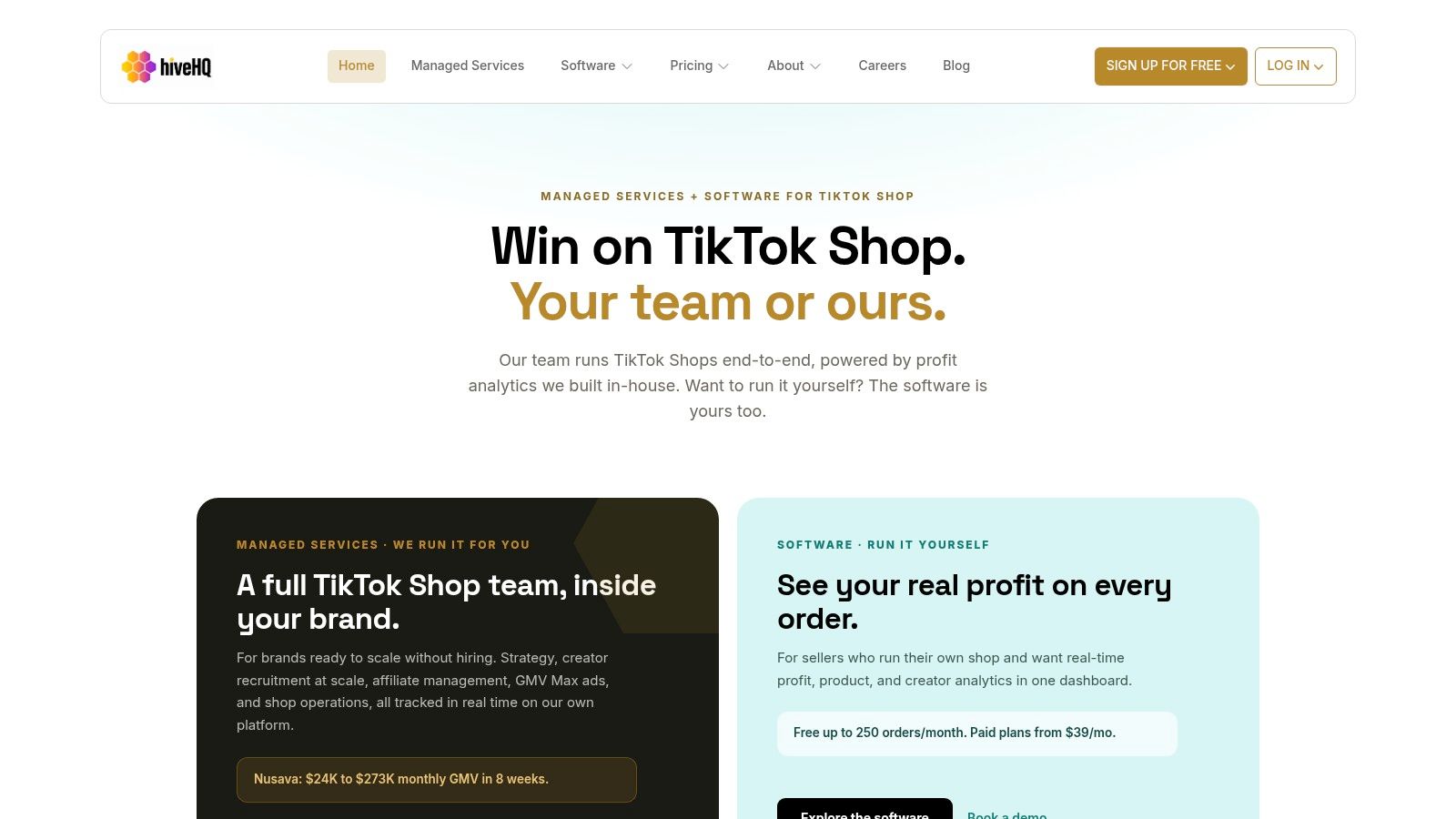
The HiveHQ Profit Dashboard is self-serve software that sellers run themselves. It surfaces real-time net profit, product-level performance, and customer analytics for TikTok Shop sellers, including the relationship between GMV, COGS, ad spend, commissions, refunds, and other operating inputs.
That changes the decision cadence. Instead of asking whether the shop had a strong sales day, an operator can ask which products produced positive contribution profit, which cohorts generated refunds, whether advertising improved the economics, and whether a discount moved enough approved orders to justify its cost.
Replace end-of-month surprises
Review performance by product and customer cohort rather than relying on a single shop-level total. A blended margin can hide a profitable product subsidizing a loss-making one, or a low-refund customer group being offset by costly returns elsewhere.
Use analytics to decide:
- Which products can support additional advertising.
- Which SKUs need a price, bundle, or shipping adjustment.
- Which campaigns produce orders that remain profitable after refunds.
- Which customer cohorts purchase again or generate costly support activity.
- Whether inventory expansion is supported by contribution profit rather than GMV alone.
The TikTok Shop Profit Dashboard provides a relevant framework for connecting shop performance with product-level decisions. The important operating principle is consistency. If the team checks net profit only after a promotion ends, it has already missed the opportunity to pause weak spend, correct pricing, or protect inventory.
Launch Checklist and Frequently Asked Questions
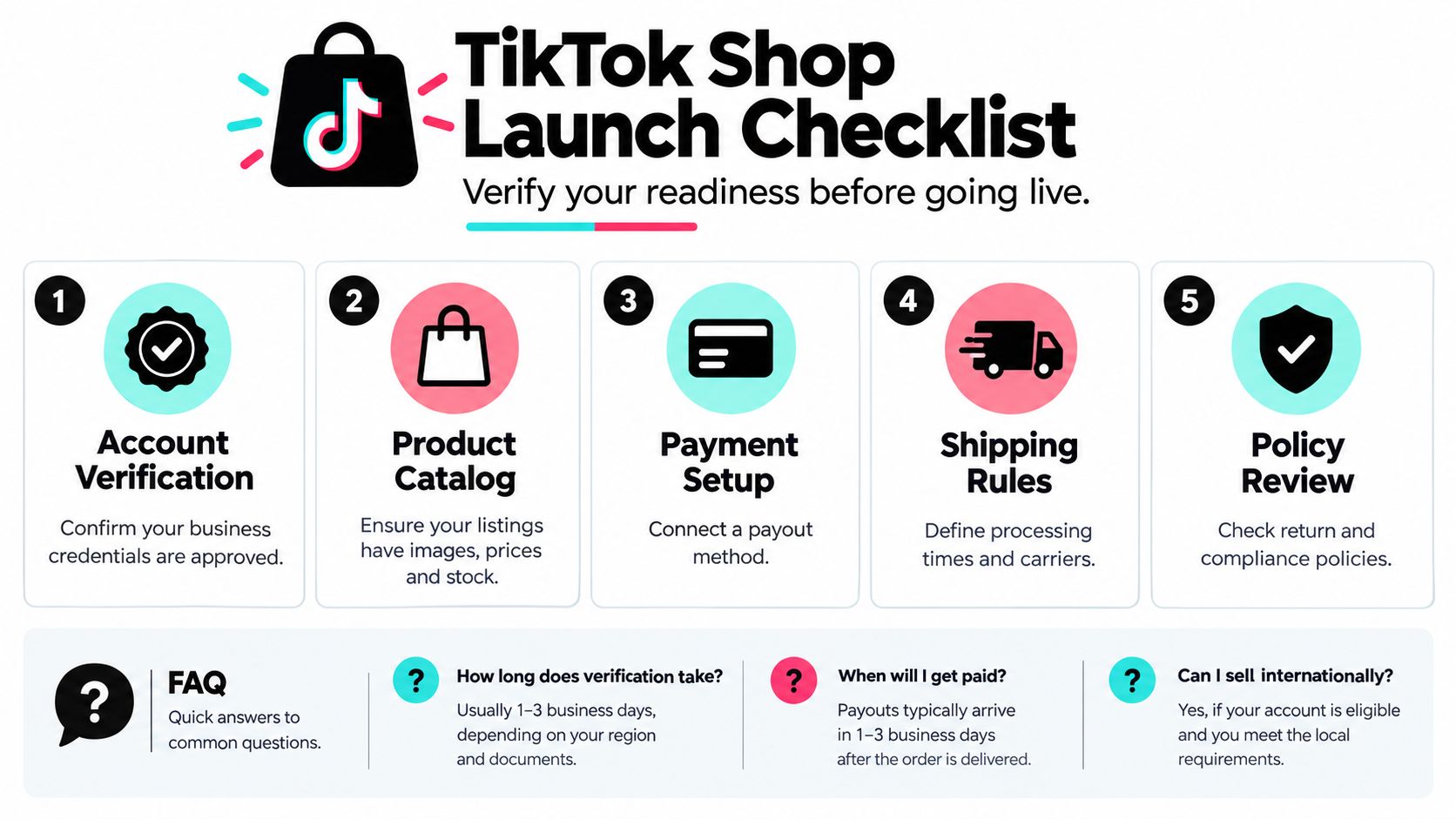
A profitable launch is ready when the account, money movement, fulfillment process, product data, and reporting layer agree with one another. Use this checklist before publishing the first SKU:
- Account verification: Confirm the selected market, legal entity, identity documents, tax details, and unique registration credentials.
- Payout setup: Verify that the bank-account name matches the approved individual or company identity.
- Catalog readiness: Check titles, descriptions, variants, prices, inventory, images, prohibited claims, and product-page accuracy.
- Fulfillment control: Define ship-from and return addresses, processing times, carrier ownership, tracking events, and exception escalation.
- Profit reporting: Load COGS, commission, fulfillment, discounts, refunds, creator costs, and ad spend into a product-level model.
Cross-border sellers should also confirm whether prices must include VAT, whether reverse-charge rules apply, and whether the seller must issue formal tax invoices. TikTok's cross-border guidance states that EU-market TIN information must match the registered legal name, prices must include applicable VAT, reverse-charge rules can apply, and TikTok doesn't generate formal tax invoices on the seller's behalf. The same guidance explains that logistics responsibility varies by workflow, so review the cross-border seller operations guidance before listing inventory in another market.
Frequently Asked Questions
Does it cost anything to open a TikTok Shop?
TikTok states that there's no setup fee to join. Sellers still need to model the per-order commission and every other variable cost before launch.
Can I reuse one account setup across countries?
Not safely. Market eligibility, identity verification, tax forms, VAT or sales-tax obligations, invoices, fulfillment responsibility, and returns can differ by market.
What should I include in a creator commission limit?
Set the limit from contribution profit, not from GMV. Subtract COGS, TikTok fees, discounts, shipping, packaging, refunds, advertising, and the creator payout before approving the maximum commission.
Should I launch advertising immediately?
Only after the product economics and fulfillment workflow are validated. Assign the correct primary ad account, then include GMV Max spend in the product-level profit model.
What should I monitor after launch?
Monitor real-time net profit, product contribution profit, refund-adjusted GMV, commission deductions, ad spend, fulfillment exceptions, cancellations, and customer behavior. Short-form content can create demand quickly, but operational data tells you whether that demand is worth scaling.
If you need video assets to support product education and launch content, a workflow for Tiktok Video Generation can help your team prepare creative concepts while the operational and financial controls remain in place.
Try the HiveHQ Profit Dashboard to monitor real-time net profit, product-level performance, and customer analytics as your TikTok Shop grows. Visit HiveHQ to connect your launch economics with daily operating decisions, and talk to the HiveHQ team about building a reliable profit-tracking workflow for your shop.