A Guide to the Best Social Commerce Platforms for Sellers
social commerce platformsTikTok Shopsocial sellingecommerce guideHiveHQ
Social commerce isn't just a buzzword anymore; it's become a core part of modern retail. We've watched social media platforms morph from simple marketing channels into full-blown digital storefronts. This shift is huge. It means brands can now sell products at the exact moment a customer discovers them, closing that frustrating gap between seeing something you love and actually buying it. For anyone running an e-commerce business, getting this right is no longer a "nice to have"—it's a must-do for growth.
The Rise of Social Commerce and What It Means for Your Brand
To really get a handle on this space, you have to understand the idea of Social Selling. At its heart, social commerce weaves e-commerce tools directly into the social media experience. Think about it: a user can go from discovery to checkout without ever having to leave their favorite app.
That seamless journey is what’s lighting a fire under the market. The global social commerce scene is on track to blow past $1.17 trillion in 2026. That explosive growth is almost entirely thanks to in-app shopping features on platforms like TikTok and Instagram. Right now, the Asia-Pacific region is the undisputed leader, making up a wild 90% of the global market value. Pioneers in China, for example, are seeing conversion rates hit 30% with immersive live streams. Here in the U.S., the second-largest market, sales are expected to top $85.58 billion in 2026.
This isn't just about slapping a "buy" button on a post. It's about creating an experience that feels native to the platform—something entertaining and frictionless that meets customers where they already are. To win, you need to genuinely understand the unique culture and tools of each platform.
Key Platforms and How We'll Compare Them
In this guide, we're going to break down the major social commerce players to help you figure out where your brand fits best. We'll dig deeper than the surface-level features to get into the nitty-gritty of what actually moves the needle. You can also explore the most impactful social commerce trends that are shaping how we sell online today.
We're going to judge these platforms on a few critical points:
- Creator and Affiliate Tooling: How good is the platform at helping you work with creators and affiliates to actually generate sales?
- Audience Engagement and Discovery: What does the platform offer to help people find your products organically and build a real community?
- Analytics and ROI Measurement: Can you get clear, meaningful data to see what’s working and what's profitable?
- E-commerce Integrations and Scalability: How smoothly does it play with your existing setup, like Shopify, and can it grow with your business?
By stacking these platforms up against each other, you'll walk away with a clear picture of how to build a social commerce strategy that truly works.
| Platform | Best For | Key Differentiator |
|---|---|---|
| TikTok Shop | Viral product discovery and impulse buys | "Shoppertainment" algorithm and native affiliate marketplace |
| Meta (Instagram & Facebook) | Community-driven sales and targeted advertising | Massive user base and mature, data-rich ad ecosystem |
| High-intent shoppers and visual discovery | Users actively seeking inspiration and planning purchases |
How TikTok Shop Is Rewriting the Rules of Social Selling

Of all the players in social commerce, TikTok Shop has become a genuine game-changer. It’s done something fundamentally different by weaving shopping directly into the fabric of entertainment, creating a space where discovering a product feels as natural as scrolling through your feed.
This model is what everyone’s calling “shoppertainment.” It’s fueled by an algorithm that's incredibly good at spotting and boosting product-focused videos that people actually want to watch. This is how a single clip can take an unknown product and make it a viral must-have overnight, driving sales through organic buzz instead of just pricey ads.
While other platforms often bolt on shopping features as an afterthought, TikTok Shop is native to the experience. The journey from seeing a product in a video to checking out is incredibly short, which is perfect for capturing the impulse buys that are much harder to secure elsewhere.
The Power of Built-In Creator and Affiliate Tools
One of the smartest things TikTok did was build its Creator Marketplace right into the platform. This isn’t just some static list of influencers; it's a living, breathing ecosystem where brands can directly find and team up with creators who are already masters at selling on TikTok.
Brands can slice and dice the data, filtering creators by their niche, sales performance, and audience demographics to find a perfect, authentic match. The platform even takes care of the nitty-gritty, like tracking commissions and handling payouts, which removes a huge operational headache from affiliate marketing.
For brands, this integrated system delivers some serious wins:
- Scalable Outreach: You can connect with hundreds of potential affiliates without spending weeks on manual research.
- Performance-Based Partnerships: The commission-based model means you’re paying for actual sales, not just eyeballs.
- Authentic Content: Creators have a real incentive to produce engaging content that genuinely convinces their followers to buy.
This creates a powerful feedback loop. More creators jump in to earn commissions, which leads to more product videos, which then feeds the algorithm and drives even more sales for brands. It's a self-sustaining engine for growth.
For TikTok Shop operators, the real challenge isn’t just finding creators—it’s finding the right ones efficiently and managing those relationships to keep the sales coming. The platform’s native tools are a solid start, but they don't always offer the deep analytics and automation needed to truly scale a business.
How HiveHQ Takes Your TikTok Shop to the Next Level
This is exactly where a specialized tool like HiveHQ comes in. If TikTok provides the stage, HiveHQ provides the backstage crew and the director, adding a crucial layer of intelligence and automation. For example, our Affiliate Bot can automate your outreach to thousands of creators at once, using smart filters to pinpoint those who are the perfect fit based on real performance data.
Instead of getting bogged down in DMs, HiveHQ users can launch automated campaigns that handle follow-ups, send out product briefs, and keep track of when content goes live. This frees you up to think about the bigger picture—your strategy, your creative, and your brand. For a deeper dive, our guide on how to sell on TikTok Shop walks through optimizing these workflows.
On top of that, HiveHQ’s Profit Dashboard gives you the kind of financial clarity that TikTok’s native analytics simply can’t. It pulls together all the critical numbers—GMV, Cost of Goods Sold (COGS), ad spend, creator commissions—into one clean view. This allows you to see your true profitability at both the product and shop level, so you can make smart decisions about which products to promote and which creator partnerships are actually making you money.
The platform's momentum is undeniable. Projections show TikTok Shop hitting $23.41 billion in U.S. sales by 2026, a massive 48% year-over-year jump. With its global GMV expected to reach around $87 billion by 2026 and a user-to-buyer conversion rate of 43.8% that leaves competitors in the dust, it’s not a trend you can afford to ignore. You can find more data and social commerce trends and predictions on eMarketer.com.
A Tale of Two Shoppers: Meta vs. Pinterest
When you’re looking beyond TikTok Shop, the conversation inevitably turns to two of the original social commerce players: Meta (with Facebook and Instagram) and Pinterest. It's easy to lump them together, but in reality, they serve completely different parts of the customer journey. Picking the right one isn't about which is "better"—it's about understanding how and when your customers decide to buy.
Meta's strength is its sheer, overwhelming scale and the deep, data-driven relationships it helps you build. It’s where you go to create a community, spark conversations, and use incredibly precise ad tools to find people who don't even know they need your product yet.
Pinterest is a whole different ballgame. It's a visual search engine, a digital mood board where intent is everything. People don't come to kill time; they come to plan, to discover, and to shop. It’s less about stumbling upon a product and more about actively hunting for the perfect one.
The Mindset: Passive Scrolling vs. Active Searching
This is the absolute core of the difference. A user scrolling through their Instagram Feed or watching Reels is in a passive, entertainment-focused mindset. A sale here is often an impulse buy, triggered by a creator they trust or a perfectly targeted ad that stops their scroll.
Jump over to Pinterest, and the user is on a mission. They're actively searching for "summer wedding guest dresses" or "small bathroom renovation ideas." In fact, a mind-blowing 97% of top searches on Pinterest are unbranded. This means users are wide open to discovering your brand if you solve their problem.
Think of it this way: Meta helps you find customers. Pinterest helps customers find you. One is about creating demand out of thin air; the other is about capturing it the moment it forms.
This fundamental split dictates your entire strategy. On Instagram, you might lean into lifestyle shots and creator unboxings to build desire. On Pinterest, your focus should be on beautiful, keyword-rich Pins that act as visual answers to a user’s search query, ready to convert them on the spot.
The Path to Purchase: In-App Convenience vs. Website Traffic
Both platforms have worked hard to make shopping easier, but their end goals are different. Meta wants to keep you inside its walled garden. With Facebook and Instagram Shops, they've built customizable storefronts that allow for a seamless browse-to-buy journey, all without leaving the app. This removes a ton of friction.
Pinterest, on the other hand, acts more like a high-powered referral engine for your own website. Its tools, like Shoppable Pins and Product Pins, sync with your e-commerce store to display real-time pricing and stock levels. A click typically sends the user directly to your product page to check out, making it an incredible tool for driving high-intent traffic.
Here’s how their shopping features stack up:
Meta (Instagram & Facebook):
- In-App Checkout: The big one. The goal is to handle the entire sale right there in the app.
- Product Tagging: You can tag products in almost everything—Posts, Stories, Reels, you name it.
- Live Shopping: Great for creating urgency and doing real-time demos to a captive audience.
Pinterest:
- Product Pins: These are dynamic, automatically updating with price and availability from your catalog.
- Shop Tab: Your brand profile gets a dedicated "Shop" section, making it easy for users to browse what's for sale.
- Visual Search: Users can snap a photo or use an existing Pin to find visually similar products—turning inspiration into a shopping cart.
Ads and Analytics: Finding People vs. Finding Intent
When it comes to paid advertising, Meta’s ecosystem is a finely tuned machine. Its ad platform lets you target users with surgical precision based on their demographics, interests, and past online behavior. It’s the gold standard for reaching very specific audiences and running powerful retargeting campaigns.
Pinterest’s ad tools are built around its search engine DNA. You're targeting keywords and interests, which is incredibly effective because you’re reaching people who have already raised their hand and shown commercial intent. It might feel less complex than Meta's Ad Manager, but it's arguably more direct.
The numbers don't lie about Meta's power in direct-to-consumer sales. Facebook is still a giant with over 3.07 billion monthly active users, and experts predict it will have 80 million U.S. social shoppers by 2026. Its Marketplace alone pulls in 1.1 billion monthly users, with 40% of them actively buying. On Instagram, 130 million users tap on shopping posts every single month, and 54% say they've bought something after seeing it on the platform. As these social commerce statistics from Hootsuite show, the sheer volume on Meta gives brands a massive runway to connect directly with buyers.
A Detailed Feature Breakdown of Each Platform
Alright, let's get into the weeds. High-level strategy is great, but success in social commerce comes down to the tools you use every day. The features on these platforms aren't just shiny objects; they directly impact how efficiently you can run your business, how well you can partner with creators, and ultimately, how profitable you are.
We're going to move past the marketing fluff and compare what really matters: the creator tools, the analytics, and the e-commerce integrations. Think of this as a look under the hood to see how each platform is built and who it's built for.
This image gives a great at-a-glance view of how Meta and Pinterest position themselves in the social commerce world.
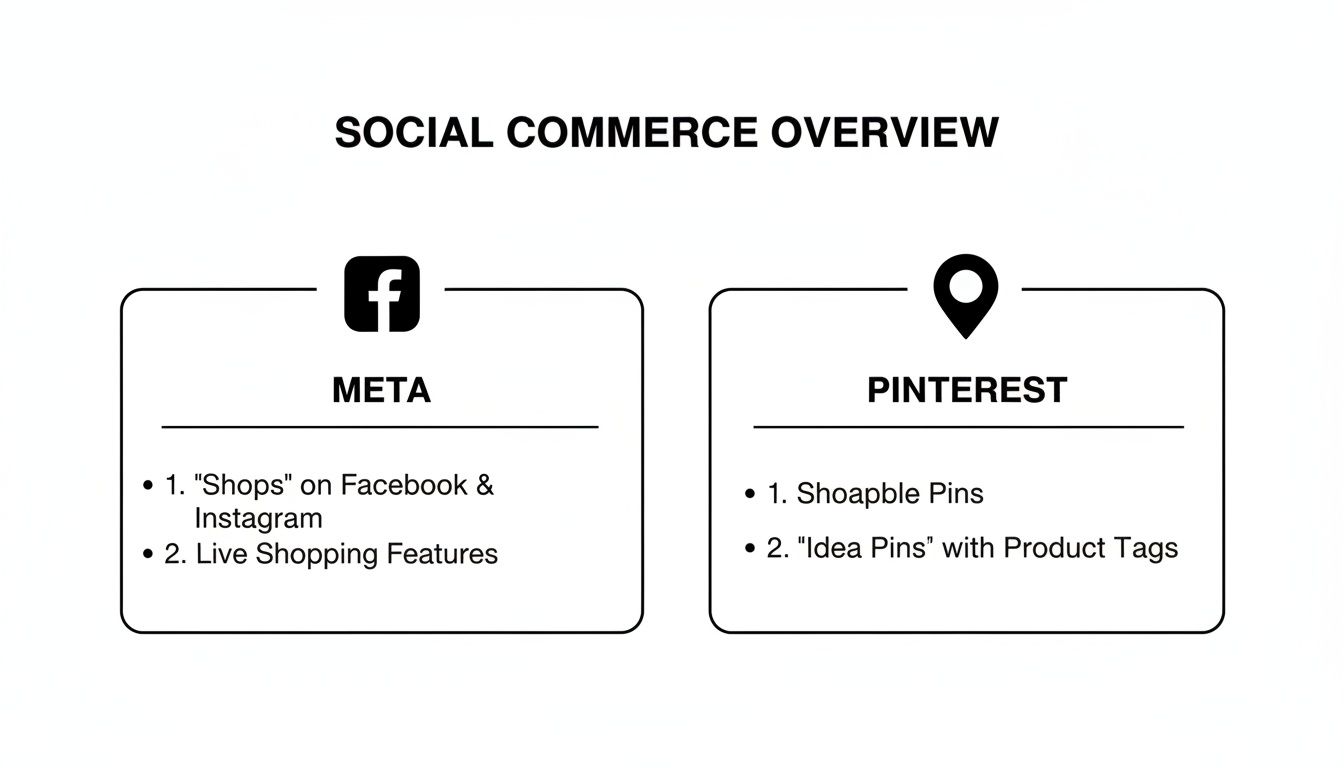
You can see Meta's focus on creating a seamless, all-in-one shopping experience, while Pinterest leans heavily into its strength as a visual discovery engine.
Creator and Affiliate Tooling
How each platform handles creator partnerships is a massive differentiator. TikTok Shop is built around its native affiliate marketplace, which is a game-changer for scale. You can find, recruit, and manage creators all within the app in a performance-driven ecosystem designed for high-volume collaboration.
Meta's setup feels a bit more traditional and, honestly, more fragmented. While Instagram lets brands use affiliate tagging, finding and managing those creators is mostly on you. It's a world of DMs, third-party platforms, or working with agencies. You get more direct control, but it just doesn't have the built-in horsepower for scaling that TikTok offers.
Pinterest's creator tools are all about inspiration. Creators can use Idea Pins with product tags to build beautiful, shoppable content, but the affiliate system isn't as formalized. It's less of a high-octane sales engine and more about authentic content that drives traffic over the long haul.
Analytics and ROI Measurement
Knowing your numbers is everything, but getting a clear picture of your ROI varies wildly between platforms. TikTok Shop's built-in analytics give you the basics on sales and traffic, but they don't tell the whole story. You're often left in the dark on true profitability because crucial metrics like COGS and detailed affiliate commission breakdowns are missing.
This is exactly why tools like HiveHQ's Profit Dashboard exist—to fill that gap. By pulling all your financial data together, you can finally see your actual margins at both the product and shop level, moving way beyond simple revenue tracking.
Meta, on the other hand, has a very mature analytics suite through its Business Manager. It gives you incredible depth on ad performance, audience demographics, and on-platform sales. The main challenge? Tracking the full customer journey can get tricky, especially if the final purchase happens off-site. For anyone just starting, figuring out how to set up a shop on Instagram is the first step to unlocking this data.
Pinterest Analytics is laser-focused on audience interest and intent. It’s fantastic for seeing which Pins are driving clicks and saves, giving you a window into your customer's planning process. It’s more of a top-of-funnel discovery tool than a dashboard for tracking direct sales performance.
The core difference in analytics comes down to focus. TikTok's data is sales-centric but lacks depth, Meta's is ad-centric and robust, and Pinterest's is intent-centric, focused on the pre-purchase journey.
E-commerce and System Integrations
Your social commerce platform has to play nice with your existing tech stack. That’s non-negotiable for any brand looking to scale. Thankfully, all the major players understand this, but their integrations come with different levels of polish.
Shopify is the universal language here. All three platforms have deep, well-supported integrations that make syncing product catalogs, managing inventory, and fulfilling orders a breeze right from your Shopify dashboard.
Here’s a quick rundown of how they connect:
- TikTok Shop: Its direct Shopify app is an all-in-one solution. It handles product sync, order processing, and more, making it incredibly simple for Shopify merchants to get up and running.
- Meta (Instagram/Facebook): The Shopify integration is arguably the most mature on the market. It creates a unified backend to manage sales across Facebook, Instagram, and your main e-commerce site seamlessly.
- Pinterest: Also offers a dedicated Shopify app. It automates the creation of Product Pins and keeps pricing and stock info perfectly in sync, effectively turning your entire catalog into a steady stream of shoppable content.
When you look beyond Shopify, things start to diverge. Meta boasts the widest ecosystem of third-party marketing and analytics partners. TikTok Shop is adding new integrations all the time but is still playing catch-up. Pinterest connects well with other big platforms like BigCommerce and WooCommerce, making it a flexible choice. Your decision here will likely come down to how complex your current operational workflow is.
Social Commerce Platform Feature Comparison
To make things even clearer, here's a side-by-side look at the key features that matter most to sellers on these platforms.
| Feature | TikTok Shop | Meta (Instagram/Facebook) | |
|---|---|---|---|
| Primary Commerce Model | Entertainment-driven, live shopping, and in-feed video. | Integrated Shops, live shopping, and shoppable posts/stories. | Visual discovery and inspiration-driven shopping (Product Pins). |
| Creator Collaboration | Native affiliate marketplace for scalable, in-app partnerships. | Manual outreach, affiliate tagging, and third-party platforms. | Idea Pins with product tags; less formal affiliate structure. |
| In-App Checkout | Yes, fully integrated for a seamless buying experience. | Yes, in the US, but many brands still link to their website. | Limited; primarily drives traffic to the merchant's e-commerce site. |
| Analytics Focus | Basic sales and traffic data; lacks deep profit metrics. | Robust ad performance, audience insights, and on-platform conversion data. | Top-of-funnel intent, audience interests, and traffic/click data. |
| Best For | Brands with viral-potential products, leveraging trends and creators. | Established brands with a strong community and ad budget. | Brands in visual-heavy niches (home, fashion, food, DIY). |
This table cuts through the noise to show where each platform truly shines. Your "best" option really depends on your product, your audience, and your overall growth strategy.
Choosing the Right Platform for Your Business Goals
Trying to find the single “best” social commerce platform is a fool's errand. There’s no winner. The real question is which platform’s unique strengths align with what you’re trying to accomplish right now. A tool that’s a rocket ship for one brand could be a total dud for another.
The trick is to look past the feature lists and think about strategy. Let's walk through a couple of real-world scenarios to see how different brands should approach this choice, whether they're aiming for a quick market test, long-term brand building, or something in between.
Scenario One: Rapid Product Validation
Business Profile: An established Amazon seller has a new product idea. They want to test the waters with minimal risk before sinking a ton of cash into a massive inventory order. The name of the game is speed to market and getting fast, honest feedback on product-market fit.
In this situation, TikTok Shop is the obvious answer. The platform's entire algorithm is a discovery engine, practically built for getting new products in front of millions of eyeballs overnight. You don't need to spend months building a following to see if your product has legs.
Here’s how that seller would be thinking:
- Objective: Find out if a new gadget has real demand within 30 days.
- Strategy: Get authentic, user-generated-style content into the wild as fast as possible. This isn't about building a brand; it's about raw sales velocity.
- Execution: Jump into TikTok's native Creator Marketplace and get the product into the hands of dozens of micro-influencers, offering them a commission on sales. This keeps upfront costs near zero and means you only pay for actual performance.
- Measurement: Watch the sales data like a hawk. A few videos go viral and drive a huge sales spike? That’s all the validation you need to confidently place that big inventory order.
The incredibly low barrier to entry and the performance-based creator model make TikTok Shop the perfect petri dish for this kind of experiment. The focus is 100% on transactional data to make a quick go/no-go decision.
The right platform choice directly reflects your business timeline. For speed and immediate sales data, TikTok Shop's 'shoppertainment' engine is unmatched. For methodical brand growth, a different approach is needed.
Scenario Two: Long-Term Community Building
Business Profile: A direct-to-consumer (DTC) clean beauty brand isn't just trying to move units. They want to build a loyal customer base, increase lifetime value, and create a real community around shared values.
For this kind of goal, Instagram is the superior platform. Its entire suite of tools is geared toward visual storytelling and nurturing relationships over time. It’s where you turn followers into genuine fans.
Here’s the strategic playbook for that beauty brand:
- Objective: Increase the customer repeat purchase rate by 20% over the next six months.
- Strategy: Create a mix of beautiful, educational content and interactive features that build trust and make customers feel like they're part of something.
- Execution:
- Use Instagram Stories for founder Q&As and behind-the-scenes glimpses of product development.
- Create short, valuable makeup tutorials in Instagram Reels, tagging the exact products used.
- Run targeted ads to bring back past website visitors and customers with new product drops.
- Build out a beautiful, seamless browsing experience using Instagram Shops directly on their profile.
- Measurement: Success here isn't just about the initial sale. They'd be tracking engagement rates, the number of DMs they get, and, most critically, monitoring customer cohorts to see if people are actually coming back to buy again.
In this case, the platform choice supports a much longer-term vision. Instagram provides the tools needed to tell a deeper brand story, which is absolutely essential in a category like clean beauty where trust and education drive every purchase.
Ultimately, the choice always comes down to this: match your immediate business needs with the core DNA of the platform. One is built for explosive product launches; the other is the perfect soil for growing a brand that lasts.
Building an Integrated Multi-Platform Strategy
Winning at social commerce rarely means going all-in on just one channel. The smartest brands I've seen build an interconnected ecosystem where different social commerce platforms complement each other, each playing to its strengths. This multi-platform approach not only diversifies your revenue but also gives you more ways to connect with customers.
The real goal isn't to find the single "best" platform. It's to strategically weave them together. For instance, you could use TikTok Shop to launch new products with viral momentum while using Instagram Shops to nurture your community and keep loyal customers coming back for more.
Centralizing Data for a Clear View of ROI
The biggest headache of a multi-channel strategy? Making sense of the data. If you’re just looking at the native analytics inside each app, you’re getting a fractured, often misleading, picture of your overall performance. To make good decisions, you need one place to see everything.
This is where a central management tool becomes a non-negotiable. When you pull all your performance metrics into one dashboard, you get a complete, honest look at what’s actually moving the needle. Seeing revenue, ad spend, creator commissions, and COGS from every platform side-by-side lets you make true apples-to-apples comparisons and figure out where your money and effort will have the biggest impact. If you want to go deeper on this, check out our guide to social media marketing automation.
The ultimate aim is to create a data-driven feedback loop. What you learn on one platform should directly influence your strategy on another. That’s how you optimize your entire social commerce operation, not just isolated campaigns.
A Framework for Multi-Platform Success
To build this kind of integrated system, you need a plan. The first step is to assign a specific job to each platform based on where it fits in your customer's journey, then set clear Key Performance Indicators (KPIs) for each one.
- Awareness & Discovery: Platforms like TikTok or Pinterest are fantastic for getting new products in front of massive audiences. Here, you'll want to track KPIs like reach, video views, and how quickly those first sales come in.
- Consideration & Community: Use Instagram or Facebook to go deeper and build real relationships. Your key metrics should be engagement rates, follower growth, and how often customers are interacting with you.
- Conversion & Retention: The checkout process has to be smooth everywhere you sell. Keep a close eye on conversion rates, average order value (AOV), and customer lifetime value (LTV).
By assigning roles like this, you stop duplicating your efforts. Instead, you're building a cohesive machine where every channel is working together to drive more profitable growth.
Frequently Asked Questions
When you're diving into social commerce, the same questions tend to pop up. Getting a handle on how these platforms really differ is the first step to building a strategy that actually makes you money.
Which Platform Is Best for Beginners?
If you're just starting out, it usually boils down to TikTok Shop vs. Instagram. For most people building a brand from scratch, Instagram is the more forgiving entry point. You're probably already familiar with the interface, and setting up a shop is pretty simple, especially if you’re already using Shopify. It’s a great place to grow a community at a steady pace.
But what if you just want to see if a product has legs, fast? That’s where TikTok Shop shines for beginners focused on quick product validation. Its algorithm is built for discovery, meaning you can get in front of eyeballs without a massive following. The creator marketplace also gives you a shortcut to initial sales. Just be warned: the trend-driven nature of TikTok means you have to move quickly and stay on your toes.
How Can I Accurately Measure ROI?
This is the million-dollar question, isn't it? Measuring your real return on investment across these channels is tough. The built-in analytics give you the headline numbers—revenue, likes, shares—but they don't tell you the whole story. They completely ignore crucial costs like your Cost of Goods Sold (COGS), shipping fees, or what you're paying creators.
To understand if you're actually profitable, you have to look beyond the native dashboards. The only way to get a clear picture is with a centralized profit dashboard that pulls all your financial data into one place. This is what lets you see your real profit margins, product by product, so you can make decisions based on hard numbers, not just vanity metrics.
The real measure of success isn't just revenue; it's profit. Without consolidating all your cost data, you're flying blind and may be scaling an unprofitable operation without even realizing it.
What Is the Best Cross-Platform Creator Strategy?
A smart cross-platform strategy isn't about just reposting the same video everywhere. It's about repurposing. That killer video that took off on TikTok? It needs a little tweaking for Instagram Reels—maybe a different trending sound or a call-to-action that fits the platform better.
When it comes to managing affiliates across different storefronts, clear communication and central tracking are everything. Give your creators unique links for each platform so you can see exactly where sales are coming from. Using a dedicated creator management tool is a game-changer here, allowing you to track deliverables and performance in one spot. It’s the only way to know which creators and which platforms are truly moving the needle for your business.
Ready to unlock your TikTok Shop's true profitability and scale your creator partnerships? The HiveHQ suite provides the Affiliate Bot, Profit Dashboard, and Creator Tracker you need for data-led growth. Start automating your success today.