TikTok Shop Affiliate Program Profit Guide
tiktok shop affiliate programtiktok shop profitaffiliate commission ratesecommerce analyticscreator tracking
The TikTok Shop affiliate program is a performance-based sales channel where creators earn commissions on successfully fulfilled orders, and affiliate content drove 42% of U.S. TikTok Shop GMV in 2025. More than 2 million creators are registered in the program globally, making it a commercial distribution network rather than a small creator experiment.
That scale changes the operator's job. The question isn't how much GMV creators generate. It's whether each product still produces acceptable profit after creator commission, refunds, fulfillment costs, cost of goods sold, and paid amplification. A product can look successful inside TikTok Shop while weakening contribution margin.
Table of Contents
- The Reality of TikTok Shop Affiliate Revenue
- How Commission Accounting Works
- Comparing Commission Structures and Collaboration Types
- Operational Thresholds and Product Eligibility
- Metrics That Actually Measure Affiliate ROI
- Streamlining Profit Measurement with HiveHQ
- Frequently Asked Questions and Next Steps
The Reality of TikTok Shop Affiliate Revenue
The TikTok Shop affiliate program connects creators to products through performance-based commerce, with creators earning when their content drives qualifying purchases. In the U.S., affiliate content represented 42% of TikTok Shop GMV in 2025, making it the platform's largest sales channel in that market, while more than 2 million creators were registered globally. Those figures come from TikTok Shop affiliate statistics for 2026.
The commercial implication is straightforward. Affiliates now function as a broad distribution layer, capable of placing a product in front of audiences that a brand might not reach through its own storefront or content calendar. But distribution scale doesn't tell you whether the channel is profitable. GMV is a sales-volume measure, not a final earnings measure.
Why GMV can mislead operators
A seller may report strong affiliate GMV while carrying substantial liabilities that haven't settled yet. Refunds can reduce the commission, paid media can add acquisition costs, and creator rates can vary by product or order type. If finance teams evaluate the channel using gross sales alone, they can approve more volume while creating less operating profit.
TikTok's own seller documentation separates several measures, including affiliate GMV, revenue, estimated commission, items sold, refund revenue, sales creator, video activity, and LIVE activity. That separation is useful because each metric answers a different question. GMV shows commercial activity, while refund revenue and commission expose the cost of generating it.
Finance rule: Treat affiliate GMV as the starting point of the income statement, not the conclusion.
The right analysis begins at the product level. A high-volume product with low contribution margin may be less valuable than a smaller product with stronger economics and lower refund exposure. Operators should compare delivered revenue against COGS, commission, fulfillment, refunds, and paid spend before expanding creator activity.
Brands also need to distinguish affiliate commerce from general TikTok advertising. For practical guidance on developing creative for paid TikTok campaigns, the RemotionAI TikTok ad guide can provide useful context. The affiliate decision, however, still depends on the transaction ledger and the final payout, not the reach of the content.
A deeper profitability framework is available in this data-driven breakdown of whether TikTok Shop is profitable. The central conclusion for operators is simple: a creator-generated sale only matters when the net contribution survives settlement.
How Commission Accounting Works
Affiliate commission accounting follows the order's settlement events. TikTok calculates commission from the item's actual paid price, rather than the marketplace list price, and finalizes the amount only after delivery and the 14-day U.S. after-sales period. A full refund produces no commission, a partial refund reduces the payout, and a cancellation before receipt does not qualify. The rules appear in TikTok Shop's commission settlement guidance.
The timing creates a reporting gap. An order may appear in top-line sales before its commission becomes a fixed liability. Booking commission at order creation, instead of against delivered and refund-adjusted revenue, can overstate near-term margin.
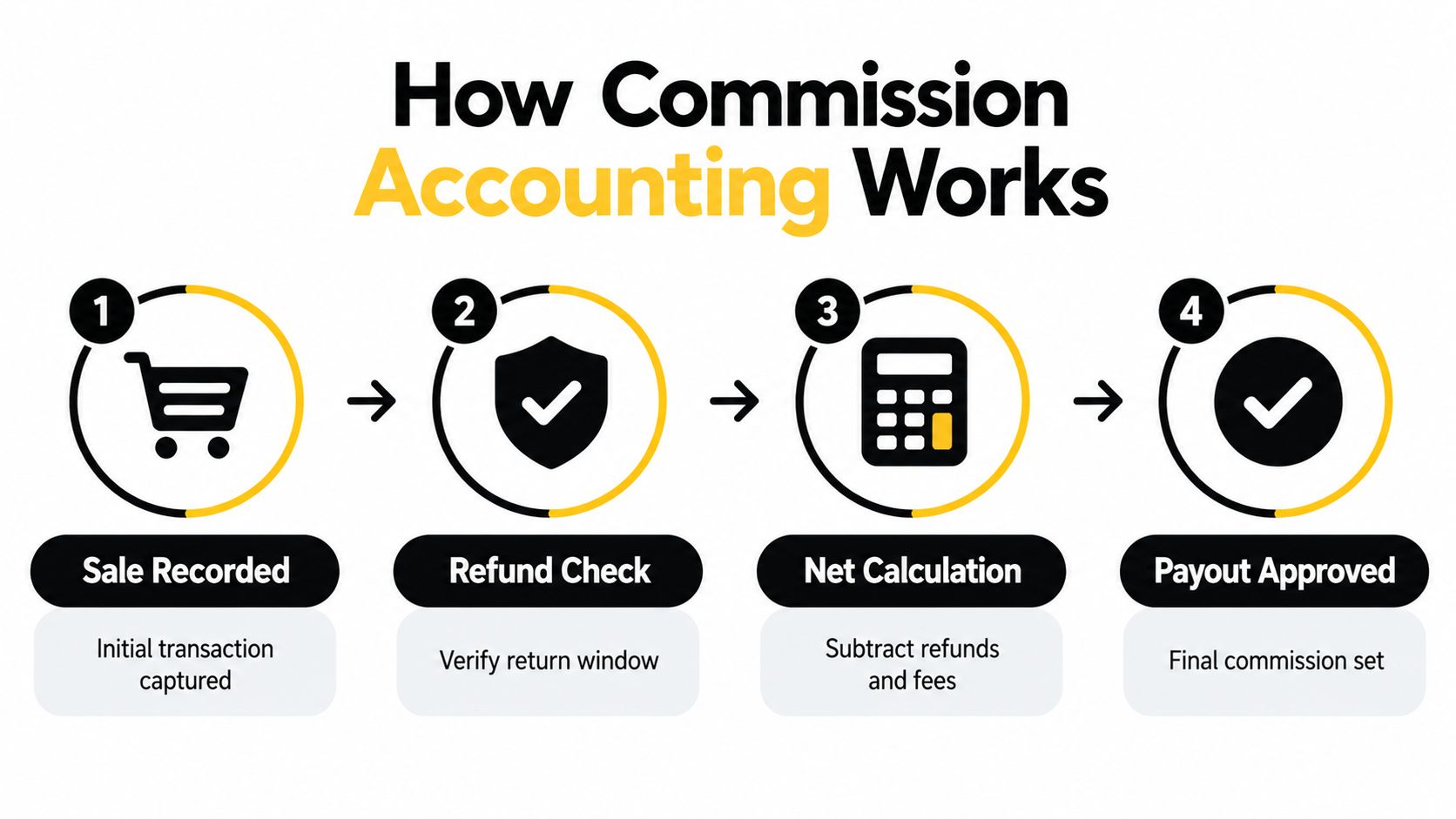
The four accounting events
Sale recorded. The order enters the reporting system. Its initial value is a sales signal, not finalized profit.
Refund check. Delivery and the applicable after-sales period determine whether the order remains eligible. A return changes both recognized revenue and commission expense.
Net calculation. TikTok applies the commission rate to the qualifying paid amount after relevant refund adjustments. The seller still absorbs product costs, fees, fulfillment, and other expenses.
Payout approved. The finalized commission becomes the expense used in settled profitability reporting.
The commission calculation follows revenue minus refunds, multiplied by the applicable rate. An internal model should therefore separate booked order value, delivered value, and settled contribution. That separation allows operators to compare product-level margin after refunds and commission, rather than judging affiliate performance from GMV alone.
Standard commission and Shop Ads commission create separate cost lines. Sellers can set one rate for organic affiliate sales and another for affiliate orders supported by paid distribution. Rates can range from 1% to 80%, so offer configuration can materially change unit economics, as described in TikTok's guidance on different affiliate commission rates.
A margin analysis of how affiliate commissions affect real margins provides a practical modeling reference. Forecast commission against delivered GMV and expected refunds, then reconcile that estimate with the final platform settlement. This process identifies whether each SKU generates contribution after creator cost, rather than adding sales volume.
Comparing Commission Structures and Collaboration Types
The commission rate is a product-level pricing decision, not merely a creator incentive. Sellers can set rates by product, product group, or catalog, and can separate organic affiliate commission from Shop Ads commission. Available rates range from 1% to 80%, according to TikTok's commission structure documentation.
| Commission Type | Rate Configuration | Best Use Case | Margin Impact |
|---|---|---|---|
| Standard organic commission | Seller-defined | Organic creator content and open distribution | Deduct the rate from refund-adjusted sales contribution before judging SKU profitability |
| Target collaboration commission | Seller-defined | Selective partnerships with chosen creators | Concentrates commission on creators whose delivered profit justifies the offer |
| Shop Ads commission | Seller-defined, separate from organic rate | Affiliate orders supported by paid distribution | Adds a variable acquisition cost that must be evaluated with media spend and post-refund contribution |
| Product or catalog-level commission | Set by SKU or product group | Different economics across products | Set 5% on low-margin SKUs and 15% on hero SKUs to protect blended contribution |
Match the structure to the product
Open collaboration gives more creators access to the offer and can help a seller test demand across audience segments. The cost is reduced control. A single rate may attract promotion for products that cannot support the commission after product cost, fulfillment, platform fees, and refunds.
Target collaboration is better suited to products that require explanation, careful positioning, or a creator with a specific audience fit. It also creates a narrower measurement set. Evaluate each partnership using delivered orders, refund-adjusted commission, and SKU contribution, rather than views or provisional GMV.
Shop Ads commission needs its own profitability view. When paid distribution contributes to an affiliate order, commission and media spend are both acquisition costs. Organic sales may produce acceptable contribution while the same product becomes unprofitable through the paid order path.
The platform's guidance on affiliate commission rates indicates that open-collaboration commission can be locked for at least 30 days. Its recommendations describe starting new shops around 10%, then reducing toward 5% or 1% as GMV grows. These figures make the rate a controlled test variable. Before changing it, calculate the incremental delivered contribution required to offset the commission increase.
A tiered structure can connect incentives to measurable outcomes. The framework for structuring affiliate commission tiers offers a useful operating reference for defining product or performance-based levels. The decision should start with contribution margin by SKU, then determine which creator access and paid distribution the margin can support.
Operational Thresholds and Product Eligibility
Affiliate economics only matter when the shop and product remain eligible. A brand can design an attractive commission offer, generate creator interest, and still lose the channel if customer experience or product feedback falls outside TikTok's requirements.
TikTok's Affiliate Marketing Policy requires a Shop Performance Score of 3.5 or above. Products also need a Voice of Customer Index below 1.5 to qualify for the affiliate program, according to TikTok's affiliate eligibility policy.
Seller health is part of marketing performance
These thresholds connect marketing output to operational execution. A product with poor feedback isn't only a customer-service concern. It may become unavailable for affiliate promotion, cutting off creator-driven distribution at the product level.
Fulfillment adds another hard constraint. TikTok requires sellers to maintain a Valid Tracking Rate of at least 95%, and an order counts as delivered on time only when the logistics provider marks it delivered on or before the delivery-by SLA. Sellers can use seller shipping, TikTok Shipping, or Fulfilled by TikTok, as outlined in TikTok Shop fulfillment rules.
Operational insight: Every missed fulfillment standard can become a lost marketing opportunity when creators stop receiving reliable products or customers generate refunds.
The financial team should therefore connect four operating views:
- Product quality: Track customer feedback and return patterns before increasing affiliate exposure.
- Inventory readiness: Avoid scaling creator demand for products that can't be replenished consistently.
- Tracking compliance: Review shipping data as a prerequisite for trustworthy revenue attribution.
- Seller health: Monitor shop-level performance because eligibility can constrain product-level growth.
This is why TikTok Shop seller requirements should be reviewed by marketing, operations, and finance together. The affiliate program isn't an isolated acquisition channel. It depends on the seller's ability to deliver the customer experience promised in the creator's content.
Metrics That Actually Measure Affiliate ROI
TikTok's reporting dashboard is useful, but platform metrics don't automatically equal profitability. A seller needs to understand what each measure includes, what it excludes, and when the number becomes reliable enough for a decision.
TikTok documentation states that revenue and affiliate GMV exclude refunded orders, while estimated commission can include paid, unpaid, and refunded orders. That distinction appears in TikTok's seller metric definitions. A dashboard can therefore show a commission estimate that doesn't align with the settled commission liability.
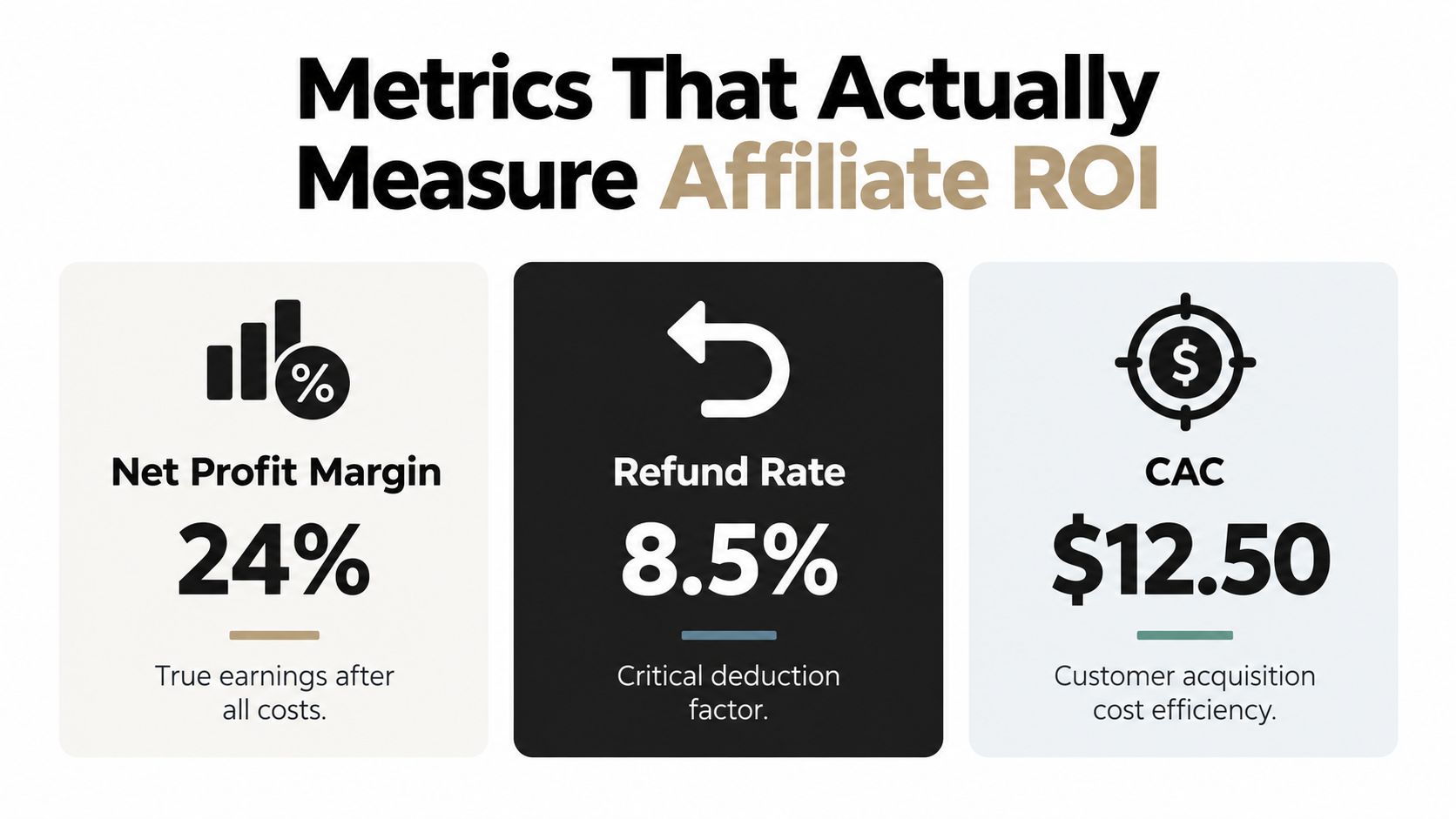
Build a profit bridge
A practical measurement framework should reconcile platform activity with internal cost data:
- Start with delivered affiliate revenue, rather than order value at checkout.
- Subtract COGS at the SKU level.
- Deduct finalized affiliate commission.
- Include fulfillment and marketplace costs.
- Allocate paid distribution costs to the relevant order path.
- Track refunds separately so return-heavy products don't hide behind gross sales.
- Calculate contribution by product, creator, content type, and campaign structure.
The most useful output is not a single channel-wide ROI figure. It's a ranking of products and creators by settled contribution. That ranking reveals whether a creator generates profitable customers or merely moves discounted inventory at an uneconomic acquisition cost.
Use metrics for decisions, not decoration
Affiliate GMV helps identify demand and distribution. Refund revenue shows how much reported activity fails to remain revenue. Estimated commission helps forecast exposure, but finance should reconcile it to the final payout before closing the period.
A product-level view is especially important because commission rates, COGS, refunds, and fulfillment costs can differ across a catalog. A channel average can make a weak SKU look acceptable because a stronger SKU compensates for it.
Decision standard: Increase exposure when settled contribution improves, not merely when affiliate GMV rises.
Track the same product across time and compare creators using delivered revenue, refund-adjusted contribution, and content-driven customer value. If the data cannot answer which SKU and creator combination produced the strongest net result, the reporting system is still optimized for activity rather than profit.
Streamlining Profit Measurement with HiveHQ
Manual reconciliation becomes difficult as orders, creators, products, refunds, and paid activity accumulate. A seller can export platform reports and build spreadsheets, but the process often separates the very inputs that determine net profitability.
A self-serve profit analytics layer brings those inputs into one operating view. The HiveHQ Profit Dashboard surfaces shop-level and product-level performance, including GMV, COGS, ad spend, commissions, and customer analytics, so sellers can examine the economics behind affiliate revenue rather than relying on top-line platform totals.
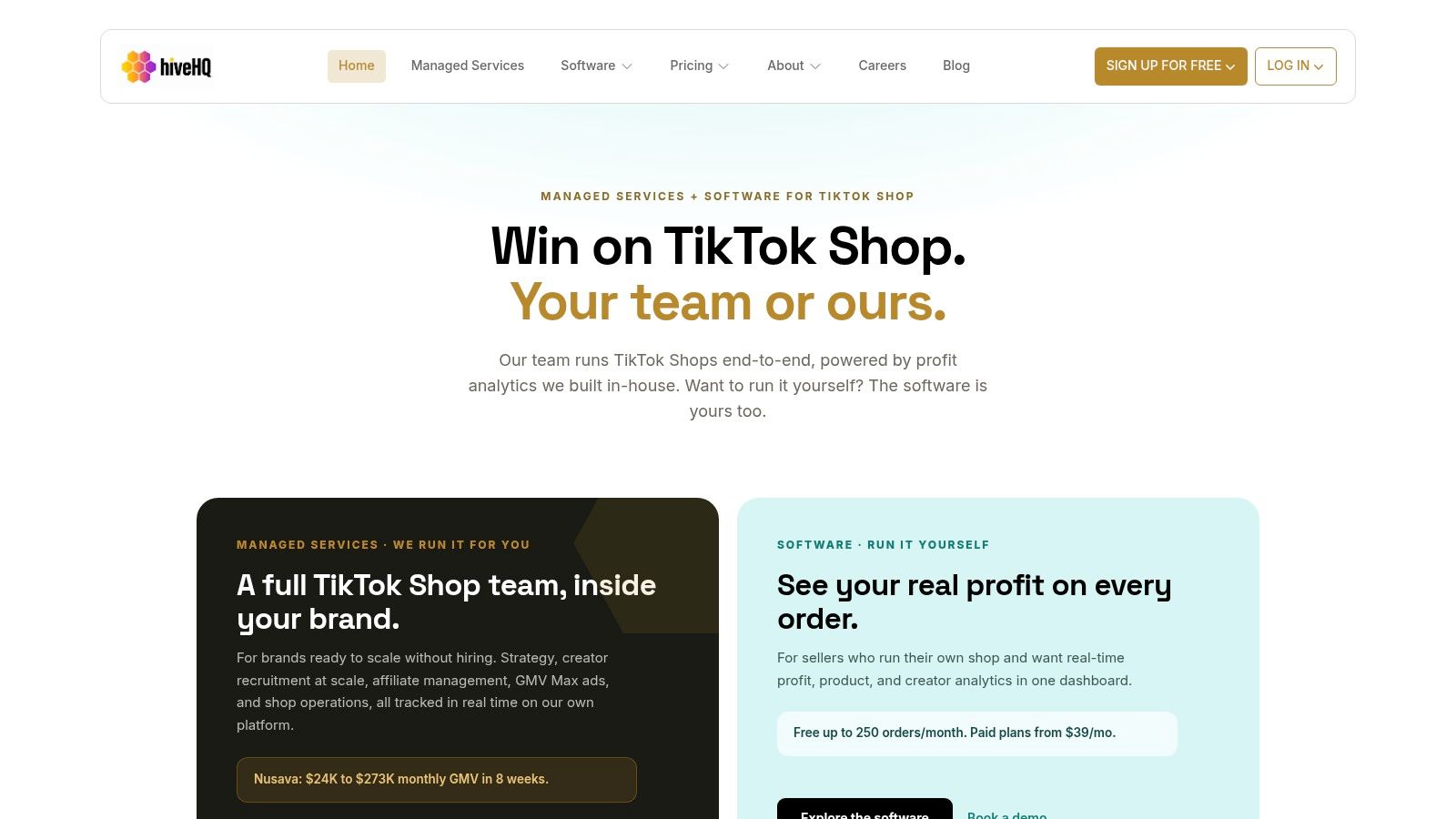
Put the product at the center
A shop-level profit number can hide SKU-level problems. One product may absorb high commission and refund costs, while another produces healthy contribution under the same affiliate program. Product-level analysis lets the operator adjust rates, inventory priorities, promotions, and creator focus with greater precision.
Customer analytics adds another useful lens. The seller can evaluate whether affiliate orders produce customers who return, which products attract first purchases, and where acquisition costs are hardest to justify. That turns the dashboard from a reporting endpoint into a decision system.
The TikTok Shop profit tracking software overview explains how dedicated reporting can reduce the gap between platform activity and finance-grade measurement. Sellers still need accurate product costs and disciplined operating definitions, but they don't have to reconstruct every relationship manually.
The correct workflow is self-serve and repeatable:
- Review settled revenue and refunds.
- Compare commission against product margin.
- Identify profitable and unprofitable SKUs.
- Segment customer performance.
- Adjust offers and spending based on contribution.
- Recheck the result after settlement data updates.
That process helps operators avoid the most common mistake in affiliate commerce, scaling sales before confirming that the underlying unit economics can support the scale.
Frequently Asked Questions and Next Steps
Who can participate in the TikTok Shop affiliate program?
In the U.S., affiliate creators need 1,000 followers to participate, while some marketplace features require 5,000 followers. Eligibility can differ by market and account path, so sellers shouldn't assume that one threshold applies everywhere. TikTok also notes that open-collaboration commission can be locked for at least 30 days, as described in its creator eligibility guidance.
Do canceled orders generate affiliate commission?
No. Canceled orders and fully refunded orders don't generate commission. Partial refunds reduce the commissionable amount, so the seller should model payout liability against delivered, refund-adjusted revenue.
Should sellers judge creators by GMV alone?
No. Compare creators by settled contribution after commission, refunds, COGS, fulfillment, and any related paid costs. GMV is useful for finding activity, but profit determines whether the relationship deserves more investment.
What should a seller review first?
Start with product-level net profit, refund exposure, commission liability, and fulfillment performance. Those figures show whether the seller can scale the affiliate channel without sacrificing margin.
Use the HiveHQ Profit Dashboard to connect TikTok Shop GMV, COGS, ad spend, commissions, product performance, and customer analytics in a self-serve workflow. Visit HiveHQ to try the dashboard, then talk to the HiveHQ team about building a more reliable profit measurement process for your affiliate channel.