What Is a UGC Video and Why It’s Your Brand’s Secret Weapon
what is a ugc videouser generated contentugc marketingcreator contenttiktok shop strategy
So, what exactly is a UGC video? Put simply, it’s any video—a review, a how-to guide, a quick TikTok post—created by an actual customer or fan, not by the brand itself. It's the modern-day version of a friend giving you an enthusiastic, unfiltered recommendation for something they genuinely love.
Understanding the Power of Authentic Video Content
Think about the last slick, high-budget commercial you saw. It probably looked great, but did you really believe it? Now, picture a raw, shaky-cam TikTok of someone unboxing a new gadget they just bought. That second video just feels more real, doesn't it? That raw authenticity is the secret sauce of UGC video.
User-Generated Content taps into a powerful psychological driver: social proof. When potential customers see people who look and sound just like them using and loving a product, it builds an incredible amount of trust. It’s a stamp of approval that traditional, top-down advertising just can't buy.
UGC Video vs Brand-Produced Video at a Glance
To really get a feel for the difference, let’s put them side-by-side. Both have their place in a marketing strategy, but they connect with audiences in fundamentally different ways.
| Attribute | UGC Video | Brand-Produced Video |
|---|---|---|
| Creator | Real customers, fans, or creators | In-house marketing teams or ad agencies |
| Tone | Authentic, relatable, and often unscripted | Polished, professional, and carefully scripted |
| Goal | To share a genuine experience or opinion | To promote a specific brand message or product |
| Trust Factor | High; seen as an unbiased recommendation | Lower; viewed as a direct sales pitch |
| Cost | Typically low-cost or performance-based | Often high-cost with significant production |
This table shows why UGC has become such a force in modern marketing. The numbers back it up, too. It’s not just a hunch; consumers are actively seeking out this kind of content.
The data shows that an incredible 68% of consumers trust videos from other users far more than they trust content coming directly from a brand. That trust has a real impact, leading to a 55% average increase in engagement when compared to brand-created videos. It’s a massive shift in how people connect with products.
The magic of UGC is that it isn’t selling a product; it’s sharing an experience. This distinction is precisely why it resonates so deeply with modern consumers who are tired of being sold to and crave genuine connection instead.
In the end, a UGC video bridges the gap between your brand and your audience, turning everyday customers into your most powerful advocates. To explore this topic further, you can check out our broader guide on what is UGC content and see how it can work for you. This unfiltered format isn't just a fleeting trend—it's a mirror of how people discover, trust, and buy things today.
The Key UGC Video Formats Driving Sales Today
So, you get what a UGC video is. That's the first step. But the real magic happens when you know which specific formats actually turn casual viewers into paying customers.
Not all user-generated content is built the same, especially on a platform as chaotic and fast-moving as TikTok Shop. Here, attention is everything. The trick is to use video styles that feel completely at home on the platform, showing off your product’s value without screaming "I'm an ad!"
These proven formats work because they look and feel just like the videos people are already watching and making. They build instant trust by placing your product in a real-world setting, which helps a potential buyer see it in their own life.
Let's break down the styles that are actually making an impact.
Authentic Unboxings and First Impressions
The unboxing video is a classic for a good reason. It taps directly into that feeling of excitement and curiosity we all get with a new package, giving viewers a genuine first look at a product through a real customer's eyes. This format is an absolute powerhouse for physical products because it shows everything from the quality of your packaging to that initial "wow" moment.
A truly great unboxing video is all about the creator's honest, in-the-moment reactions. It’s not supposed to be a slick, polished presentation. It’s about the raw, unfiltered experience of opening something for the first time. That authenticity is exactly why it’s a cornerstone of any smart UGC strategy.
An authentic unboxing video does more than just show a product; it shares the feeling of receiving and experiencing that product for the first time, creating a powerful emotional connection with the audience.
Relatable How-To Demos and GRWMs
Another format that consistently delivers is the "how-to" or product demo. These short clips show your product in action, answering the viewer’s most important question: "How is this actually going to work for me?" This could be a quick tutorial on applying a skincare serum, putting together a new gadget, or styling a piece of clothing.
A massively popular twist on this is the "Get Ready With Me" (GRWM) video. Here, creators weave products into their everyday routines—skincare, makeup, picking an outfit. This format feels incredibly organic because the product isn’t the main character; it’s just a natural part of the creator’s life. By fitting so seamlessly into a relatable routine, the product instantly feels more practical and desirable.
To really get the most out of these, brief your creators on a few key angles:
- Problem-Solution: The video starts by calling out a common frustration, then shows exactly how your product solves it. This is a super persuasive way to demonstrate a product's real-world value.
- Before-and-After: This is all about the visual proof. It’s a powerful, undeniable way to show results, whether you’re selling a cleaning product, a cosmetic, or a fitness tool.
- Product Hauls: The creator shows off a collection of items they’ve recently bought. Getting your product featured in a haul gives it a huge dose of social proof, placing it alongside other things the creator genuinely loves.
By guiding creators with these specific formats, you can help them produce content that not only feels authentic but is also structured to convert.
So, What's the Real Business Payoff of UGC Videos?
Putting a real UGC video strategy in place isn't just another box to check on your marketing to-do list; it's a proven way to drive actual business growth. Its power lies in an uncanny ability to build trust and social proof on a massive scale. It influences shoppers in a way that slick, polished brand ads just can't touch anymore.
Think about it: when potential buyers see real people—not paid actors—genuinely using and enjoying a product, that wall of skepticism immediately comes down. This kind of raw authenticity builds instant credibility and has a direct, measurable impact on conversion rates, both on your product pages and in your ad campaigns.
UGC essentially becomes a self-powering content engine, churning out a steady stream of persuasive testimonials that do the selling for you. It's less of a marketing expense and more of a high-return investment in your brand's long-term health.
Getting More Eyeballs and Organic Buzz
Social platforms like TikTok are practically wired to reward authenticity. Their algorithms are designed to favor content that feels real and gets people talking. This gives UGC videos a massive head start in the race for organic reach, leaving traditional, over-produced brand content in the dust.
The difference in performance is staggering. User-generated videos on YouTube pull in 10 times more views than content produced by brands on the very same platform. That’s a 1,000% jump in viewership.
And it’s not just YouTube. On TikTok, the average organic engagement rate hits 2.63% per post—a number brands dream of. Meanwhile, Instagram posts that feature UGC see 70% more engagement than brand-only content. Other studies have found that UGC posts get 6.9 times higher engagement than what brands produce themselves. The numbers don't lie.
By giving the algorithms—and your audience—exactly what they want, UGC lets your content break through the noise without you having to pour a fortune into ad spend.
UGC isn't just content; it's a conversation starter. Each video shared by a customer becomes a new entry point for your brand, creating ripples of engagement that extend far beyond your own follower count.
Building a Rich Content Library Without Breaking the Bank
Beyond all the engagement metrics, one of the most practical benefits of UGC is just how budget-friendly it is. Filming a single, high-quality brand video can easily run into thousands of dollars for scripts, actors, locations, and editing. A UGC program, on the other hand, can fill your content library with dozens of diverse videos for a tiny fraction of that cost.
This constant stream of fresh, authentic content gives you a few major advantages:
- Endless Creative Angles: You get a ton of different perspectives, styles, and real-world use cases for your product, which keeps your marketing from ever feeling stale.
- Quick and Easy A/B Testing: With so many creative assets at your disposal, you can rapidly test different hooks, calls-to-action, and video formats to find out exactly what makes your audience click.
- High-Converting Ad Creative: UGC videos are gold for paid social ads. They look native to the feed, blend in with other organic content, and are fantastic at stopping the scroll.
Weaving UGC into a smart social media marketing plan is the key to unlocking its full potential. It helps you build a powerful, scalable content pipeline that fuels both your organic channels and paid campaigns, turning genuine customer stories into a predictable source of revenue.
How to Brief Creators for Authentic UGC Videos
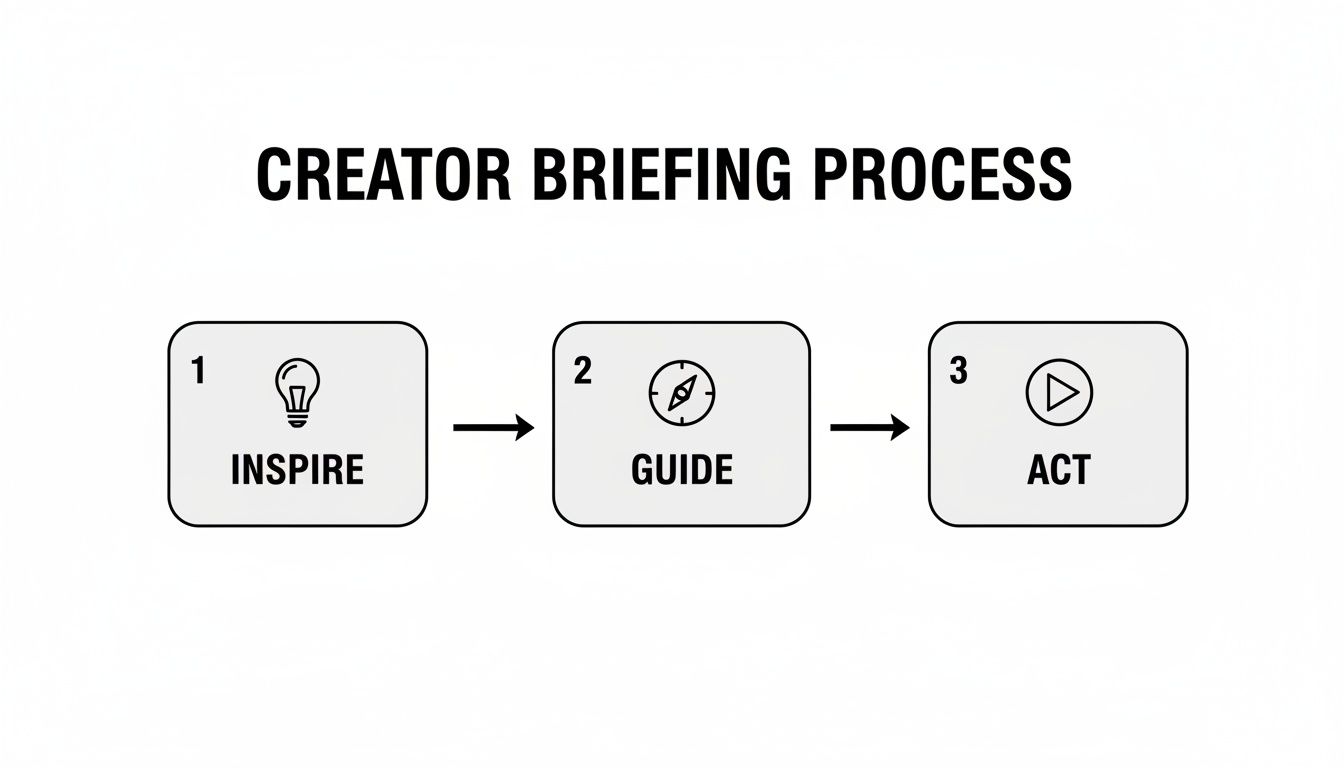
The real magic behind a great UGC video isn't a strict, word-for-word script. It's all in the brief. Think of a good brief as a compass, not a cage—it points creators in the right direction but gives them the freedom to explore the terrain.
You’re not just hiring someone to read lines from a teleprompter. You're bringing on a creative partner who knows how to tell a story that connects. The goal is to get them excited about your product and then trust them to translate that excitement into content their audience will actually want to watch. If you try to control every little detail, you’ll strangle the very authenticity that makes UGC work so well.
When you give creators the space to be themselves, the final video feels less like a polished ad and more like a genuine recommendation from a friend. That balance is the secret sauce for winning on a platform like TikTok.
Building a Brief That Inspires Action
A truly effective brief is clear, concise, and feels like a collaboration. It should give the creator all the essential info they need to knock it out of the park, without micromanaging every second of the video. Looking at examples of viral video scripts for UGC creators can be a great way to get their creative juices flowing.
Here’s what you absolutely need to include:
- The Big Idea: In just one or two sentences, what’s the point of this video? Are you trying to highlight a specific feature, solve a nagging problem for your customer, or just show the product in a real-world context?
- Key Message Pillars: Give them 2-3 must-have talking points. These are the non-negotiables—the core benefits or unique features that absolutely have to be mentioned.
- A Clear Call-to-Action (CTA): What, exactly, should the viewer do next? Whether it’s “Tap the orange cart to buy” or “Check out the new flavor,” keep it simple and direct.
The best UGC briefs focus on the what and the why, but they leave the how to the creator's expertise. This is how you get content that's both true to your brand and genuinely authentic.
Below is a quick, actionable template you can adapt. It’s designed to provide structure without stifling creativity, making it perfect for your next TikTok Shop collaboration.
| Brief Section | Example Content / Prompt |
|---|---|
| The Big Idea | "Show how our EverGlow Vitamin C Serum solves the problem of dull morning skin, making you look awake and refreshed in under 60 seconds." |
| Target Audience | "You're talking to busy women (25-40) who want a fast and effective skincare routine. Keep it relatable and conversational, like you're sharing a secret with a friend." |
| Key Message Pillars | "1. Mention it's packed with Vitamin C for instant brightness. 2. Show the lightweight, non-greasy texture on your skin. 3. Emphasize that it creates a perfect, smooth base for makeup." |
| Call-to-Action (CTA) | "End the video by pointing to the TikTok Shop link and saying something like, 'Grab yours right here by tapping the orange cart!'" |
| Visual Inspiration | "Film in bright, natural light (e.g., near a window in the morning). We love a good before-and-after shot showing your skin before and after application." |
| The "Don'ts" | "Please don't make any medical claims (e.g., 'cures acne'). Avoid using heavy beauty filters that change how the product looks on the skin." |
This simple framework ensures you cover all the important bases while still empowering your creators to do what they do best: create content that feels real and gets people to take action.
Setting Guardrails with Do's and Don'ts
Finally, a simple "Do's and Don'ts" list is an absolute lifesaver. This is your chance to outline brand safety, compliance rules, and visual preferences without having to write out an entire script. For a more comprehensive look at building these out, our full influencer briefing template is a fantastic resource.
Example "Do's":
- Do show the product in natural, bright lighting.
- Do explain how it personally solved a problem for you.
- Do speak directly to the camera like you’re on a FaceTime call.
Example "Don'ts":
- Don't make any unverified medical or health claims.
- Don't show competitor products or logos in the shot.
- Don't use any filters that change the color or texture of the product.
6. How to Build a Scalable UGC Video Machine
Running a couple of creator partnerships by hand? Easy enough. But if you want to turn UGC into a real engine for predictable growth, things get messy—fast. Juggling dozens of creators through chaotic spreadsheets, endless email threads, and clunky payment systems is a one-way ticket to a logistical nightmare.
This isn't just about being inefficient. The manual approach actively stunts your growth. To truly scale your UGC program from a time-sucking chore into a repeatable, profitable machine, you need smart automation and centralized systems. This is the secret sauce top brands use to manage hundreds of creators without everything falling apart.
The real shift happens when you stop thinking about one-off collaborations and start building an operational workflow. It's all about automating the repetitive stuff, centralizing your data, and getting a clear, real-time view of what’s actually moving the needle.
Automating Creator Sourcing and Outreach
The first major bottleneck is always finding and recruiting the right people. Manually scrolling through TikTok, sending individual DMs, and trying to keep track of follow-ups is an incredible time-drain. This is where automation completely changes the game.
Instead of burning hours on manual outreach, an affiliate bot can do the heavy lifting for you. For instance, a tool like HiveHQ's Affiliate Bot lets you set specific filters to sift through a massive pool of active affiliates and find the perfect match. From there, you can automate outreach and follow-ups on a scale that's simply impossible for a human team.
Imagine setting up automated workflows that can:
- Discover Creators: Pinpoint affiliates based on their niche, follower count, or even past performance.
- Send Initial Outreach: Fire off customized messages to thousands of potential partners at once.
- Trigger Follow-ups: Automatically send briefs the moment a product sample is delivered and nudge creators when content is due.
This frees your team from administrative quicksand, allowing them to focus on what matters: building genuine relationships and sharpening your overall strategy.
Centralizing Performance and Profit Tracking
The second pillar of a scalable system is putting all your data in one place. When your metrics are scattered across spreadsheets, the TikTok Shop dashboard, and various payment platforms, you're flying blind. You have no real way to measure the true ROI of your UGC videos or see which creators are actually driving sales.
A unified dashboard is non-negotiable for making smart, data-driven decisions. This visual from the HiveHQ Creator Tracker shows how a profit-focused dashboard brings all your critical numbers together, giving you a crystal-clear picture of your business's health.
This centralized view lets you instantly track Gross Merchandise Value (GMV), ad spend, commissions, and other costs on both a per-creator and per-product basis.
With this kind of clarity, you can immediately spot your top performers and double down on what's working. It transforms your UGC strategy from a guessing game into a predictable growth channel. By combining automated outreach with a single source of truth for your data, you create a powerful, scalable engine that turns authentic creator content into sustainable profit.
Measuring the True Impact of Your UGC Videos

Likes and views feel good, but they don't pay the bills. The real test for any UGC video strategy is whether it’s actually moving the needle on your bottom line. To get past these surface-level numbers, you have to connect content directly to sales and profitability.
This means you need to get obsessed with the numbers that truly matter for e-commerce growth. Instead of just celebrating a viral video, the sharpest brands are tracking metrics like the Gross Merchandise Value (GMV) each creator brings in, the conversion rate from video view to sale, and the actual Return on Investment (ROI) once all costs are factored in.
Having clear shop- and product-level data is the difference between guessing and knowing. It’s what allows you to see exactly which creators and content styles are your superstars so you can double down on what’s working.
Defining Your Core Financial KPIs
To get a crystal-clear picture of your UGC performance, you need to track a few specific, non-negotiable metrics. Think of these KPIs as the direct link between a creator's video and your company's bank account.
- GMV per Creator: This is the total dollar amount of sales a single creator's content has generated. It’s the cleanest way to see their direct revenue contribution.
- Video View Conversion Rate: This tells you exactly what percentage of people who watched a video went on to actually buy the product. It's a powerful measure of how persuasive the content is.
- True Return on Investment (ROI): This goes way beyond basic ad spend. It’s your net profit after you subtract all the costs—product samples, creator commissions, shipping, everything. For a complete breakdown, check out our guide on calculating the ROI on influencer marketing.
The most powerful UGC programs are run like a financial portfolio. By tracking profit-driven KPIs for each creator, brands can reallocate their resources to the partnerships delivering the highest returns.
This data-first approach is backed by some pretty compelling consumer behavior stats. A staggering 79% of shoppers say that UGC videos significantly influence their decision to buy. On top of that, ads featuring UGC can see 4 times higher click-through rates compared to standard brand ads.
Answering Your Top Questions About UGC Video
Getting started with User-Generated Content can bring up a lot of questions. Let's tackle some of the most common ones that brands ask as they start building their creator programs.
What’s the Real Difference Between a UGC Creator and an Influencer?
It really boils down to purpose. Think of a UGC creator as a freelance creative whose specialty is making videos that feel authentic and native to platforms like TikTok. You're hiring them for their content creation skills, not their follower count. The video they make is for your brand to use on your own channels, like in your paid ads or on your TikTok Shop page.
An influencer, on the other hand, is more like a distribution partner. The main reason you work with them is to tap into the audience they’ve already built. While they also create content, the primary goal is for them to post it on their profile to reach their followers. The content might look like UGC, but the strategy is all about audience access.
How Do Brands Usually Pay UGC Creators?
Creator compensation isn't one-size-fits-all, but a few popular models have emerged. For brands just starting out, product seeding is a common entry point—you send the creator your product for free, and they create a video in return.
As you scale, you'll likely move to flat-fee payments for each video. This is pretty standard for experienced creators. A model that’s gaining a ton of traction, especially with TikTok Shop, is performance-based commission. You give the creator a unique affiliate link, and they earn a percentage of every sale they drive. This perfectly aligns their goals with yours.
The best payment structures are the ones that connect the creator's effort directly to your business goals. Whether it's a fixed rate for a killer ad creative or a commission that rewards them for driving real sales, clear and fair compensation is the foundation of a great partnership.
Do I Really Need to Worry About Usage Rights for a UGC Video?
Yes, 100%. This is one area you can't afford to overlook. If you plan to use a creator's video anywhere on your own brand channels—especially in paid ads—you absolutely must have the rights to do so.
A straightforward agreement is all you need. It should clearly outline where you're allowed to use the content (e.g., TikTok ads, organic social, your website) and for how long. This simple step protects both you and the creator and prevents any headaches down the road.
Ready to stop guessing and start scaling your UGC program with data? HiveHQ provides the automation and analytics you need to find top creators, track real-time profit, and build a predictable growth engine on TikTok Shop. See how it works at hivehq.ai.