Ecommerce Automation Tools for TikTok Shop Operators
ecommerce automation toolstiktok shop automationprofit dashboardcreator automationshopify integrations
Ecommerce automation tools turn repetitive store tasks into rules-based workflows, but TikTok Shop operators should choose them by whether they protect profit, not just process more orders. If you're switching between inventory updates, creator messages, ad spend reviews, and refund requests while sales climb, the priority is connecting those decisions to the money you retain.
Table of Contents
- What Ecommerce Automation Tools Actually Do for Operators
- The Main Categories of Ecommerce Automation Tools
- Why GMV Growth Is Not the Same as Profit Growth
- KPIs That Measure Whether Automation Is Working
- Choosing Tools With a Decision Matrix
- An Implementation Roadmap for TikTok Shop Operators
- Specialized Use Cases for TikTok Shop Profit Tracking
- Frequently Asked Questions About Ecommerce Automation Tools
What Ecommerce Automation Tools Actually Do for Operators
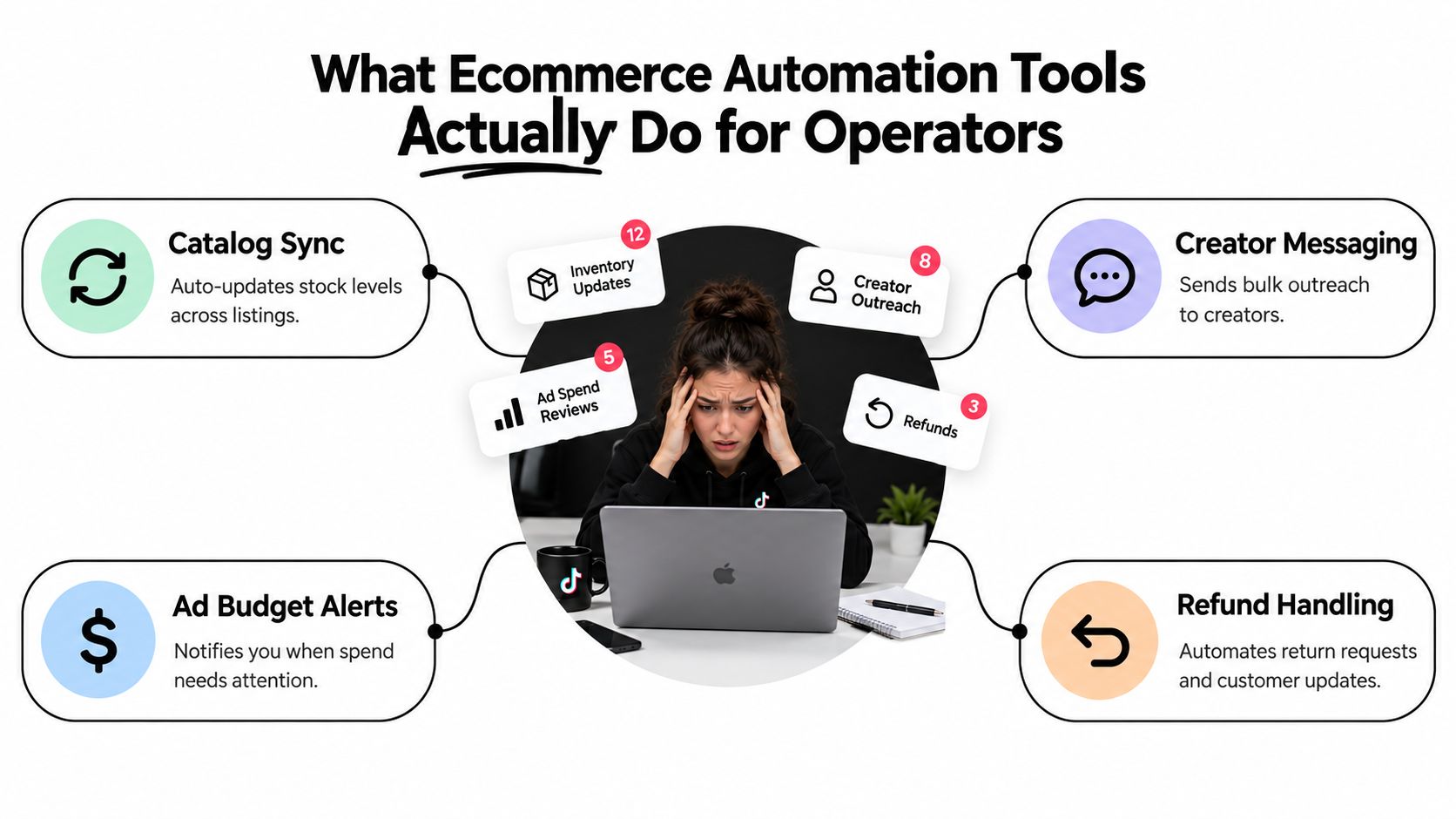
You've updated stock, approved a commission change, and checked yesterday's advertising results. Then a refund arrives, another listing needs attention, and nobody's reconciled the costs behind the latest sales push.
Ecommerce automation tools turn repeatable workflows into scheduled or event-triggered actions. An order arrives, the software checks your conditions, and an approved action follows, such as reserving inventory, routing fulfillment, or flagging an exception.
The workload isn't imaginary. A 2025 marketplace-seller report found that sellers spend 36% of their working week on repetitive tasks, 52% still rely on spreadsheets or internal tools, and 91% consider automation important or business-critical.
Recognize the conditions that justify automation
Automation becomes worth prioritizing when the same operational pressure keeps recurring:
- Growth: Orders and catalog changes exceed what the team can reliably review manually.
- Multichannel complexity: Different systems disagree about available stock, order status, or approved prices.
- Profit erosion: Sales rise, but the team can't explain which products, costs, or acquisition sources changed retained earnings.
Start by mapping what you already manage in TikTok Shop Seller Center. Identify the authoritative record for each field before connecting more software. Otherwise, an integration can distribute conflicting information faster.
Separate execution from judgment
Labor replacement handles predictable work. Decision support tells an operator when a predictable rule no longer makes economic sense.
For example, inventory synchronization can update available quantities without intervention. Deciding whether to replenish a product with deteriorating post-refund margin requires a broader view.
Practical rule: Automate the repeatable action, define the exception, and name the person responsible when that exception occurs.
Every workflow needs a trigger, approved conditions, an action, and a failure path. A process that stops or keeps retrying a bad instruction isn't dependable automation. It's another task you'll eventually have to untangle.
The Main Categories of Ecommerce Automation Tools
Organize the stack by operator bottleneck, not by how many features appear on a sales page. Catalog accuracy, fulfillment execution, commercial decisions, partner economics, and financial visibility require different information and controls.
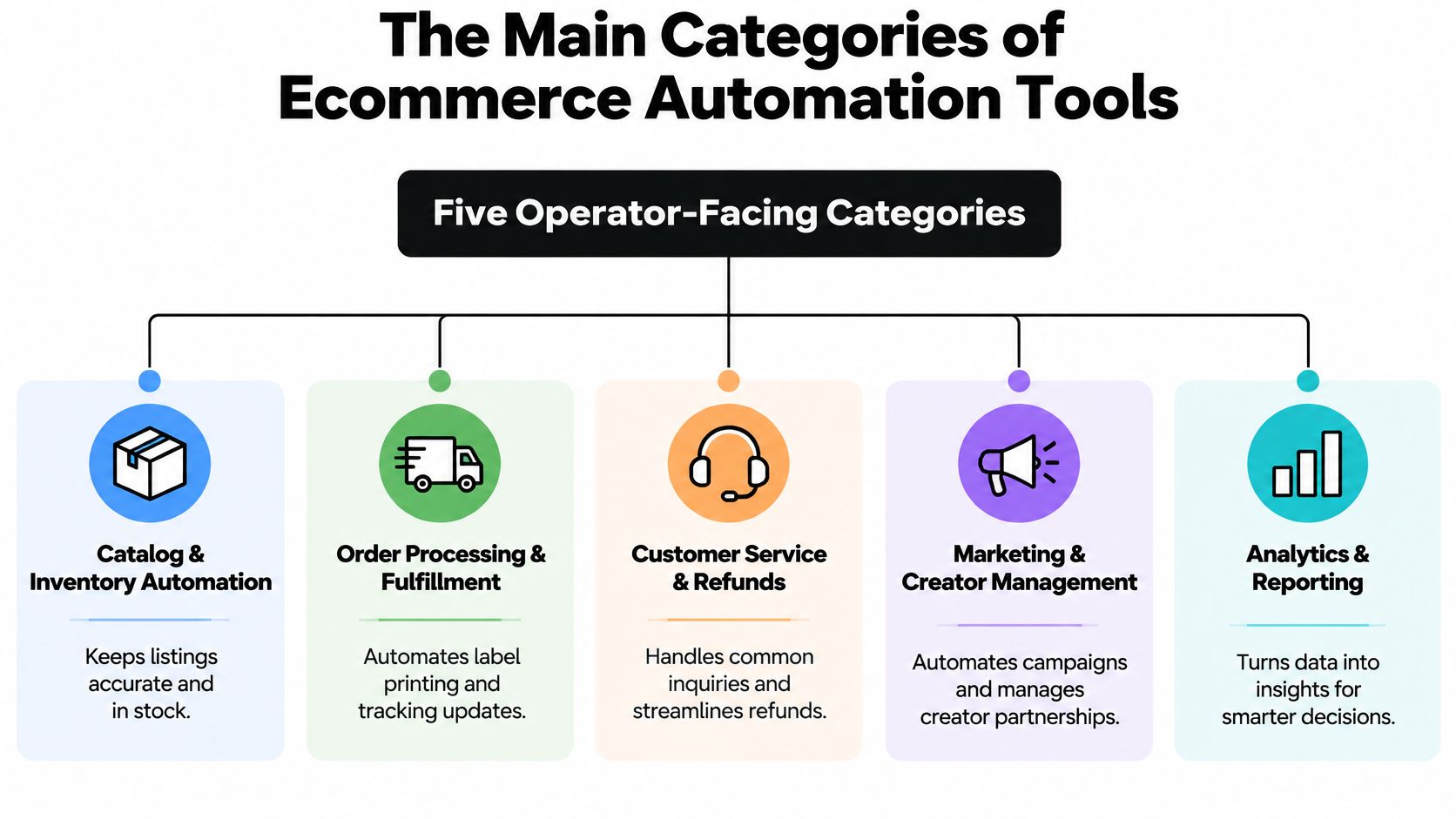
Map each category to a decision
| Category | TikTok Shop workflow example | Where to start | Profit safeguard |
|---|---|---|---|
| Catalog and inventory | Propagate available stock after an order | Native controls for shop-level needs; connected software for shared inventory | Safety stock and a single inventory authority |
| Orders and fulfillment | Route paid orders and surface shipping exceptions | Native order records plus fulfillment integration | Prevent duplicate dispatches and incorrect routing |
| Advertising and pricing | Flag spending or proposed price changes | Native advertising execution; connected reporting for cost context | Minimum margin and price approval gates |
| Creator and affiliate operations | Reconcile commission terms against product performance | Native agreements plus consolidated analysis | Store actual commissions rather than assumed rates |
| Profit analytics and reporting | Combine sales, costs, and post-purchase adjustments | Self-serve product-level analytics | Trace profit changes back to underlying transactions |
Customer service and refund routing belong across the order and financial layers. They shouldn't operate as an isolated inbox disconnected from product economics.
A reported 2025 multichannel benchmark found that automating inventory synchronization, order routing, and price updates saved 15 to 20 staff hours weekly, reduced overselling incidents by 78%, and eliminated an average of 23 manual data-entry errors per week for teams managing at least 500 SKUs across three or more channels. Treat those results as directional, not a forecast for your store.
Buy the missing layer
A broad workflow connector makes sense when information must pass between systems. Cyndra's resource on the best workflow automation tools for teams offers a starting point for exploring that category.
But moving data and interpreting profit are different jobs. A connector can deliver an ad-spend record without determining whether the associated product deserves more budget.
Self-serve software is useful when your operators need to inspect assumptions and change decisions directly. Delegating configuration may help with difficult integrations, but don't delegate ownership of cost definitions, approval rules, or the decision to scale.
Why GMV Growth Is Not the Same as Profit Growth
GMV measures merchandise sales, not what the business keeps. An automated workflow can increase orders while sending more unprofitable transactions into fulfillment.
For a broader terminology reference, Refport's guide to GMV for SaaS growth teams provides useful context. For store-level decision-making, the more relevant question is why GMV can become a vanity metric on TikTok Shop.
Build the cost waterfall before setting rules
TikTok Shop's Seller Terms state that creator commissions are deducted from buyer payments according to the commission agreement and that sellers also pay platform fees. Use the actual agreement and transaction deductions, not a universal commission assumption.
Your profitability model should capture:
- Retained sales: Buyer-paid sales adjusted for refunds and relevant discounts.
- Product costs: COGS and a consistent treatment of returned or unrecoverable inventory.
- Selling costs: Platform fees, creator commissions, and advertising.
- Delivery costs: Outbound fulfillment, return shipping, and handling.
- Business expenses: Overhead needed to move from contribution margin to net profit.
Contribution margin measures what remains after the variable costs included in your model. Net profit also accounts for the wider business expenses you've chosen to allocate. Label both clearly, and don't describe an incomplete cost view as final profit.
A practical break-even expression is:
Maximum affordable acquisition cost = expected retained sales − all other variable order costs
If creator commission is already included among those costs, don't subtract it again when evaluating paid acquisition. Equally, don't overlook it because the advertising dashboard doesn't include it.
Treat returns as an operating constraint
TikTok Shop's return policy requires responses to returnable-product requests within four business days, while unshipped-order requests can require a response within 24 hours; sellers are responsible for return-related costs in both buyer-fault and seller-fault cases.
A response deadline belongs in the workflow. The financial consequence belongs against the original order.
Route requests early, but don't confuse faster handling with lower return cost. Profit guardrails need to evaluate the retained outcome, not merely whether a ticket closed.
KPIs That Measure Whether Automation Is Working
Measure automation with a scorecard that connects execution to an operator's next action. A successful API call isn't evidence that an order shipped correctly or generated an acceptable margin.
One ecommerce order-processing benchmark reports handling times falling from approximately 11 minutes per order to 3 minutes with AI-assisted workflows, alongside reported error rates declining from roughly 9% to below 1%. Those are directional reference points, not universal service targets.
Automation Scorecard by Category
| Automation Category | Primary KPI | Target Benchmark | Decision Triggered |
|---|---|---|---|
| Order processing | Touchless-order rate and median order-to-ship time | Improve against your manual baseline without increasing errors | Revise validation or routing |
| Inventory synchronization | Oversell rate and inventory-sync latency | Stay within your approved stock-risk tolerance | Adjust safety stock or investigate delayed updates |
| Return handling | Request response time and exception rate | Meet the applicable policy deadline | Escalate requests before the deadline |
| Advertising and pricing | Ad cost as a percentage of revenue and contribution margin per SKU | Remain inside the product's margin guardrail | Hold spending increases or review pricing |
| Creator economics | Creator-driven GMV share and associated margin | Contribution remains acceptable after agreed commissions | Review the partnership's economics |
| Profit reporting | Refund-to-GMV ratio and return-related cost as a percentage of revenue | Investigate departures from the product baseline | Review product quality, content, or fulfillment |
Use the TikTok Shop KPIs that matter to keep the scorecard focused. For a store operating at meaningful scale, prioritize post-refund contribution margin per SKU, order-to-ship time, and exception rate before adding elaborate secondary reporting.
Give each review a purpose
- Daily: Check deadline-sensitive requests, fulfillment failures, and stale data.
- Weekly: Review product margins, acquisition costs, and changes in return behavior.
- Monthly: Reconcile reported profit with settlements and accounting records.
Broad ecommerce automation platforms are useful for evaluating whether a workflow executed. TikTok Shop profit analytics should help evaluate whether its commercial result justified continuing it.
Don't reward a rising touchless-order rate if staff spend more time correcting mistakes afterward. Track rework against the originating workflow so apparent efficiency doesn't hide downstream labor.
Choosing Tools With a Decision Matrix
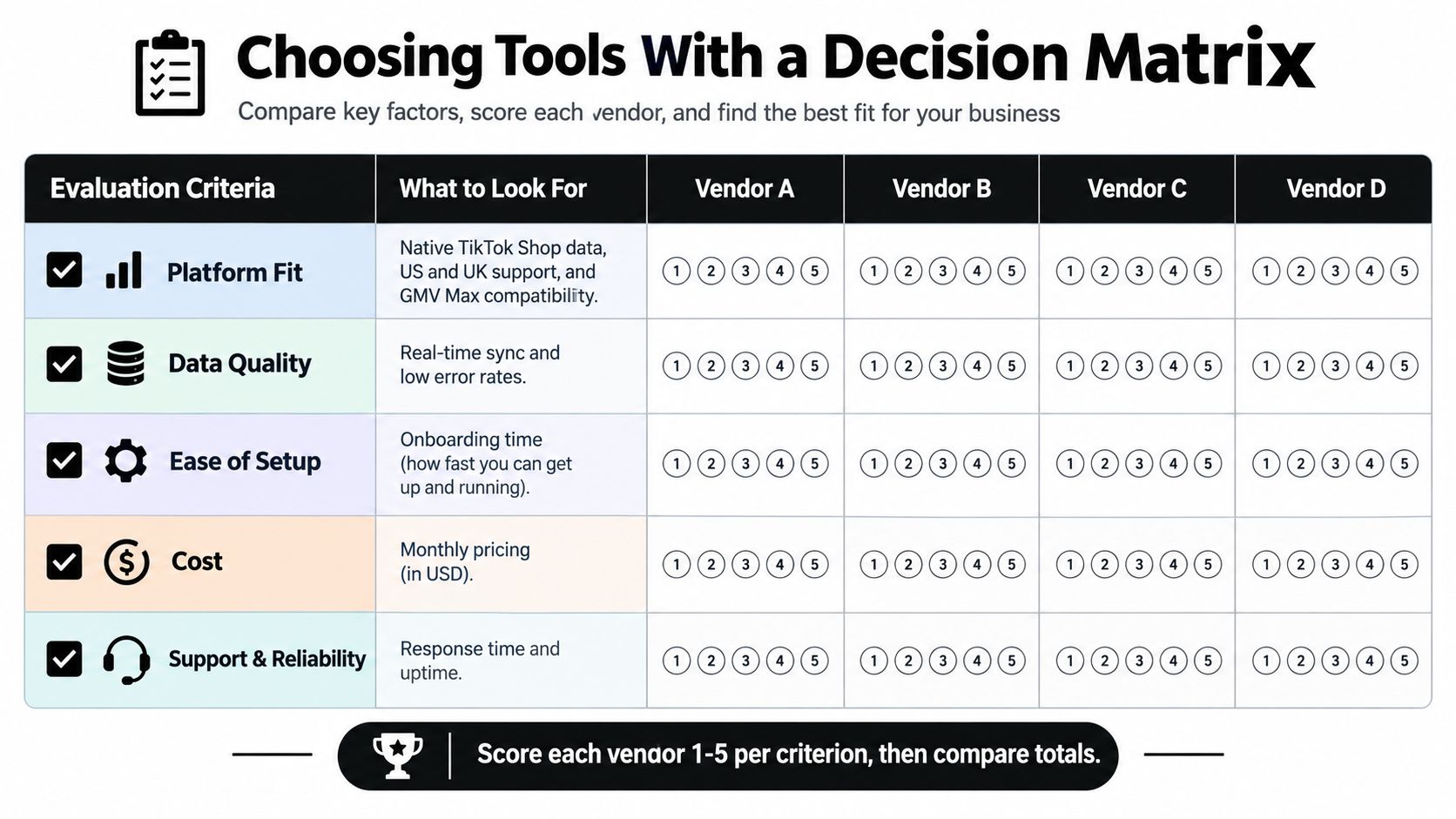
Choose tools against a documented failure you need to fix. “More automation” isn't a buying criterion; accurate inventory, explainable product profit, and controlled spending are.
The broader adoption trend doesn't remove the need for careful evaluation. Warehouse automation research includes a forecast that 26% of warehouses globally will be automated by 2027, while a separate 2025 study found 60% already integrate AI into everyday operations. These measure different capabilities and populations, so don't treat them as interchangeable adoption rates.
Compare breadth with depth
| Evaluation criterion | General ecommerce automation platform | TikTok Shop profit analytics |
|---|---|---|
| Main purpose | Coordinate actions between systems | Explain financial performance |
| Data test | Can it move and validate required fields? | Can it reconcile product sales with associated costs? |
| Operator control | Inspect conditions, retries, and approvals | Inspect cost assumptions, allocation, and reporting |
| Commercial fit | Review usage charges and maintenance burden | Review shop coverage, reporting depth, and exportability |
| Failure risk | Incorrect or duplicate actions | Incomplete costs or misleading profit conclusions |
As one specialized option, the HiveHQ Profit Dashboard is self-serve software for TikTok Shop sellers, providing real-time net profit, product-level performance, and customer analytics. Evaluate it against your actual reporting requirements rather than assuming a profit dashboard replaces inventory or fulfillment execution.
Apply gates before scoring features
Check native TikTok Shop data access, required US or UK coverage, and how GMV Max data enters the reporting process. Ask for demonstrations using refunds, commission changes, missing costs, and delayed records, not just clean sales.
Use the analytics maturity model to match the purchase to your team's readiness. Assign greater weight to financial completeness and reconciliation than cosmetic dashboard preferences.
Then run a 14-day pilot, as an evaluation window rather than a promised deployment timeline. Disqualify a vendor if your team can't explain the calculations, export its records, understand pricing, or identify who resolves a failed integration.
Buying test: Ask an operator to explain a product's reported profit using its underlying records. If they can't, the dashboard isn't ready to govern spending.
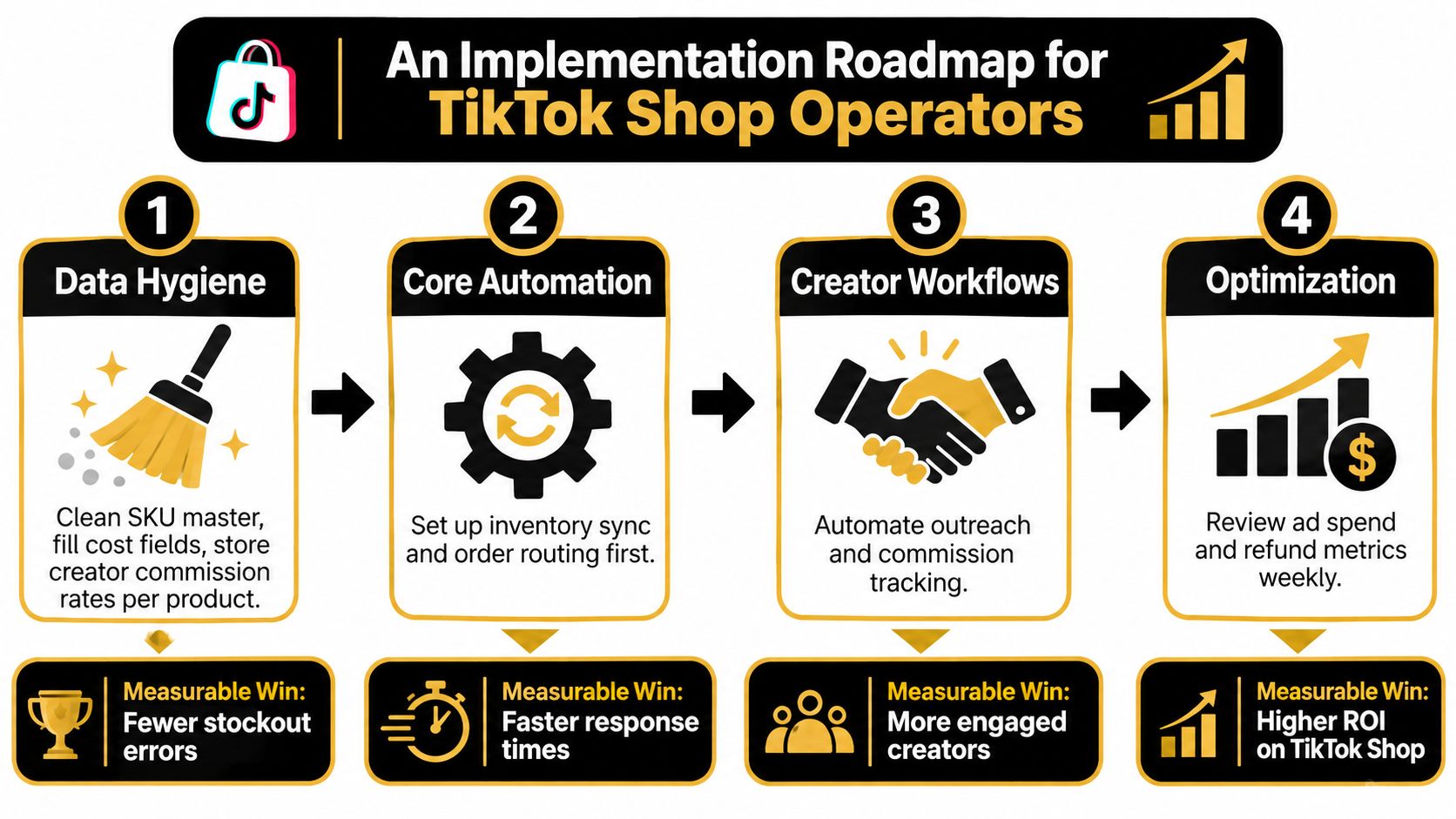
An Implementation Roadmap for TikTok Shop Operators
Consider a representative shop where a creator-driven product becomes a bestseller. The team increases paid support, replenishes stock, and celebrates the order count, but hasn't connected later refunds to the original acquisition costs.
This is an illustrative operating scenario, not a case study. A product-level profit view could change the decision from scaling immediately to holding spend while the team investigates retained margin.
Establish the financial foundation
Use a 30-60-90 day rollout plan as a planning framework, not a performance promise. Each phase should pass a checkpoint before the next begins.
- First phase, data hygiene: Clean the SKU master, populate cost fields, and store applicable commission terms. Pause automated commercial decisions when important inputs are missing.
- Middle phase, connected reporting: Reconcile orders, advertising, returns, and refunds into the product-level view. Trace sample transactions through the calculation before trusting aggregate results.
- Final phase, controlled execution: Pilot a low-risk workflow, compare outcomes, and expand only when operational accuracy and margin remain acceptable.
TikTok Shop's U.S. Analytics Product tab provides visibility into GMV, orders, traffic, conversion, pricing, inventory, reviews, and top-performing content and creators. Use those records as an operating foundation, then connect the costs required for your profitability model.
Test the process without changing everything
Choose comparable SKU cohorts for automated and manual handling. Keep promotions, commission arrangements, and fulfillment conditions as consistent as practical, and record any differences that could distort the comparison.
Start with routing and alerts rather than irreversible actions. For example, route return requests to the right owner before considering broader automated handling.
For paid-traffic planning, Wojo Media's TikTok ads guide is a complementary resource. Keep advertising execution separate from the decision about how much margin the product can afford to spend.
Expand only after your team can distinguish workflow improvements from changes in demand. If the economics deteriorate, roll back the rule, preserve the audit trail, and investigate before increasing scope.
Specialized Use Cases for TikTok Shop Profit Tracking
More automation doesn't always improve the outcome. Sometimes the correct decision is to pause a rule that's working exactly as configured.
When creator volume conceals weak economics
A creator can generate substantial sales on a product with little room for acquisition costs. Before expanding the relationship, inspect retained contribution by product and agreement.
If margin is unacceptable, stop automatic commission increases. Review the rate, product selection, and commercial terms rather than treating creator-driven GMV as sufficient evidence of value.
When a content push precedes return problems
A sudden increase in returns deserves investigation before another promotional push. Review whether the content created inaccurate expectations, the listing omitted an important detail, or fulfillment introduced damage.
The platform's return and refund guidance states that most U.S. products can be returned within 30 days of delivery, damaged or defective items may qualify for refund claims for up to 90 days, and refunds are generally processed within 3 to 10 business days after receipt of the return.
Recent sales therefore need provisional treatment. Don't compare immature sales cohorts with older cohorts that have already absorbed their returns.
When advertising appears efficient but margin deteriorates
Pause automated budget expansion when the reported acquisition result excludes costs that matter to the order. Check attribution and allocation before assuming the campaign or creator alone caused the loss.
Build a spreadsheet sensitivity model with columns for retained sales, COGS, commission, platform deductions, advertising, fulfillment, and return costs. Change one assumption at a time to identify the point where scaling no longer meets your required contribution.
Before increasing exposure, ask:
- Cost completeness: Are all relevant deductions included without double-counting?
- Cohort maturity: Have enough post-purchase adjustments appeared to support the decision?
- Reversibility: Can the team stop the rule and identify affected orders?
- Customer impact: Would the proposed change create misleading expectations or slower resolution?
Frequently Asked Questions About Ecommerce Automation Tools
Which automation category should a growing TikTok Shop prioritize?
Prioritize the most expensive recurring failure, not the broadest software package. Inventory or order routing may deserve attention first when execution is unreliable; connected profit reporting should come first when the team can't explain whether growth earns money.
There's no universal fastest-return category. Establish a baseline and evaluate the cost of the problem alongside implementation and maintenance effort.
How should creator commissions be modeled?
Use the commission applicable to the product or order and preserve the underlying agreement. Reconcile expected commission with recorded deductions, and investigate differences before using the result to approve more spending.
Do profit dashboards replace spreadsheets?
They can replace repetitive consolidation while spreadsheets remain useful for sensitivity analysis. Keep hypothetical assumptions separate from realized performance, and reconcile both to consistent source records.
How quickly can a self-serve platform be deployed?
Deployment depends on access permissions, SKU consistency, cost completeness, and integration quality. Define readiness by whether your team can reconcile transactions and explain product profit, not merely whether a connection is active.
How should operators evaluate pricing?
Compare subscription cost with implementation work, ongoing maintenance, usage charges, and exit costs. The scale of the category explains the pressure to automate: global ecommerce sales reached nearly $5 trillion in 2021, online-shopping adoption surpassed 2.3 billion consumers, and an industry forecast projects sales above $10 trillion by 2030. Your buying decision should still depend on your store's economics.
Try the HiveHQ Profit Dashboard to connect ecommerce automation decisions with real-time net profit, product-level performance, and customer analytics. Visit HiveHQ to explore the self-serve software, and talk to the HiveHQ team about a rollout for your US or UK TikTok Shop that starts with reliable costs and clear profit guardrails.