How to Become TikTok Affiliate in 2026
how to become tiktok affiliateTikTok Shop affiliateaffiliate eligibilitycreator commissionsTikTok Shop profit
Becoming a TikTok affiliate means meeting TikTok Shop's entry requirements for your market, applying through TikTok Studio, and earning commission on attributed qualifying orders rather than a wage.
The popular advice stops at reaching the follower floor and posting product links. Approval only opens the first gate. U.S. creators under 5,000 followers enter a 30-day Creator Pilot that keeps limits in place even after acceptance, and category eligibility plus account violations decide whether promoting continues at all. Refunds then cut into the commission you keep, so a credited sale and a paid-out sale are two different things. A creator can pass the application and still promote under restrictions, while a seller can generate affiliate orders and keep little of the revenue once returns and fees land.
Table of Contents
- TikTok Affiliate Eligibility by Market
- How to Join TikTok Shop for Creator
- What Approval Unlocks and What It Does Not
- Commission Rates and Profit After Refunds
- Habits That Keep Affiliate Access Open
- Frequently Asked Questions
- Check Net Profit Before You Scale
TikTok Affiliate Eligibility by Market
Start with your market, not your follower count. TikTok's affiliate eligibility guidance sets a minimum age of 18, a standard U.S. floor of 1,000 followers, and API-listed floors of 5,000 followers for the United Kingdom and Southeast Asia, alongside a cap of three account violations.
Check the path your account actually qualifies for
The table separates basic entry from unrestricted operation. The pilot row is a U.S. operating stage, not a way around the standard application requirements.
| Market or path | Minimum age | Location | Follower rule | Other checks |
|---|---|---|---|---|
| United States, standard | 18 | Based in the United States | At least 1,000 | Identity verification, Shop and community policy compliance, no revoked e-commerce permissions, no more than 3 account violations |
| United States, under 5,000 followers | 18 | Based in the United States | At least 1,000 and fewer than 5,000 | Enters 30-day Creator Pilot; limits stay until 5,000 followers and the minimum pilot period |
| United Kingdom | 18 | United Kingdom | 5,000 or more | No more than 3 account violations |
| Southeast Asia | 18 | Supported Southeast Asia market | 5,000 or more | No more than 3 account violations |
Read the location column carefully. Having viewers in a supported market isn't the same as satisfying the account's residence requirements, and Southeast Asia shouldn't be treated as a single unrestricted application region.
For U.S. applicants, TikTok's creator eligibility policy also requires compliance with the Creator Code of Conduct and excludes applicants with previously revoked e-commerce permissions, including association with an account whose permissions were revoked. An eligible-looking profile can therefore fail for reasons unrelated to audience size.
Check account standing before spending money
Open the application flow and inspect the rules shown to your account before buying samples or batching product videos. Market requirements can change, and an older tutorial isn't evidence that your account qualifies today.
- Confirm residence: Use the market your account can legitimately apply in, not the market offering the easiest follower threshold.
- Review restrictions: Resolve account-health issues through the available review process rather than opening another account to avoid them.
- Prepare verification: Have the requested identity information ready and make sure account details are consistent.
- Separate business models: Commission-based selling isn't the same arrangement as being paid to produce brand content.
That last distinction matters if you're choosing where to begin. Our guide to becoming a UGC creator explains the content-production route, which shouldn't be confused with earning from attributed Shop purchases.
Practical rule: Qualify the account before committing production time. A strong demo can't bypass an eligibility restriction.
How to Join TikTok Shop for Creator
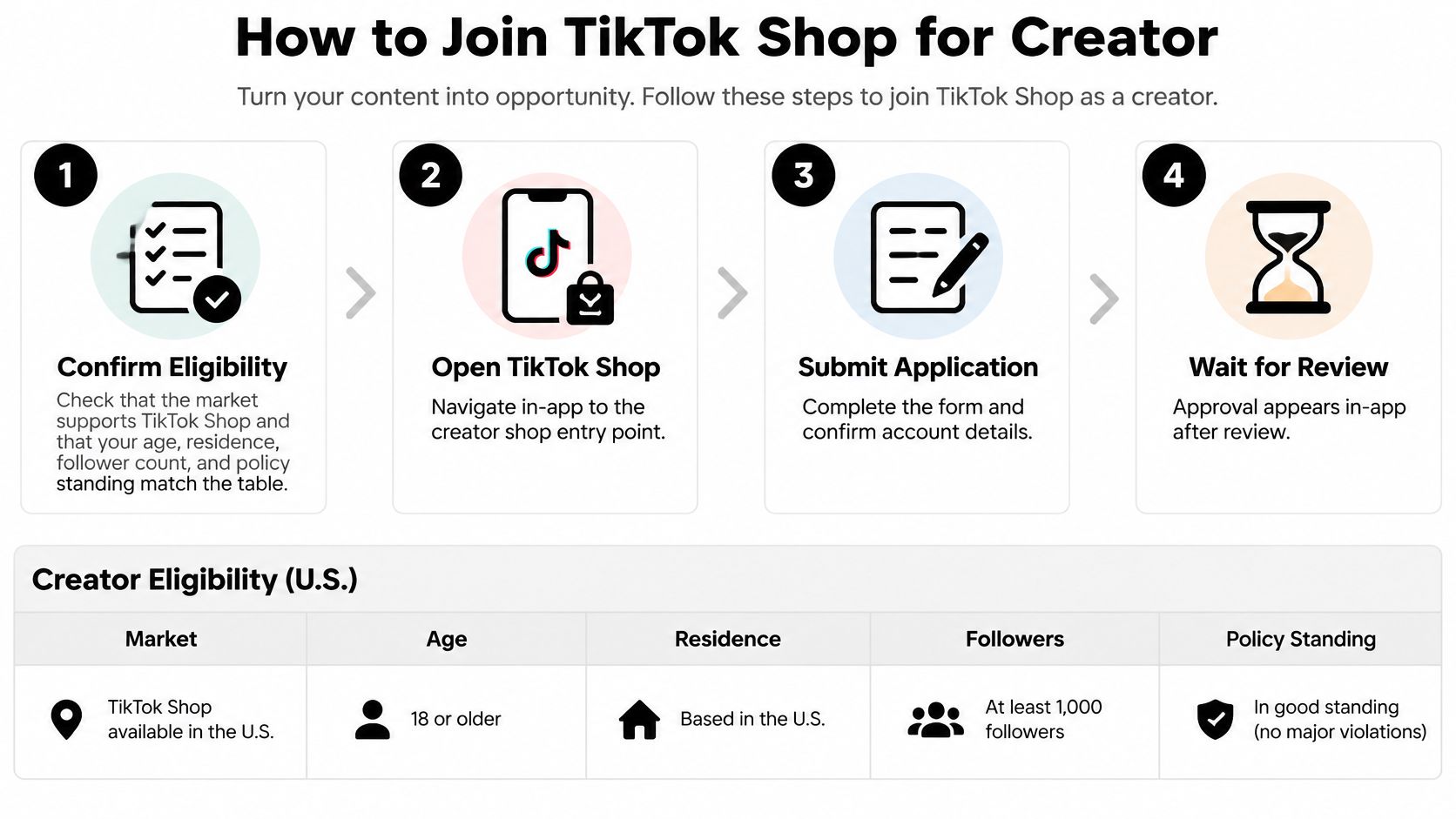
Apply through the creator route inside the app, rather than assuming you need to register as a seller. TikTok's creator onboarding guidance gives the path Profile → TikTok Studio → Monetization → TikTok Shop for Creator → Join now, followed by age and identity verification.
Use this process overview to orient yourself before completing the application.
Complete the application and publishing checks
Confirm account eligibility. Check supported-market access, residence, age, follower standing, and policy status. Do this on the account you'll use to promote products.
Open the creator application. Follow the TikTok Studio route and select Join now. Read the terms and restrictions displayed rather than treating the button as a promise of full access.
Finish verification. Complete the requested age and identity checks before trying to add products or withdraw earnings. Submit accurate details, and don't assume a pending application is an approved one.
Build your Showcase after approval. Choose products you can explain and demonstrate truthfully. Check availability, customer feedback, seller reliability, and sample options before committing to a shoot.
Publish original shoppable content. Attach the appropriate product link to a video or LIVE session. Make the commission relationship obvious in the content, for example by plainly saying you earn commission from qualifying purchases, rather than burying it in vague hashtags.
Review purchase outcomes. Inspect attributed orders, refunds, product-page conversion, and commission. A video with attention but no purchases needs a different diagnosis from a video that sells products buyers later return.
Withdraw available earnings. Check the creator balance and complete the withdrawal requirements shown in your account. Don't treat an order notification as proof that the money is immediately withdrawable.
TikTok Shop's affiliate program page states that there's no setup fee and publishes a 6% charge on each sale. That platform charge is a seller-side cost, not the creator's commission rate or wage.
Make the first test useful
Say an eligible U.S. creator joins with a small audience, requests an available sample of a product with credible demand, and films a clear demonstration. The video shows what the item does, who it suits, and an important limitation, without borrowing unsupported claims from the seller's listing.
After publishing, the creator checks whether viewers click, buy, and keep the product before filming another version. If clicks are healthy but purchases are weak, inspect the listing, price, and audience fit before changing the opening shot.
For a broader grounding in attribution and performance-based compensation, use our affiliate marketing guide for beginners. Test several product and creative combinations before treating any single video as your strategy.
What Approval Unlocks and What It Does Not
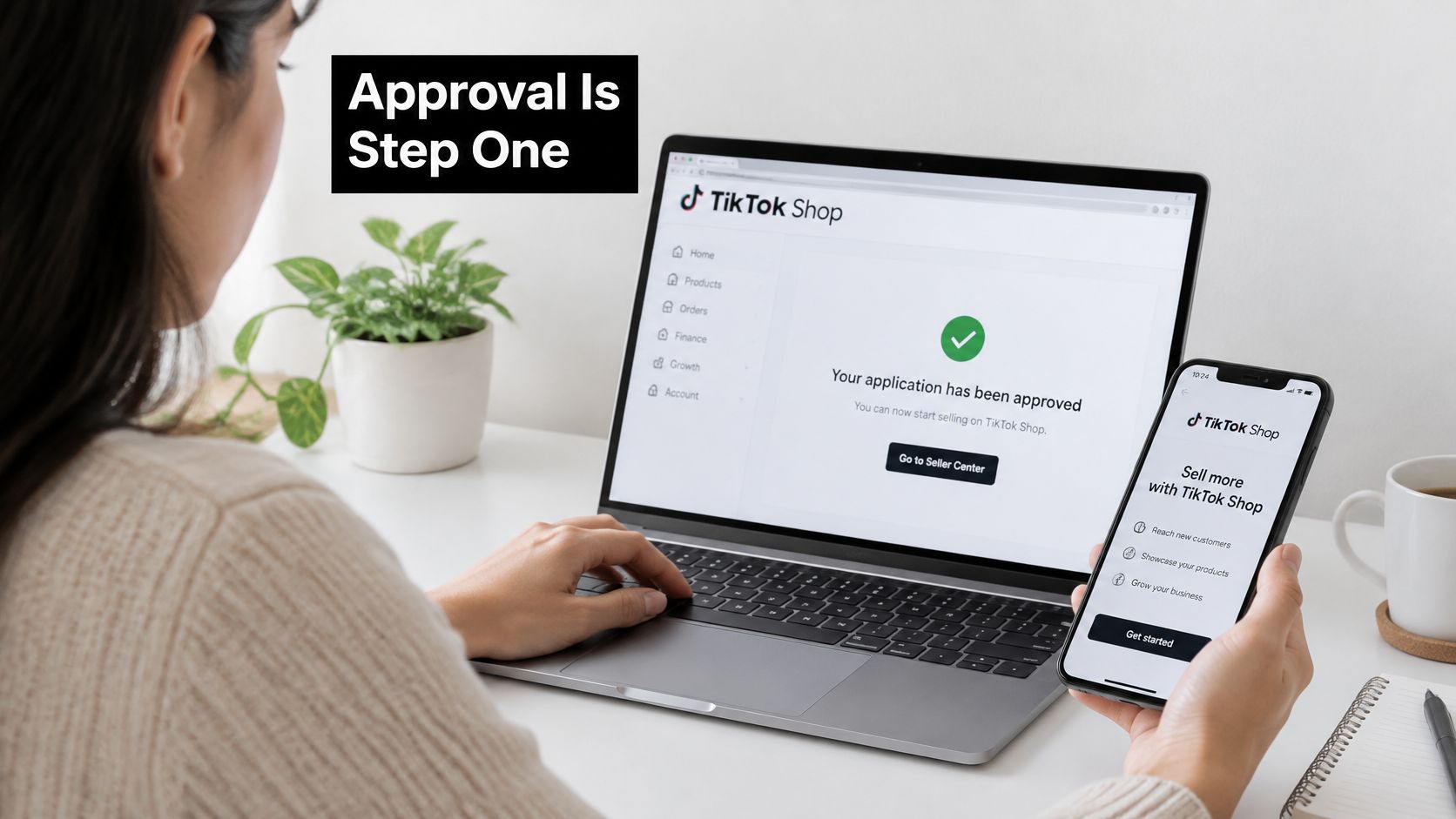
Join now doesn't mean every product becomes available. Approval confirms entry into the program under the conditions attached to your account; it doesn't erase pilot limitations or category-specific requirements.
An approval confirmation is a milestone, not the end of the eligibility checks.
The pilot and category checks are separate
Under TikTok's U.S. creator policy, creators with fewer than 5,000 followers enter a pilot lasting at least 30 days, and must both reach 5,000 followers and complete the minimum pilot period to remove pilot limitations. Finishing the time requirement alone isn't enough.
Treat that period as a chance to establish a useful operating record. Publish original demonstrations, keep claims supportable, and inspect whether the products satisfy buyers instead of chasing follower growth through unrelated viral content.
Some categories impose another gate. TikTok's Affiliate Marketing Policy identifies a Promotion Performance Score of at least 3.5 and a Creator Health Rating of at least 150, alongside sales history and sustained content quality; for creators without a Promotion Performance Score, an alternative may require more than three e-commerce LIVE streams in the previous 30 days, each lasting at least 10 minutes, with no bottom-tier content violation during that period.
Passing the application doesn't override a product's eligibility rules, and graduating the pilot doesn't automatically satisfy a category's performance requirements.
Diagnose the restriction before changing your strategy
Consider an approved creator who can add some Showcase products but can't select an item in a restricted category. The useful next step is to inspect the specific restriction, not assume the app is broken or that another application will help.
- Pilot limitation: Complete the applicable graduation conditions shown in the account.
- Category requirement: Check the relevant health, performance, sales, or LIVE criteria.
- Product issue: Investigate whether the item itself remains eligible for affiliate promotion.
Product availability can also be affected by poor buyer ratings, seller-fault returns, complaints, or intellectual-property problems. Inspect the product before requesting a sample so you don't build a production schedule around an item you may be unable to promote.
For a visual walkthrough of the creator application journey, use the video below.
Follower count can get an account to an entry threshold. Demonstrated conversion and account health influence what the creator can do after entry.
Commission Rates and Profit After Refunds
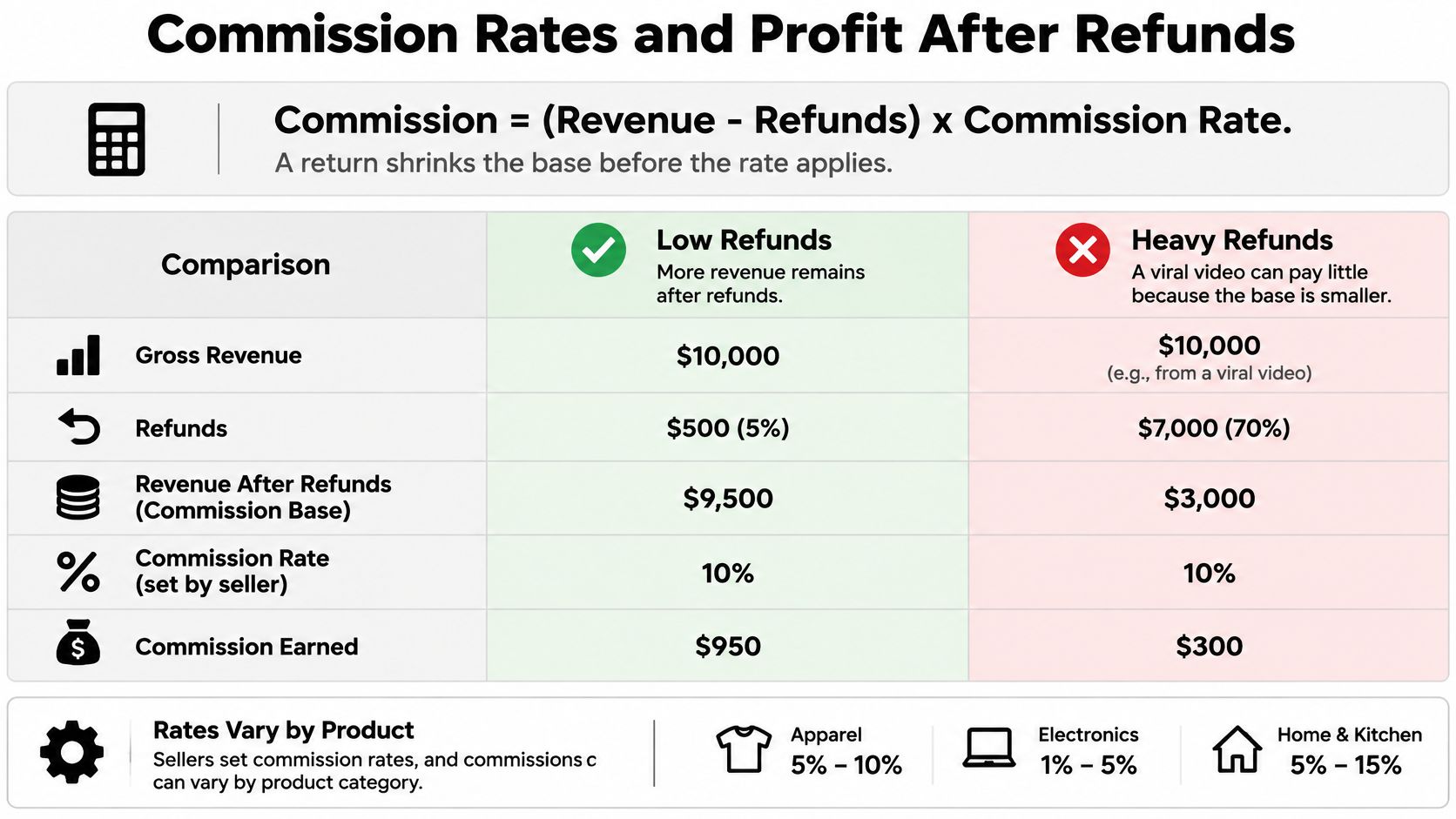
Approval gets a creator into the program. The commission math decides whether the promotion pays. Commission = (Revenue - Refunds) × Commission Rate. TikTok's commission documentation gives this formula, documents settings from 1% to 80% for eligible Shop Ads arrangements, and illustrates separate 10% organic and 5% Shop Ads rates.
A return shrinks the commissionable base before the rate applies. Sellers can configure rates by product, product group, or campaign, so check the rate attached to the actual purchase classification rather than assuming every order pays the headline percentage.
What a 40 dollar affiliate order pays
The figures below are hypothetical and apply the formula to the same selling price under different commission and refund conditions.
| Scenario | Price | Refunds | Creator commission | Seller-side implication |
|---|---|---|---|---|
| Organic affiliate sale, 10% rate, no refund | $40 | $0 | $4.00 | Deduct platform fee, product cost, fulfillment, and other expenses |
| Shop Ads attributed sale, 5% rate, no refund | $40 | $0 | $2.00 | Include paid amplification costs as well |
| Organic affiliate sale, 10% rate, full refund | $40 | $40 | $0 | Sale revenue doesn't remain; inspect unrecovered costs |
| High 30% rate, no refund | $40 | $0 | $12.00 | Larger creator payout can exhaust seller margin |
In that order, applying the published platform rate produces a $2.40 platform deduction before product cost, fulfillment, or advertising. The high-commission example leaves $25.60 after creator commission and that platform deduction, but before those remaining costs, so it still isn't a net-profit figure.
Refunds decide the difference. A full return wipes out the commission entirely, while product costs and fulfillment spending on the seller's side may already be committed.
Choose the offer by expected earnings
The highest percentage can be the worst offer when buyers don't convert or frequently return the product. A useful item with a credible listing and dependable fulfillment may produce better retained commission than a high-rate item that disappoints customers.
Creators should evaluate selling price, likely conversion, return risk, and production effort together. Sellers should include creator compensation and paid amplification such as GMV Max before deciding whether an affiliate-attributed sale helped the business.
Margin check: Check whether the retained margin after refunds covers the payout.
For context on how affiliate earnings differ from other creator income, this TikTok monetization guide for affiliate creators is a useful companion. When setting product offers, our guide to affiliate commission rates helps frame the rate decision around economics rather than headline generosity.
Keep creator earnings and seller profit separate. Creators need retained commissions worth their production effort; sellers need enough contribution left to cover the rest of the operation.
Habits That Keep Affiliate Access Open
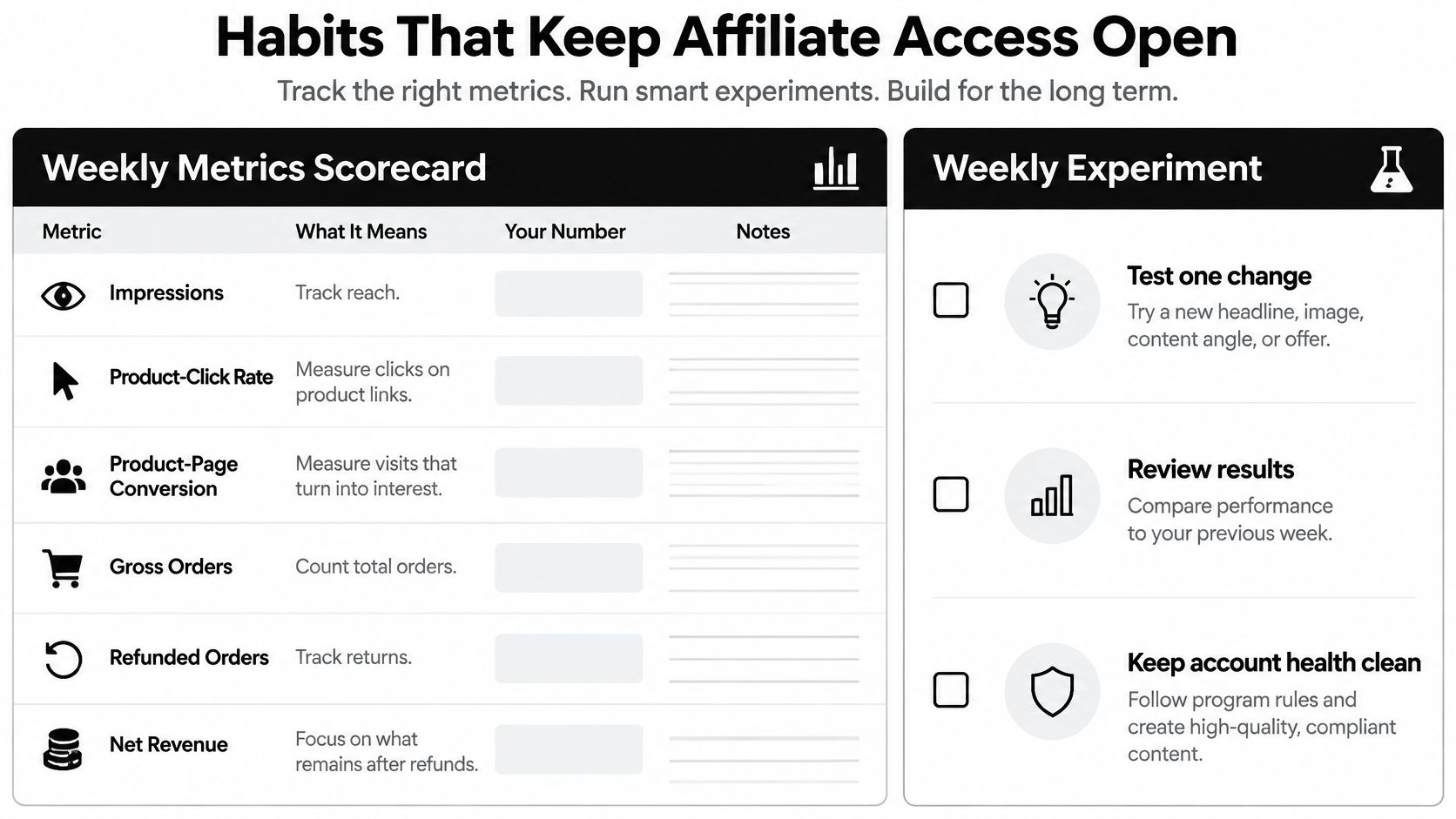
Build a weekly scorecard that records impressions, product-click rate, product-page conversion, gross orders, refunded orders, net commission, content age, and violations. Use it to decide what to repeat, revise, or stop, not just to report that views increased.
TikTok's affiliate performance and compliance guidance supports treating account health as an operating constraint and evaluating net commission per 1,000 views after refunds. Compare content over similar observation periods so a mature video with processed returns isn't judged against a fresh video with only initial orders.
Tie each intervention to a metric
- Weak product-click rate: Make the product's use and audience clearer. Don't disguise an irrelevant item inside an entertaining video.
- Weak product-page conversion: Inspect price, listing clarity, delivery expectations, and product fit before rewriting every creative.
- Rising refunded orders: Read return reasons and pause promotion when the demonstration creates expectations the product can't meet.
- New violations: Review the claim, footage, product classification, and disclosure before publishing another variation.
- Declining net commission: Check both return behavior and the rate applied to attributed orders.
Keep the scorecard beside your publishing checklist.
Stop preventable enforcement problems
Before promoting, inspect product ratings, return reasons, complaints, rights to footage and music, and evidence supporting each claim. Log samples and disclosures so you can distinguish what the seller supplied from what you've independently checked.
Avoid misleading or prohibited content, unsupported medical or financial claims, deceptive demos, prohibited products, fake engagement, miscategorized products, duplicated or recycled content, and extra accounts used to dodge restrictions. Our affiliate fraud detection guide provides another operating checklist for evaluating suspicious activity.
For clothing content, WearView's ai video generator for clothing brand is a relevant production resource to evaluate. Generated visuals still need review for accurate product representation, usage rights, and claims; they aren't proof of fit, fabric behavior, or performance.
Consider a creator scaling a before-and-after clip that implies a medical result. Enforcement could damage account standing and restrict access to the products that were generating commission, even while the clip continues attracting attention.
A seller faces a related risk when seller-fault returns rise and a product becomes ineligible for promotion. Existing videos don't guarantee continued affiliate sales, so investigate the product problem rather than asking for more content.
Compliance is a growth input. Clean, converting content supports continued access, while sellers protect the economics of those orders by tracking retained revenue and profit instead of gross views.
Frequently Asked Questions
Can I join with fewer than the standard U.S. follower minimum?
Not through the standard U.S. Affiliate Creator path. You must meet the follower floor along with the age, residence, identity, and policy requirements. A qualifying smaller account can still enter under pilot restrictions, but approval under limited operating conditions is not an exception to the entry requirements.
Is there a fee to apply?
TikTok Shop states the affiliate program has no setup fee, and anything you choose to spend on samples or production is an optional cost you judge against likely retained earnings.
When do creators get paid?
Creators earn commission on qualifying attributed purchases, not on views alone. TikTok describes commission payment as automatic when a sale is made, though automatic crediting is different from funds being available for withdrawal. Check the creator balance, order status, refund adjustments, and account-specific withdrawal conditions. A refund after the sale reduces what you keep, so treat credited commission as provisional until the return window closes.
Does approval let me promote every product?
No, the limits described in the approval section above still apply after you are accepted.
What if my application stays in pending status?
Pending usually means review is still running rather than a rejection. Recheck that your age, residence, and identity details are accurate and that the account stays in good standing while you wait. Opening a second application on another account creates a bigger problem than a slow review.
Check Net Profit Before You Scale
Compare a product's net profit before and after a rate change, then check whether retained sales improved enough to justify the extra payout. A higher commission that fails to lift orders you keep only shrinks margin. Use our TikTok Shop net profit calculator guide to structure that calculation.
Make the next scaling decision measurable
Affiliate orders help sellers only when money remains after product cost, fulfillment, refunds, platform fees, creator commission, and ad spend. Refund adjustments can land after a campaign already looks profitable on attributed sales, so judge products on retained orders rather than the initial order total.
HiveHQ is an Official TikTok Shop Partner. The self-serve Profit Dashboard gives sellers real-time net profit and product-level performance, with profit calculations powered directly by TikTok Shop data, and the suite includes a free TikTok Shop Fee Calculator that accounts for referral fees and commissions.
Run it on your own shop before increasing commission rates or scaling paid spend. Products that hold margin after returns earn the next budget; products that rely on headline sales totals get paused. Try the Profit Dashboard at HiveHQ, or talk to the team about reading shop and product profit on your own account.