How to Sell Products on Tik Tok: Step-by-Step Guide
TikTok Shop sellingTikTok ShopTikTok sellingTikTok Shop profitTikTok creators
To sell products on TikTok Shop, register and verify a seller account, list products with enough margin to cover selling costs, and use shoppable videos, LIVE sessions, creators, and ads to generate orders. Scale only when net contribution per fulfilled order stays positive after platform commission, creator commission, refunds, returns, fulfillment, and advertising.
Table of Contents
- How to Sell Products on TikTok Shop in Seven Steps
- Set Up the Shop and Build Listings That Pass Review
- Work With Creators Without Wasting Samples
- Run Ads and Organic Videos That Convert
- Fulfill Orders and Handle Returns Without Losing Margin
- Measure Real Profit on Every Order
- Frequently Asked Questions About Selling on TikTok Shop
- Start Tracking Profit on Your First Product
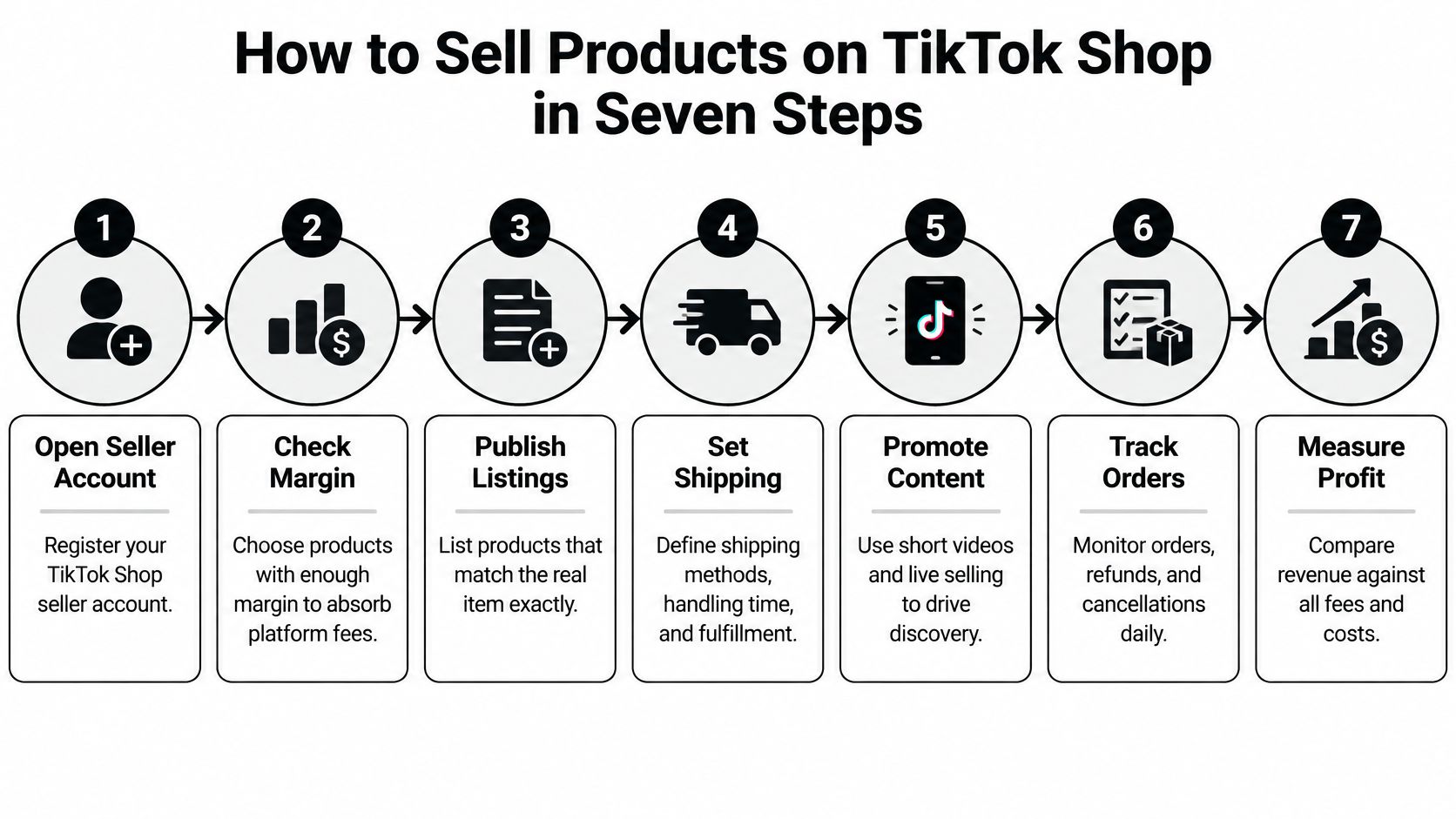
How to Sell Products on TikTok Shop in Seven Steps
- Register and verify your seller account. Open Seller Center for your market and complete the identity, business, tax, and payment checks relevant to your seller type. Keep the details consistent across your documents.
- Choose a small, margin-ready product range. Calculate what remains after product cost, platform charges, shipping, expected refunds, and acquisition costs. A product that needs an aggressive discount to attract buyers may leave too little room for promotion.
- Build complete product listings. Add accurate variants, quantities, dimensions, images, stock, and offer conditions. Make sure the item buyers select is the item you'll dispatch.
- Audit claims, prices, and discounts. Check your listing alongside every promotional asset. Remove unsupported promises and offers that won't match checkout.
- Test content and creator demand. Start with products you can demonstrate clearly and fulfill reliably. Track whether viewers become profitable buyers, not just whether they watch.
- Add paid distribution after conversion is understood. Keep publishing organic demonstrations, then test advertising against a defined acquisition-cost ceiling. Don't pay to amplify a confusing offer.
- Fulfill orders and review contribution weekly. Record actual costs, cancellations, returns, and commissions. Increase inventory or spending only when the completed-order economics justify it.
The scale is substantial: Momentum Works estimates that TikTok Shop generated $64.3 billion in global GMV during 2025, while US GMV reached $15.1 billion, up 68% from $9 billion in 2024. That establishes a meaningful sales channel, not a promise that every seller will make money.
Why product choice and profit tracking come first
Product selection sets your spending ceiling. If the item is expensive to ship, vulnerable to damage, or frequently misunderstood, each additional order can bring costs your initial margin calculation missed.
The weekly profit review tells you whether that ceiling still holds. Creator commissions, promotion depth, carrier costs, and return behavior can change after launch, so your original spreadsheet isn't a permanent approval to scale.
Practical rule: Choose products for the money you can retain, not just the sales you think you can generate.
Use this workflow to keep setup, promotion, and measurement connected.
This week, start your Seller Center registration and prepare a cost sheet for your initial product range. Don't commit to inventory expansion before you've established a defensible selling price.
Set Up the Shop and Build Listings That Pass Review
Your listing is an operational promise. It tells buyers what they'll receive, what they'll pay, and which conditions apply, so create it from the physical product and fulfillment process rather than from promotional copy.
Build the account and product record
- Confirm eligibility before registering. Check that your market, business type, and product category are supported in Seller Center. Prepare the requested verification documents, tax information, and payment details; use our TikTok Shop seller requirements guide to organize the checks.
- Create accurate SKU records. Enter each variant, stock quantity, packed weight, and applicable shipping settings. A lightweight item with bulky packaging can cost more to fulfill than the bare product suggests.
- Write literal titles and attributes. Name the actual product, size, quantity, material, and included accessories. If the offer is a multipack, don't let a single-item image imply a different quantity.
- Show what arrives. Photograph close-ups, packaging, scale, and the product in use, then add a short demonstration. Show limitations when they matter, such as which surfaces an accessory fits.
- Attach the matching listing. Link each video or LIVE demonstration to the exact item being shown. A similar-looking variant isn't an acceptable substitute for the demonstrated offer.
I would launch with five to ten SKUs you know well, as a working recommendation rather than a platform requirement. That gives you enough range to test without making every content correction a catalog-wide project.
Audit the complete buying journey
TikTok's product-promotion guidance calls for detailed product information, visual demonstrations, matching promoted and listed products, and clear offer eligibility conditions. It also prohibits misleading prices, unsupported claims, inaccurate discounts, external purchase prompts, and unapproved promotion of restricted products.
Before publishing, run this checklist:
- Product identity: SKU, category, images, quantity, and variants describe the same item.
- Price consistency: The promoted price is available under the stated conditions.
- Offer eligibility: Minimum quantities, dates, eligible products, and locations are explicit.
- Claims: Benefits are supportable, without invented performance or medical promises.
- Purchase path: Buyers can complete the intended purchase within the permitted shopping flow.
- Local compliance: Tax, labeling, advertising, and product-safety obligations are checked separately from platform approval.
Test the buyer journey yourself. Open the promotional asset, follow the product attachment, select the demonstrated variant, and inspect checkout before submitting payment.
Can a buyer find the same product, price, and offer in the video, the listing, and at checkout?
If the answer is no, fix the mismatch before sending traffic. For example, a video showing a complete storage set shouldn't open a listing whose displayed entry price buys only the smallest component.
Keep a master product record with approved descriptions, claims, images, and offer conditions. When a promotion changes, update the listing and active content instructions together rather than relying on each person to remember the new terms.
Work With Creators Without Wasting Samples
Set your allowable acquisition cost before contacting a creator. Subtract non-acquisition costs and your required contribution from expected order revenue; the remainder is what you can afford to spend acquiring that order, including commission and allocated sample costs.
Treat sample dispatch as a cost commitment, not a sign of progress.
Make each partnership testable
Choose category fit before audience size. For a kitchen accessory, favor a creator who can demonstrate its actual use over a broad entertainment account with no relevant purchase context. Rank proven partnerships by net contribution per order, not follower count.
Issue a written brief before shipping. Include the approved product, price, claims, offer window, product attachment, and exact disclosure wording applicable to the collaboration. If the promotion expires, the creator needs an explicit instruction not to present it as ongoing.
Release samples against capacity. Don't encourage demand for a variant you can't replenish or dispatch reliably. Our guide to managing samples at scale without losing money explains how to keep sample commitments financially accountable.
Define a publication window and stop rule. If a creator receives a sample but doesn't publish within the agreed window, stop sending additional products until the commitment is resolved. Record sample cost even when no content appears.
For additional context on selling through TikTok Shop, watch this walkthrough.
Review quality as well as sales
TikTok's creator-fraud guidance identifies fake orders, self-purchases, rapidly canceled high-value orders, fake engagement, misleading promotions, and automated manipulation. These behaviors can make conversion benchmarks unreliable and expose the shop to enforcement.
Don't increase incentives because an account suddenly produces impressive headline sales. Inspect cancellations, refunds, posted assets, and the cost of the resulting orders, then assess whether the partnership generated additional profitable demand.
Use a weekly scorecard:
- Content reliability: Did the creator publish the agreed asset on time and follow the approved facts?
- Net contribution per order: After product cost, commissions, fulfillment, samples, ads, and refunds, is the partnership worth continuing?
- Refund rate: Are buyers keeping the product, or did the demonstration create the wrong expectation?
Retain creators who combine reliable content with profitable, refund-adjusted orders. High conversion isn't enough when the costs of winning those orders consume the margin.
Run Ads and Organic Videos That Convert
Match each buying surface to the job it does
| Source | Role in the order | What sellers should do |
|---|---|---|
| Video | Creates demand inside the feed | Make short demonstrations that explain the item quickly and let buyers purchase without hunting for the listing |
| Shop marketplace interface | Converts comparison and search intent | Keep product pages complete with clear images, accurate details, and matching prices |
| Livestreaming | Concentrates attention around an offer | Schedule hosts, state offer conditions, and attach the exact product listing |
Each surface earns orders differently. Read the mix as a diagnostic for where buyers enter, then set spend from your own refund-adjusted contribution rather than copying a market pattern.
Give each channel a specific job
Video should make the product understandable quickly. Show the problem, demonstrate the item, and answer the objection most likely to prevent purchase. Use our TikTok shoppable videos guide to connect the demonstration to a usable buying path.
Product pages should resolve uncertainty. Buyers need to confirm dimensions, compatibility, contents, and price without reconstructing the offer from comments. Strong content cannot compensate for a listing that leaves those questions unanswered.
LIVE needs preparation. Assign a host, prepare stock-aware product selections, and make offer conditions easy to repeat accurately. Include preparation and hosting costs when judging whether the session was worthwhile.
Maintain a sustainable organic posting rhythm using different demonstrations, objections, and use cases. Reuse angles that produced profitable orders during creator tests, while keeping enough variation that the feed does not become the same pitch repeated.
If production capacity is the bottleneck, Veo3 AI's guide to create product videos with AI offers a workflow resource. Check generated assets against the product, and keep simulated footage away from performance claims.
Use GMV Max with a cost ceiling
TikTok's GMV Max documentation describes an automated commerce advertising solution in Seller Center's Shop Ads area: choose products or livestreams, set an ROI target and budget, and the system optimizes across available organic videos, paid ads, and affiliate posts. Its documented product ROI is total non-LIVE GMV from paid and organic orders divided by total ad spend, including orders placed while the campaign is active.
Treat that figure as campaign-period revenue over spend. Campaign-period revenue can include orders that paid distribution did not solely acquire.
Start with a modest budget on a product whose conversion and costs you understand. Check the source breakdown, refund-adjusted contribution, and actual ad allocation before increasing spend.
Budget guardrail: A reported advertising ROI can look attractive while the underlying orders fail your contribution target after platform commission, creator commission, refunds, returns, fulfillment, and ads.
Fulfill Orders and Handle Returns Without Losing Margin
Ship exactly what the listing promises, with a process that can absorb the demand your videos are about to create. Scaling ads before packing, stock control, and returns handling are ready turns preventable operational mistakes into acquisition costs.
Build fulfillment around actual order costs
- Align stock and shipping settings. Keep available quantities, packed weights, and shipping fees synchronized with the listing. Reserve stock consistently across sales channels so the same unit isn't promised to different buyers.
- Pick, pack, and dispatch against your stated timeline. Check the variant and quantity before sealing the parcel, then record packaging and carrier costs against the order. Our guide to TikTok shipping and fulfillment costs helps organize the expenses that belong in this calculation.
- Keep exposure open after delivery. TikTok's global seller terms describe a 30-day period for certain customer claims and potential disposal of uncollected returned goods. Confirm how long claims stay open in your market; delivery confirmation doesn't close them.
- Verify return-shipping responsibility. Return-cost liability follows the fault classification on each claim: seller-caused returns such as defects, wrong items, or misleading descriptions sit with you, while buyer-preference returns can be treated differently depending on the market. Your return rate and Shop Performance Score weigh on how disputes and account health are assessed, so record the classification and actual charge on every return. A flat assumed cost hides where returns eat margin.
Turn return reasons into decisions
A refund can remove revenue while leaving outbound shipping, handling, and acquisition costs behind. A damaged return can also remove the inventory value you expected to recover. Either way, net contribution per order drops below what the original sale price promised.
Review late shipments, return reasons, and claim counts weekly. Separate misleading-description returns from defects, transit damage, and customer preference, because each needs a different correction.
- Description mismatch: Correct sizing, compatibility, images, or the demonstration.
- Packing damage: Change protective packaging and inspect the next dispatch batch.
- Unsustainable losses: I pause a SKU when refund and return costs exceed the margin it can absorb.
Feed those actual costs into your product-level profit review. When the fulfilled-order cohort shows a worse refund rate than your allowance assumed, update the allowance and let the actual figure decide whether the product still clears your contribution target.
Measure Real Profit on Every Order
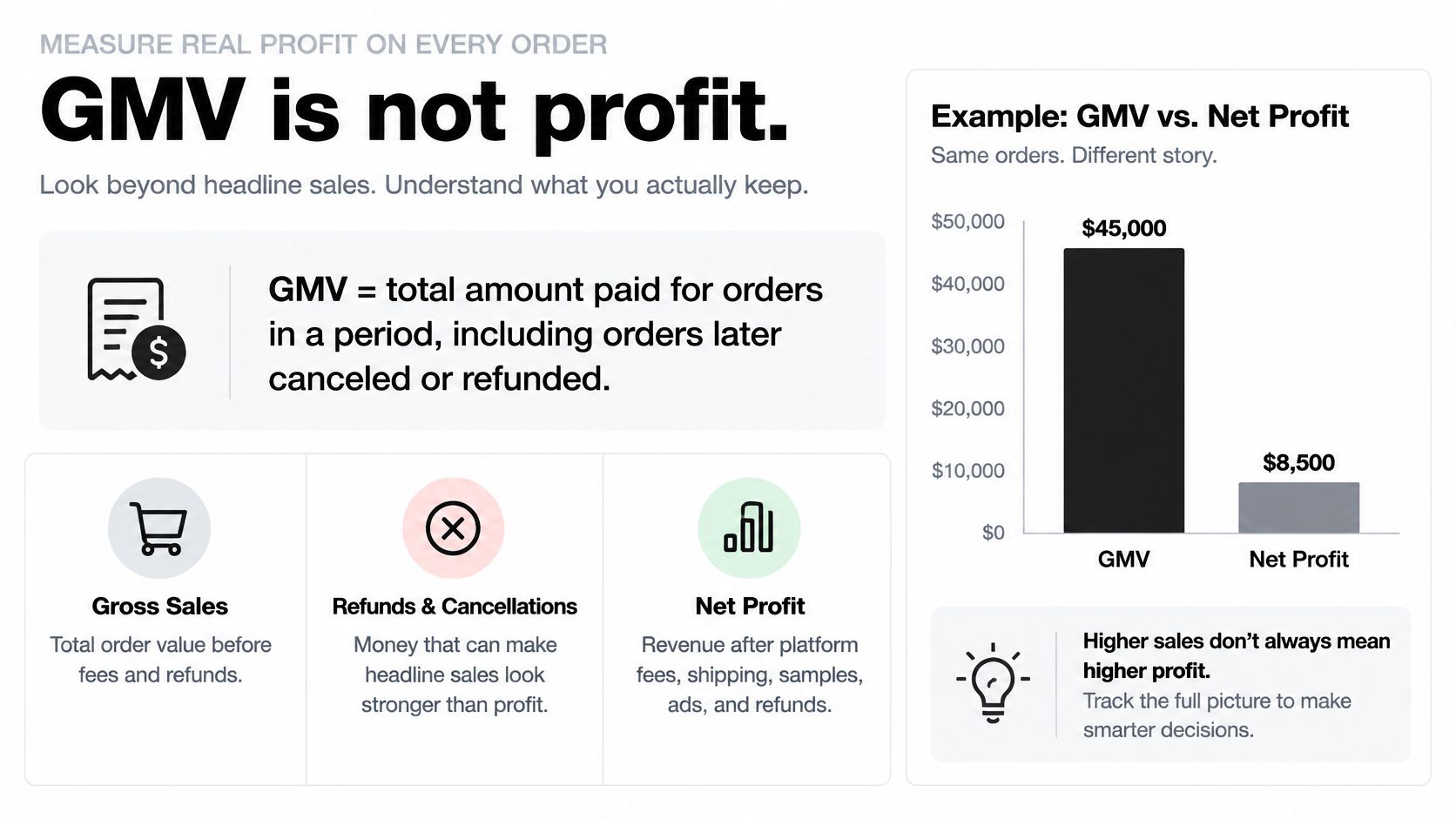
TikTok's GMV definition counts paid orders even when they are later canceled or refunded, so a strong sales total can hide weak earnings. The figure that matters is what each fulfilled order contributes after platform commission, creator commission, refunds, fulfillment, and ads.
TikTok's official US seller site states that joining has no setup fee and that the platform charges a 6% commission on each sale. Treat that commission as a marketplace expense, separate from any creator incentive.
Rebuild contribution from the order
The following is a hypothetical $30 sale using illustrative figures for the creator commission and refund allowance. Supply your actual product, fulfillment, and advertising costs before making a scaling decision.
Contribution per order on a $30 sale
| Line item | What it means |
|---|---|
| Order price paid by customer | $30.00, starting GMV for this hypothetical order |
| TikTok platform commission (6%) | $1.80, marketplace cost using the stated US rate |
| Creator commission (15%, example rate) | $4.50, replace with your actual affiliate rate |
| Cost of goods | Subtract the actual landed cost of the unit |
| Fulfillment and shipping | Subtract actual pick, pack, packaging, and carrier cost |
| Refund allowance (5% of price) | $1.50, illustrative allowance for expected returns and disputes |
| Ad spend allocation | Subtract the campaign cost allocated to this order |
| Contribution per order | $22.20 minus actual goods, fulfillment, and ad costs, must remain positive before scaling |
Start with the customer-paid amount after seller-funded discounts. Subtract the platform charge and creator commission, then deduct landed product cost and the full fulfillment bill.
Next, reserve for refunds and associated losses. When actual refund costs become known, replace the estimate; deducting both the allowance and the same realized loss counts the expense twice.
Finally, allocate advertising consistently. The remainder is contribution toward overhead and other operating expenses that may still need to be deducted, so keep that figure visible beside your revenue reporting.
Read contribution alongside cash and customers
Divide total cohort contribution by fulfilled orders, using a consistent treatment of later returns. Compare cohorts with similar time to develop refunds so recent orders don't look artificially stronger.
TikTok's analytics documentation distinguishes settlement from GMV: settlement is GMV minus total fees and adjustments, representing the final withdrawable amount. Reconcile that cash figure separately from your profitability calculation, because a healthy payout can still sit on top of orders that lose money once product costs and ad spend are counted.
The HiveHQ Profit Dashboard is self-serve TikTok Shop profit analytics software that brings real-time net profit and product-level performance into one view, surfacing metrics such as GMV, COGS, ad spend, and commissions. Shop-level analytics are included in all Profit Analytics Suite plans, run on data pulled directly from your TikTok Shop, and account for operational expenses such as referral fees and commissions.
Use our step-by-step TikTok Shop profit calculation guide to establish consistent inputs. Approve scaling only when contribution per fulfilled order stays positive after the next expected promotion or commission change.
Frequently Asked Questions About Selling on TikTok Shop
Why is my GMV high while my payout is lower?
Check the withdrawable amount in your payout records, not the GMV headline. Settlement lands after the platform nets out fees and adjustments, and a single deposit can carry deductions tied to orders placed earlier, so a strong sales week can still produce a modest transfer. Match each payout against the orders it covers before judging the week.
Which sales source should I check first?
Ask which source delivers the most contribution per fulfilled order, then rank video, LIVE, product card, affiliate, and advertising results accordingly. These labels are not mutually exclusive acquisition channels: a buyer who watched an affiliate video and finished on a product card can show up in more than one bucket. Fix the weakest bottleneck instead of scaling whichever source shows the largest GMV.
Is GMV Max required?
GMV Max is optional. Run it when the offer is clear, the ROI target is defensible, and you have enough cost visibility to judge the orders it produces. Organic demonstrations and accurate product pages still carry weight whether you advertise or not.
Do I need to recalculate profit when a commission changes?
Treat every cost change as a new deal. A higher creator commission can lift conversions while leaving less money per fulfilled order, so weigh the additional contribution you expect against the additional expense before agreeing. Apply the same check to discounts, shipping subsidies, and paid promotions.
Start Tracking Profit on Your First Product
Treat your first product as a measured test with a defined price, known cost inputs, and a set review date. Set the sequence up so each step feeds the next decision instead of scrambling for numbers after sales start.
- Connect shop-level reporting first. Pull authorized TikTok Shop data into one consistent view before launch, so every later read reflects real orders rather than estimates.
- Confirm the price before publishing. Check it against platform charges and verify it still leaves the net contribution per order you need once creator commission, refunds, fulfillment, and ad spend come out.
- Set decision thresholds in advance. Write down the contribution level that justifies reordering inventory, the level that triggers a listing or price correction, and the loss level that stops spend.
- Fix the review moment. Choose a date or order count where you compare actuals against those thresholds, then commit to one of the three paths.
A product that has already accumulated losses forces the same decision later at a higher price, so the thresholds belong in place before the first promotional push.
Try the HiveHQ Profit Dashboard for real-time net profit, product-level performance, and customer analytics you can run yourself, and use our free TikTok Shop Fee Calculator to check selling costs. Visit HiveHQ today and talk to the HiveHQ team about setting up profit tracking for your shop from the first order.