TikTok Shoppable Videos: A Practical Profit Guide
tiktok shoppable videostiktok shop profittiktok shop analyticsshoppable video adstiktok shop dashboard
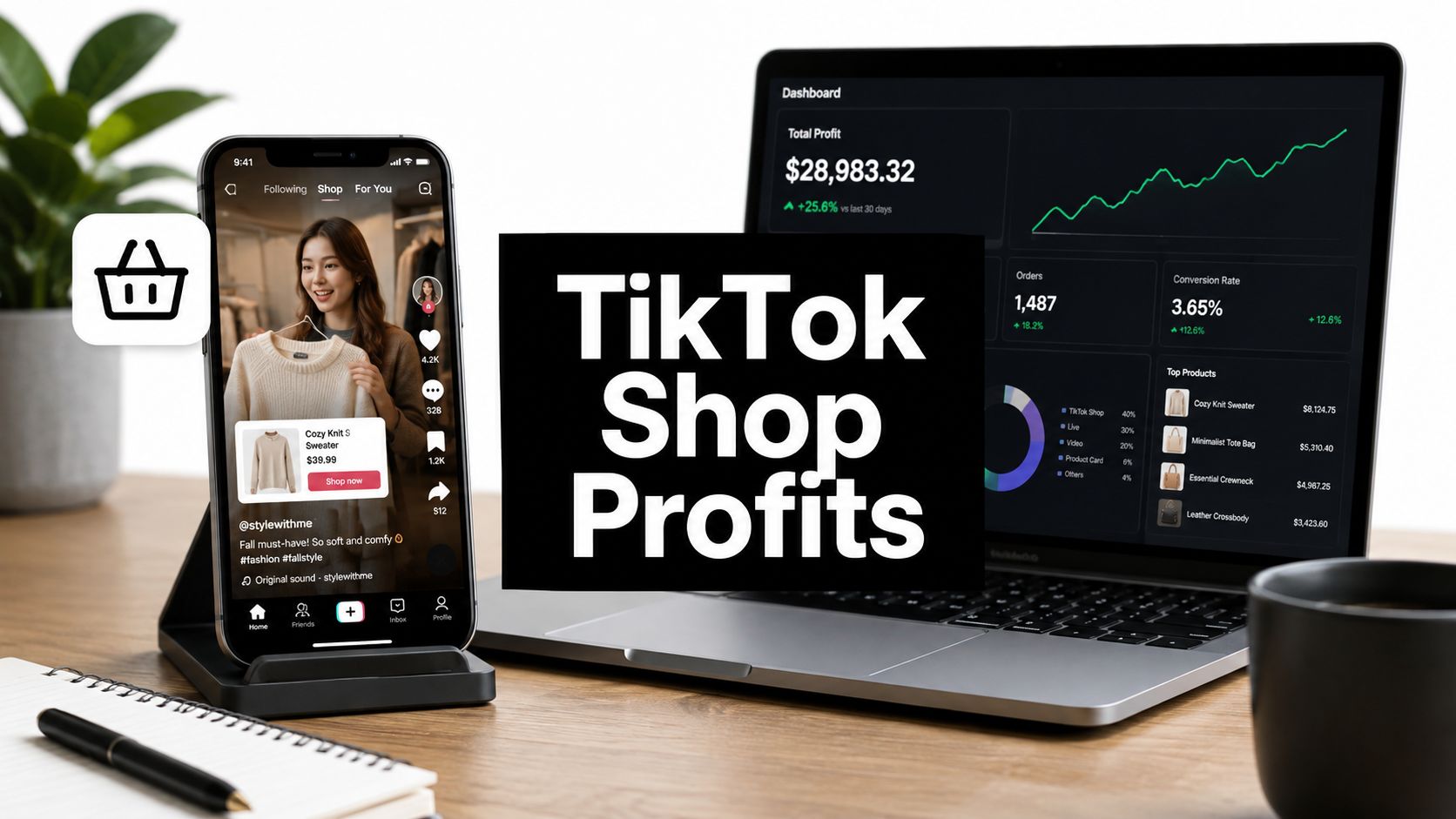
TikTok shoppable videos don't fail because they can't sell, they fail because operators read them like traffic assets instead of profit assets. The moment you treat them as a product-level margin problem, the question changes from “How many views did we get?” to “Which videos created profitable demand after commissions, refunds, and ad spend?”
Table of Contents
- What TikTok Shoppable Videos Actually Are
- How Shoppable Videos Fit TikTok Shop's Two-Stage Distribution
- Product Anchors, Showcase Rules, and GMV Max Mechanics
- Why Trust, Not Reach, Is What Converts a Shoppable Video
- Comparing Organic Video, Affiliate Ads, and GMV Max Amplification
- Sample Productivity Beats Follower Count Every Time
- Why Shoppable Video Profit Needs a Product-Level Dashboard
- Scaling Shoppable Video Sales Without Losing the Margin
What TikTok Shoppable Videos Actually Are
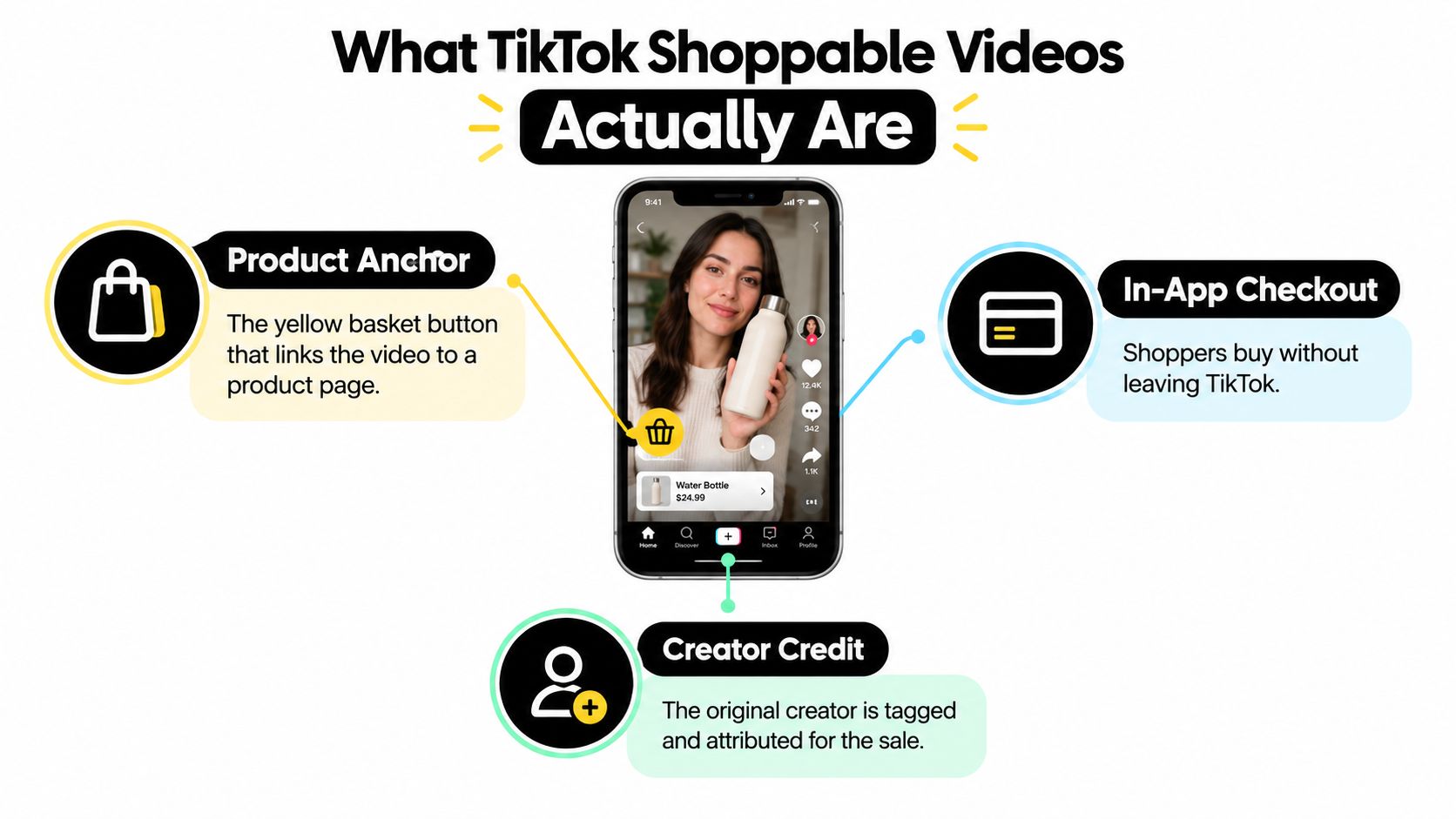
TikTok shoppable videos are short-form in-feed posts with a product anchor, usually shown to shoppers as the Yellow Basket button, that lets people buy without leaving the app. They only earn creator commission when the product is attached to both the video and the creator's Showcase, so the video and the storefront identity have to match for the sale to count.
Why this format matters
This is not the same thing as TikTok Shop LIVE. Shoppable video lives continuously in the feed, while livestream shopping depends on scheduled broadcasts and real-time attendance, which makes it far more fragile operationally. That difference matters because feed video can keep generating orders long after the post goes live, while a live only works when someone shows up at the right time.
TikTok's U.S. launch turned this into a real commerce surface, not a side feature. In-feed shoppable video became the largest single TikTok Shop sales surface in the United States in 2025, accounting for approximately 50% of GMV, with the Shop tab at 36% and livestream shopping at 14% (analysis-atlas.com research). That share tells you where the money really moves.
Practical rule: if a video can't be tied to a product anchor, a checkout event, and a creator attribution trail, it's content, not commerce.
For a basic primer on how TikTok Shop itself works, this overview of TikTok Shop helps put the format in context. The operator takeaway is simple, shoppable videos deserve their own profit view because one store-wide revenue number hides which creative, product, and creator combination made money.
How Shoppable Videos Fit TikTok Shop's Two-Stage Distribution
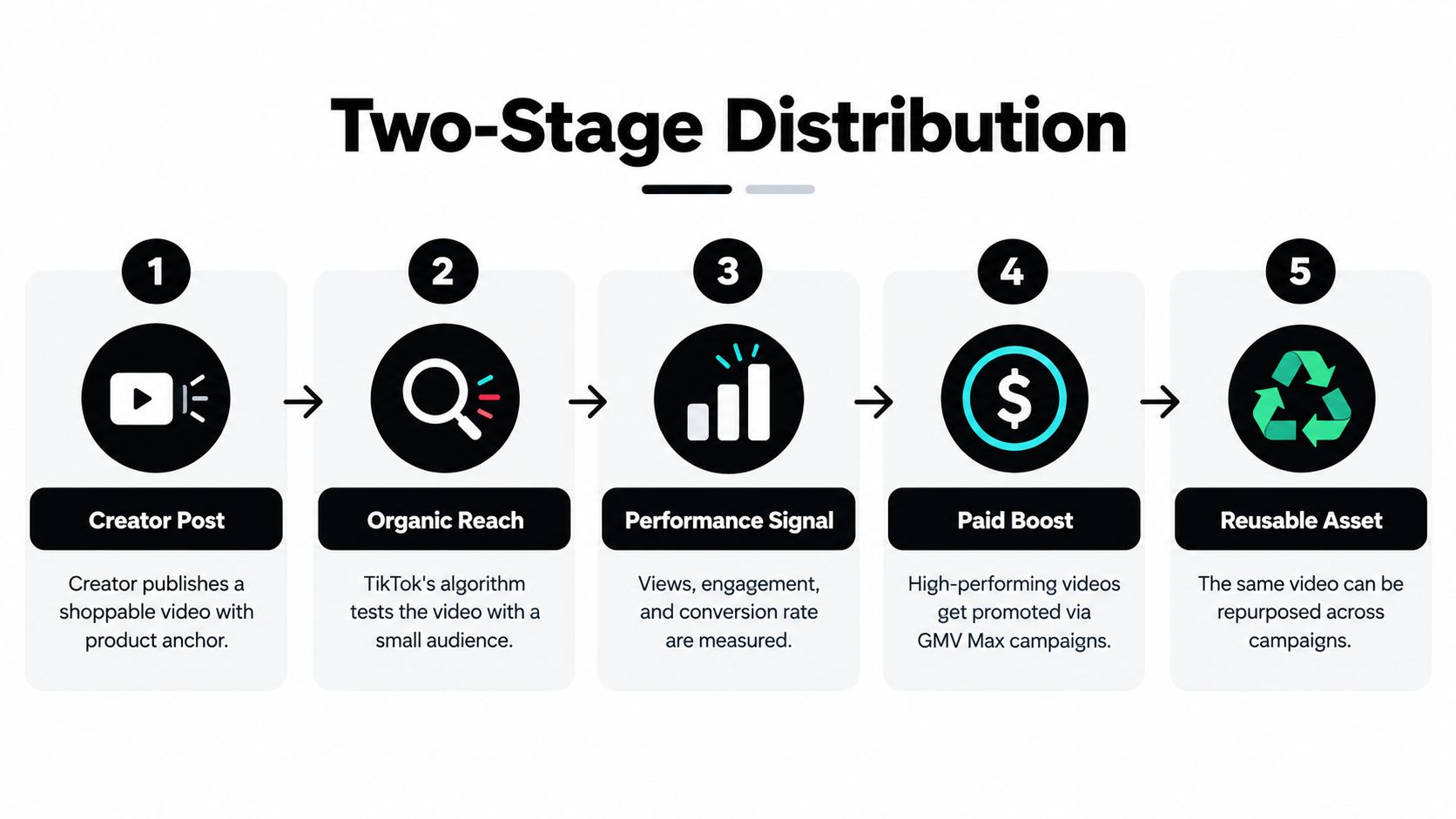
Shoppable video earns its keep in two stages, first as organic content, then as paid media if the post proves it can sell. That makes each video a reusable sales asset, not a one-time upload, so creative-source identifiers have to stay attached from the start. TikTok says authorized affiliate videos can run in Video Shopping Ads, and the Ads x Affiliate report separates organic sales from ad-driven sales on the same creative (TikTok Ads help).
Organic first, paid second
The cleanest workflow is to let the post prove itself before you pay to extend it. Start by finding which videos generate clicks and orders without amplification. Then authorize only those assets for paid delivery, because a paid impression that mostly captures demand created elsewhere can make a weak video look stronger than it is.
That distinction gets missed often. Attribution can point to the last qualifying touch, but credit is not the same as incrementality. If an organic post already closed the sale, paid delivery on the same creative may only be collecting the receipt.
Keep the operating fields attached from publish time onward:
- Creator commission, so profit is separated from gross sales.
- Authorization status, so you know which assets were eligible for paid use.
- Ad spend, so paid lift is not confused with organic momentum.
- Time-windowed orders, so organic and paid orders stay comparable.
- Product-level identifiers, so the same creative can be judged by SKU, not only by post.
If you turn short-form content into shoppable inventory, including reposted clips or creator edits, this guide to posting TikTok clips is a useful operational reference for workflow thinking. Pair that with the HiveHQ breakdown of the TikTok Shop flywheel (awareness → conversion → retargeting), and the structure is clear, discover the asset, validate the sale, then scale only what keeps earning its keep.
Product Anchors, Showcase Rules, and GMV Max Mechanics
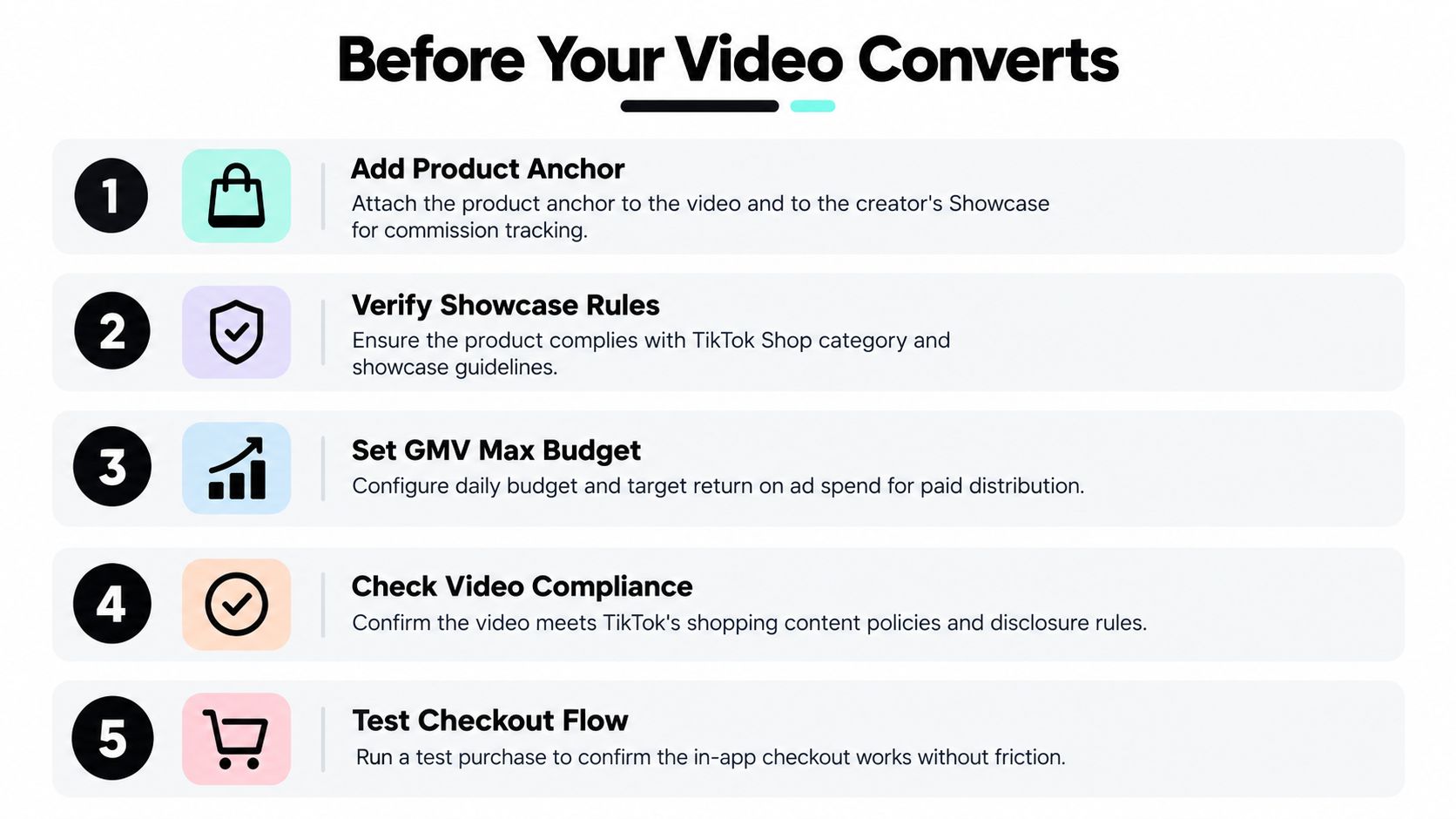
A shoppable video does nothing until the product anchor is attached correctly. TikTok's UK seller guidance says creators add products through + Add Link from their Showcase, and commission is credited only when the product appears in both the video and the Showcase. It also allows up to 10 product links in one short video, so product choice is an operating decision, not decoration (TikTok UK seller guidance).
The mechanics that change the math
GMV Max adds another layer. Product GMV Max can use TikTok Shop video creatives only when the video contains a single product anchor, and TikTok's U.S. seller documentation says the system can source videos from the shop's official account, the shop's TikTok Business accounts, and authorized accounts connected through Business Center (TikTok U.S. seller documentation). Multi-product storytelling and automated scaling follow different creative rules, and that difference affects how you read results.
There is also an account-level constraint that matters in practice. Only one ad account can have GMV Max access for a TikTok Shop at a time, and an active GMV Max campaign can pause existing Video Shopping Ads using the same product (TikTok U.S. seller documentation). If delivery shifts, the cause may be campaign overlap rather than the creative itself.
That is why product-level setup should be checked before any scaling decision. For a practical reference on how shoppable video setup works in the shop flow, the HiveHQ TikTok Shop selling guide is useful.
The operational readout is simple:
- Product anchor missing, commission cannot be credited.
- Too many products in one concept, attribution gets harder to interpret.
- Single-product GMV Max eligibility, the creative has to be built for automation.
- One primary ad account, governance matters as much as content.
Product-level attribution beats a store-wide total because the platform's rules are already product-specific before they are account-wide.
Why Trust, Not Reach, Is What Converts a Shoppable Video
Reach gets attention. Trust gets orders. A mixed-method study of 717 respondents and 30 interviews found that both cognitive trust and emotional trust significantly influence purchase intention, and that purchase intention then influences actual purchasing behavior (study).

What trust looks like inside a video
Cognitive trust comes from proof. Show the product in use, identify the seller or brand clearly, and be honest about limitations so shoppers do not feel tricked after the click. Emotional trust comes from tone, familiarity, and credible demonstration, which is why a creator who uses the product daily usually converts better than one who only performs around it.
That also explains why privacy-sensitive or overly aggressive claims can hurt conversion. If the viewer senses confusion, exaggeration, or opacity during the viewing session, the sale often disappears before checkout. Shoppable video is not just trying to entertain someone into curiosity, it is trying to reduce risk fast enough to earn an order.
A practical review should compare the video's attributes with the metrics that should move if trust is doing its job:
- Click-to-order rate, to see whether the video turns interest into action.
- Refund rate, to catch overpromising or mismatch.
- Repeat purchase rate, to separate one-time curiosity from durable demand.
- Content attributes, such as demos, testimonials, and clear disclosures.
If you are building or reviewing creator-style content, this UGC video reference helps frame the gap between polished promotion and believable product proof. The standard is straightforward, if the content does not lower perceived risk, it is probably decoration, not conversion.
Comparing Organic Video, Affiliate Ads, and GMV Max Amplification
These three paths answer different questions, so they need different scorecards. Organic shoppable video shows whether the creative itself can create orders. Authorized affiliate ads show whether paid distribution adds incremental demand on top of that creative. GMV Max shows whether automated multi-surface delivery can improve product-level contribution after ad spend, commissions, COGS, and refunds.
| Distribution path | Attribution source | Spend control | Primary metric | Incrementality question |
|---|---|---|---|---|
| Organic shoppable video | Native post and product anchor behavior | No media spend, only production and commission exposure | Creator-level efficiency and order rate | Did the creative itself create demand? |
| Authorized affiliate ads | Same creative, with ad attribution layered on top | Paid budget set by the operator | Lift versus the organic baseline | Did paid distribution add real demand, or just capture it? |
| GMV Max amplification | Campaign-level product and placement delivery | Automated within the chosen budget and ROI target | Product-level contribution margin after ad spend, commissions, COGS, and refunds | Did automation improve net profit, not just attributed revenue? |
TikTok's attribution rules matter because attributed sales can flatter all three paths if you read them as profit instead of credit. Orders are credited to the most recent qualifying interaction, with clicks taking precedence over views, inside windows of up to 7 days after a click and 24 hours after a view (TikTok attribution help). A video can get credit for demand that another touchpoint helped create.
What to measure before you scale
The wrong question is which channel “won.” The useful question is which path produced profitable incrementality for a specific product. That means keeping the creative source visible in reporting, because an organic post, a paid ad, and a GMV Max campaign can all touch the same order at different points.
Attribution helps, but it does not settle margin. You still need to separate creator source, campaign source, and product-level profit if you want to know whether volume is worth it.
If you want a practical creative reference point, AdCrafty's TikTok UGC guide is useful. The operator lens still has to stay profit-first, because total GMV can hide weak unit economics.
Sample Productivity Beats Follower Count Every Time
Follower count looks impressive, but it doesn't tell you who publishes, ships, and sells. Sample-to-sale productivity does. Digiday's analysis of 1.5 million samples found that only 47% became a creator video and only 14% of creators generated sales, while creators posting 20 or more videos averaged about $74 per video (Digiday). That is a production problem.
What to optimize instead
The unit that matters is sample-to-sale productivity. A creator who takes a sample and never posts gives you no read on demand. A creator who posts once and stops still leaves too little output to learn whether the message, hook, or product angle can hold.
Treat each sample like a pipeline stage. The working scorecard should track:
- Sample shipped, so fulfillment is visible from the start.
- Posting deadline, so idle inventory does not drift.
- Number of videos published, because repeat output is what creates learning.
- GMV per 1,000 followers, which says more than follower count alone.
- Sales persistence after the first post, to see whether the creator can keep moving the product.
A creator who posts consistently is usually easier to manage than a creator with a bigger audience and no operating rhythm.
Audience still matters. It is one input among several, and it is often not the one that decides whether the sample turns into profitable content. A creator who can turn one sample into multiple useful posts gives you more testing cycles, more inventory value, and more chances to find a profitable angle.
For teams that want to normalize the economics before they send more samples, a net profit calculator for TikTok Shop can help frame the trade-offs. The better recruiting question is simple: Who reliably ships content that sells?
Why Shoppable Video Profit Needs a Product-Level Dashboard
Store-wide GMV can flatter the wrong video. As noted earlier, last-touch crediting can assign demand to the wrong post, so a sale may land on the video that closed the order, not the one that created it.
That is why the unit of analysis has to be the product, not the account. A profit view should reconcile the full path to margin, not just the order count.
The numbers that belong on one screen
A product-level dashboard should show the figures that decide whether a SKU earned money:
- GMV, to measure gross demand.
- COGS, to show what the stock cost.
- Creator commissions, to capture partner expense.
- Refunds, to strip out sales that did not hold.
- Ad spend, to separate paid delivery from organic lift.
- Net contribution margin, to show the result after costs.
That is the difference between reporting and action. If one video drives strong revenue but the product loses money after commissions and ads, it should not be scaled. If another video produces less GMV but better net contribution, that is the one worth repeating.
Operator rule: if you cannot see profit by product, you are guessing on the number that decides whether the channel is healthy.
The same view also helps separate creative performance from customer quality. Some orders look fine until refunds and repeat purchase behavior change the picture. A TikTok Shop profit dashboard gives sellers a way to track real-time net profit, product performance, and customer analytics without stitching the numbers together by hand.
Scaling Shoppable Video Sales Without Losing the Margin
The operating model is simple once you stop treating every attributed sale as equal. Use organic shoppable video to find product-message fit, use authorized paid delivery to test lift on proven creative, and use GMV Max only when product-level margin still holds after commissions, refunds, and ad spend. That sequence keeps the channel honest and stops you from scaling revenue that doesn't survive the costs attached to it.
Frequently Asked Questions
How do I know whether a shoppable video created incremental demand?
Compare the paid-attributed result against the same creative's organic baseline, then subtract commissions, refunds, COGS, and ad spend. If the paid version only captures orders that the post already would have earned, it isn't incremental.
Should I recruit creators for audience size or output?
Output. A creator who publishes repeatedly gives you more tests, more learning, and a better chance of finding a profitable message. Follower count matters less if the creator doesn't ship consistently.
What should my first product-level dashboard show?
It should show GMV, COGS, commissions, refunds, ad spend, and net contribution margin by product. Anything less leaves the profit question unresolved.
If you're ready to see which TikTok Shoppable Videos make money, try the HiveHQ Profit Dashboard and talk to the HiveHQ team about a setup that fits your catalog, creators, and ad structure. It gives TikTok Shop sellers a self-serve way to track product-level performance and net profit in real time, which is the only view that makes scaling feel controlled instead of risky.
Try the HiveHQ Profit Dashboard to see product-level net profit, customer analytics, and shoppable video performance in one place. If you want to set it up for your TikTok Shop and compare organic, affiliate, and GMV Max performance properly, talk to the HiveHQ team and get a workflow built around the numbers that matter.