Influencers Amazon Storefront Guide for Brands
influencers amazon storefrontAmazon Influencer Programcreator storefrontTikTok Shop ROIaffiliate attribution
A brand should treat an influencer Amazon storefront as a persistent shoppable page, usually amazon.com/shop/creatorhandle, that pays the creator only when a shopper completes a qualifying purchase. Judge that page by incremental shipped profit after commissions, returns, and fees, not by clicks or followers.
The popular playbook still says the opposite. Hire the biggest following, drop a product link, and call the page a win if the click report looks busy. That advice hires on a weak signal and pays for the wrong outcome. A large audience can move almost no new units. A quieter creator can collect credit for sales that shoppers were already going to make. I would not renew anyone on clicks, views, or a follower screenshot. I would renew them only when shipped contribution stays positive after returns, the category commission, and any flat fee. Use that same profit test before you assume the creator will sell on TikTok Shop.
Table of Contents
- What an Influencer Amazon Storefront Does for a Brand
- Amazon Storefront Versus TikTok Shop Creator Workflows
- How to Brief Creators and Drive Storefront Sales
- Measure Incremental Sales and Manage Storefront Content
- Influencer Storefront Questions Brands Still Ask
- Choose the Next Test and Read TikTok Profit
What an Influencer Amazon Storefront Does for a Brand
An influencer Amazon storefront is the creator's own shoppable page. About Amazon's account of the Influencer Program describes a custom URL, typically amazon.com/shop/influencerhandle, where an approved creator groups recommended products into themed collections instead of relying on one-off affiliate links. The creator earns a commission when a shopper completes a qualifying purchase through the storefront, a shared link, or eligible onsite content. Clicks alone do not generate a commission, and views and follower counts do not pay either.
Amazon launched the Influencer Program in 2017 as a creator-focused extension of Amazon Associates. The program is built for creators who already have a social audience, and applications are weighed on factors such as audience reach and engagement. That shift moved recommendations off scattered posts and onto persistent pages inside the marketplace, where you can read product-level sales and commissions instead of vanity metrics.
Amazon also surfaces some creator content to shoppers already on the retail site, so the page can reach people who have never followed the creator. That second audience is not the audience the creator brought.
Who owns which part of the page
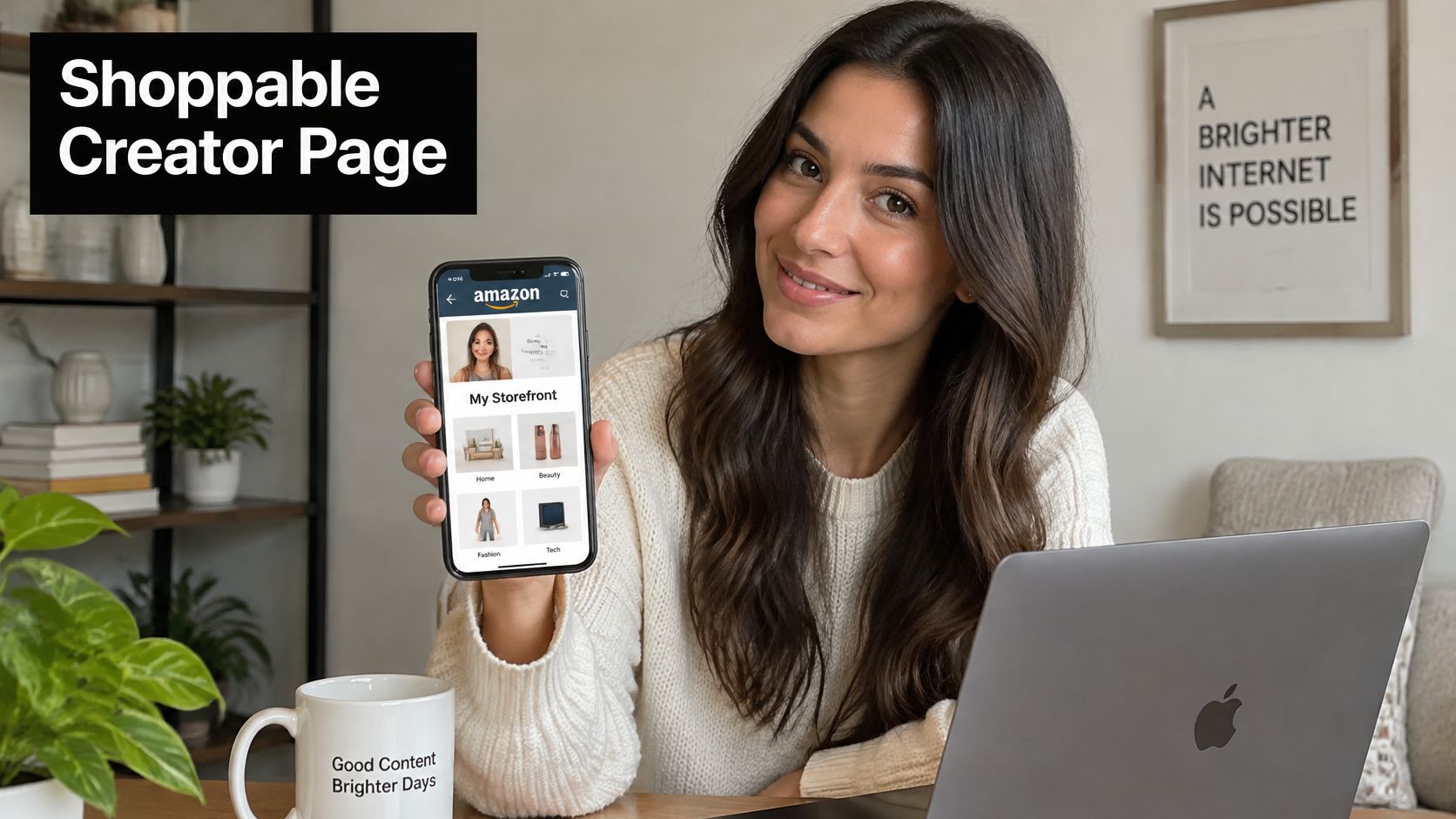
The creator owns curation, collections, videos, and the public URL. You can't fully rewrite their page.
Amazon owns checkout, attribution, and commission reporting.
The brand owns product truth, inventory, claims, and the offer. If the ASIN is out of stock or the claim is wrong, the storefront can't fix that.
Amazon's shop overview describes the money paths that sit under this page: personalized storefronts and affiliate links, creator content Amazon may display to shoppers, and commissions on qualifying purchases, with rates that vary by product category. Sponsored-product activity can create a separate advertising-related payout for the creator. That payout is not your storefront return.
Practical rule: Pay for demand the creator actually brought. Don't pay a second time for placement Amazon chose.
Recruit and brief for traffic the creator sends in, then keep Amazon-surfaced exposure in its own column. If you later use Amazon Creator Connections, treat a bonus campaign as a third bucket, not as proof the creator's audience will travel. Don't copy this workflow onto TikTok Shop and expect the same page, the same attribution, or the same profit.
Amazon Storefront Versus TikTok Shop Creator Workflows
Pick the row that matches the decision you're about to make, then hire against that row. External traffic a creator sends to a storefront is not the same channel as content Amazon places in front of people who are already browsing.
| Decision point | Amazon influencer storefront | TikTok Shop creator workflow |
|---|---|---|
| What the creator publishes | Themed collections and videos on amazon.com/shop/handle | Short videos, lives, and shoppable posts inside TikTok Shop |
| When the brand gets paid demand | Qualifying purchase, not a click | Completed in-app order tied to content or affiliate |
| Attribution split | External referral versus a separate Onsite Store ID | Orders, content, and affiliates in one shop record |
| Attribution window | 24-hour window on referred qualifying purchases | Order-level, visible with the shop's own reporting |
| Creator pay | Category commission on sale price, not list price | Commission, sometimes a fee, against GMV |
| Who controls the page | Creator curates; brand cannot fully edit the storefront | Brand owns the shop and the offer |
| Discovery guarantee | Upload does not guarantee onsite placement; 10 approved videos is only an eligibility step | Feed, live, and shop distribution; paid reach uses GMV Max |
| Profit read | Commission reports miss fees, returns, and true incrementality | Net profit after COGS, commissions, returns, and ad spend |
Rows brands misread
Attribution is the row that gets brands in trouble. Traffic the creator sends keeps standard affiliate attribution. Content Amazon surfaces to shoppers already on the site is reported under a separate Onsite Store ID, can earn onsite rates, and those onsite earnings exclude traffic the creator sends directly. Adding the two lines together makes a creator look like they created demand they didn't create.
Pay and discovery don't transfer. On Amazon, commission follows the category and the price the shopper pays. On TikTok Shop, creator pay is usually a commission, sometimes plus a fee, against in-app GMV. An upload on Amazon does not guarantee placement. On TikTok, distribution still depends on the content, and when you pay for reach you buy it through GMV Max, not an older paid format.
Control sits in different hands. You don't edit the creator's Amazon page. You do own the TikTok Shop, the price, and the offer. If you need to track TikTok traffic to your Amazon storefront, treat that path as external referral and keep it out of the onsite line. A creator who wins because Amazon placed a video on a product page can still fail on TikTok if they can't create demand without that page.
A Prime spike is not a run rate. Modern Retail reported in 2025 that clients using Creator Connections during both the 2024 and 2025 Prime Big Deal Day events achieved a 244% year-over-year increase in affiliate-driven revenue. Use that as a warning about event spikes, not as a forecast for an ordinary month. Build the standing plan in a TikTok Shop marketing strategy around ordinary weeks, where orders, commissions, returns, and ad spend can be read on the same order and rolled into net profit.
How to Brief Creators and Drive Storefront Sales
Run this in a week. Don't outsource the judgment to an outreach sequence. The point of the brief is one product, one external push, and a metric you can audit.
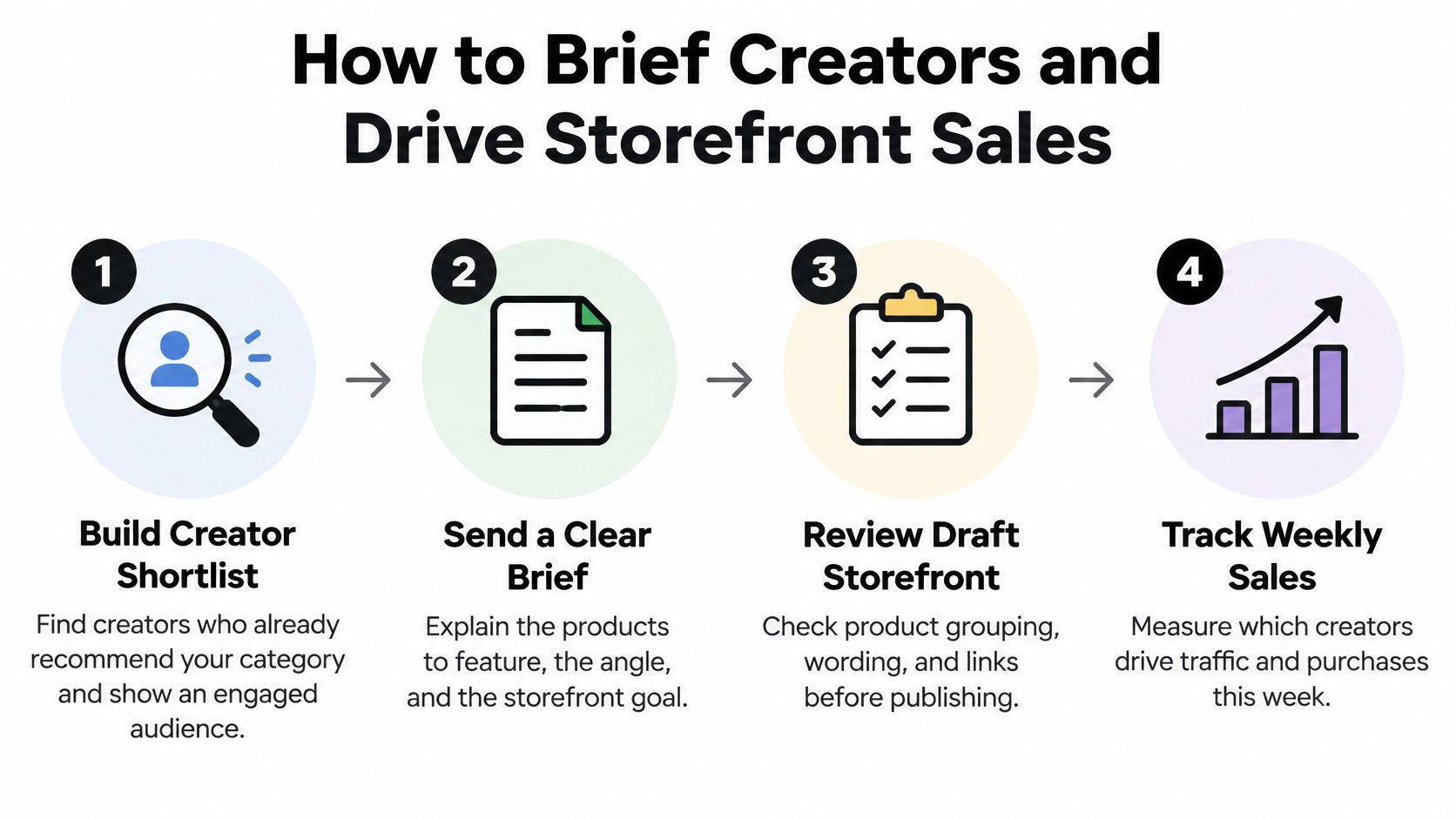
Build the shortlist on category fit, not followers. Look for creators who already recommend your category and show an approved storefront. Rank them by how specific the recommendations are. A cleanser review that names skin type beats a haul from an account ten times larger.
Open the storefront before you write. Check themed collections, whether the featured ASINs are still in stock, and whether recent videos match products you can supply. If the hero product is a different size or a discontinued scent, the collection will send shoppers to a page you can't fulfill.
Send a short note with one product, one audience reason, and one ask. A useful line is: "Your sensitive-skin collection already features a cleanser like ours. Can we brief the 50 ml size for a two-week external push?" A weak line only praises reach. Use this note as the whole first touch.
Subject: Your storefront collection and one product.
Hi [creator name], your storefront collection for [category] already features a product like ours. We would like to brief our [ASIN] for a two-week external push with a sample and an agreed publish window. Could you share the exact storefront URL and confirm your Amazon Associates disclosure wording? Thanks, [brand contact name].
Confirm the URL and the disclosure before anything ships. Amazon's Associates operating agreement requires associates to identify themselves clearly with "As an Amazon Associate I earn from qualifying purchases," or substantially similar language Amazon has already approved. For social user-generated content, the statement has to be associated with the account, and it has to appear in the same medium as the recommendation. Text needs text. Voice needs voice. Content that uses both needs both.
Brief three assets only. Ask for one evergreen collection, one link the creator will push off Amazon, and an optional onsite video. Amazon's influencer help says that after an influencer uploads 10 videos that pass moderation and completes signup for onsite commissions, shoppers may discover those videos on relevant product-detail pages, on the storefront, and in placements across Amazon.com. That threshold is eligibility. It is not a promise of placement or earnings, and onsite commission still depends on a click plus a qualifying purchase.
Lock the commercial terms before the sample leaves. Agree the offer, banned claims, and a publish window in writing. If the creator can't hit the window, don't ship a second sample to "keep the relationship warm."
Put the success metric in the brief itself. Shipped units after returns, inside the attribution window, split by external versus onsite. Not clicks.
Say a skincare brand seeds one ASIN to three storefronts. Each brief names the 50 ml size, a two-week external push, and the disclosure line. One creator already has a sensitive-skin collection, so that creator gets the sample first. The other two are backups if the first misses the window. You are not buying three audiences. You are buying one clean comparison. The same discipline shows up when you brief a TikTok creator for a brand deal: one product, one window, one profit rule.
Measure Incremental Sales and Manage Storefront Content
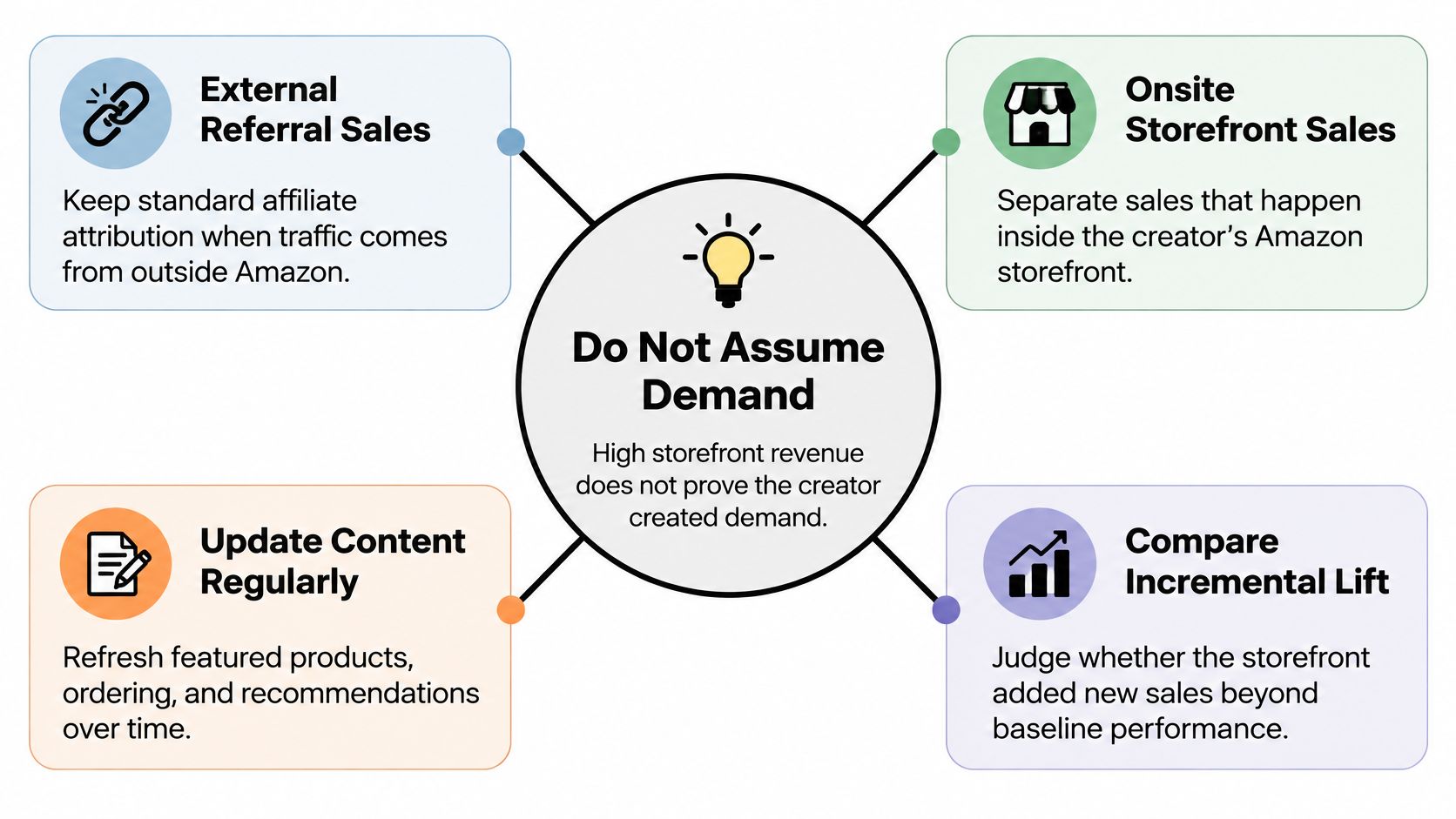
High storefront revenue doesn't prove the creator created demand. Amazon's influencer program separates external referral activity, which keeps standard affiliate attribution, from content surfaced to shoppers already browsing Amazon, which is reported under a separate Onsite Store ID and earns onsite rates. Amazon also says onsite earnings exclude traffic creators send directly. A storefront can show sales when the creator redirected an existing shopper, or when Amazon's placement did the work.
Two blocks you never add together
Keep a monthly scorecard with two blocks.
Block A, external. Attributed orders, shipped units after returns, category commission on the sale price rather than the list price, flat fees, and net contribution against a pre-period or a holdout on the same ASINs. Reconcile that against the 24-hour attribution window after you confirm current Associates terms. This block is the promotional test.
Block B, onsite. Onsite Store ID sales, labeled as Amazon-surfaced demand. This block tells you what the retail site did with the content. It doesn't tell you what the creator's audience did.
Never rank creators by clicks, gross commission, or video count. If you need the mechanics of splitting credit, start from what attribution modeling actually separates, then apply it to these two IDs.
A sketch that shows why gross units lie
Say one creator is credited with 200 attributed units. Returns take 8%, so 184 units stay. Commission is 10% of a $25 sale price, which is $2.50 on each kept unit, or $460. You also paid a $500 flat fee. This sketch assumes $12 of gross margin per unit before any creator cost, so you can see the gap. The baseline on the same ASINs, without this creator, was 140 units. The extra shipped units are 44, not 200.
| Line item | Value |
|---|---|
| Attributed units | 200 |
| Units kept after 8% returns | 184 |
| Flat creator fee | $500 |
| Total creator cost | $960 ($460 commission on kept units plus the $500 fee) |
| Baseline units without creator | 140 |
| Extra shipped units versus baseline | 44 |
| Gross margin per unit | $12 assumed in this sketch, before creator cost |
Those 44 extra units produce $528 of gross margin in the sketch. Creator cost is $960. The report that says "200 units" would have renewed this creator. The contribution math would not. Change the margin and the fee to your own numbers. Don't change the structure. The gain is the extra shipped profit, not the full attributed pile.
Three portfolios, scored apart
Seller Sprite's write-up of the influencer and affiliate programs notes that uploading a video or having a storefront doesn't guarantee placement or earnings. Creator-reported tracking, not an official Amazon disclosure, put average Creator Connections participation up from 114 opt-ins to 746, about 93% full, in under a year, with another report putting campaign capacity at 800 creators. Treat those figures as directional. They still show why "post more videos" is not a revenue plan. Income can be constrained by platform inventory and attribution conditions more than by audience size.
Score three portfolios separately, on contribution profit, content age, conversion, return rate, and dependence on temporary placement.
- Evergreen onsite videos earn only while Amazon keeps selecting them. Refresh when the ASIN, price, or season changes. Retire duplicates that compete with a stronger cut of the same product.
- Externally promoted collections are the portfolio you can brief. Keep a creator only if external contribution stays positive after returns and fees for two reporting cycles.
- Bonus-driven campaigns should be retired when the bonus ends. A full campaign slot is not durable demand.
Cross-channel, the same blindness shows up in reverse. In the Nusava case, Amazon spillover from TikTok momentum added $68K, which a view-only read of either channel would have missed. A creator who only wins inside Amazon placement hasn't shown you they can create that kind of spillover.
Influencer Storefront Questions Brands Still Ask
Can our brand page be the influencer storefront?
No. Storefronts belong to approved creators in the Amazon Influencer Program. You brief products and offers. You don't take over the creator's URL, and you shouldn't ask them to hand you the login.
Do we pay for clicks or followers?
No. Commission requires a qualifying purchase. When you renew, use shipped units after returns, not traffic and not follower count. A busy click report with flat shipped units is a failed test.
How long does attribution last?
Referred qualifying purchases are commonly tied to a 24-hour window. Confirm the current Amazon Associates terms before finance accrues a payout, and keep Onsite Store ID sales on a separate line so a placement win doesn't get booked as audience demand.
If a storefront sells well, should we hire them on TikTok Shop the same way?
Not automatically. Amazon onsite placement can inflate storefront revenue without the creator creating demand. Run a small TikTok test and compare contribution profit after COGS, commissions, returns, and GMV Max spend. Keep the creator only if that test is positive on its own.
Choose the Next Test and Read TikTok Profit
Make one decision this week, not a recap.
If external storefront contribution is already positive, keep a tight roster and refresh collections by season. Don't add creators just to look busy.
If the revenue is mostly Onsite Store ID, stop paying as if the creator's audience created it. Redesign the brief around off-Amazon traffic, or end the fee.
If you already sell on TikTok Shop, or you're ready to launch there, don't assume the Amazon roster transfers. Define one profit rule for the test: net profit after COGS, creator commissions, returns, and GMV Max ad spend, at product level, with customer analytics beside it. A creator who only won on an Amazon product page has not passed that rule. Read how TikTok Shop can drive top-of-funnel awareness for Amazon brands as a separate motion, with its own orders and its own profit, not as a copy of the storefront.
The HiveHQ Profit Dashboard is self-serve software you run yourself. It shows real-time net profit, product-level performance, and customer analytics for TikTok Shop, with calculations powered directly by your shop's TikTok data. Use it to see whether the TikTok test cleared the profit rule before you scale the roster.
HiveHQ's Profit Dashboard shows TikTok Shop sellers real-time net profit, product-level performance, and customer analytics, so you can apply the same incremental test you use on an influencer Amazon storefront before you scale a creator. Run it yourself on your shop's own TikTok data, then decide who stays. Try the HiveHQ Profit Dashboard and talk to the HiveHQ team at HiveHQ.