TikTok Shop Explained: Profit Analytics for Sellers
tiktok shopseller guideecommerceprofit analyticshivehq
TikTok Shop isn't won by the seller with the biggest GMV headline. It's won by the seller who knows which products, creators, campaigns, and orders still produce cash after commissions, discounts, advertising, fulfillment, refunds, and cost of goods sold.
That distinction matters because TikTok Shop has already become a substantial commerce channel. Momentum Works estimates that global GMV reached approximately $33.2 billion in 2024, compared with about $11.09 billion in 2023, while the United States generated roughly $9 billion in sales during 2024, according to reported TikTok Shop market data. The opportunity is real, but top-line sales can hide a weak business.
Table of Contents
- What TikTok Shop Actually Rewards
- Commerce Models and Fee Mechanics
- Seller Onboarding and Eligibility Rules
- Creator Economics and Paid Growth
- Product-Level Profit Analytics with HiveHQ
- Common Pitfalls and Next Steps
What TikTok Shop Actually Rewards
A strong sales day can still produce a loss. Orders rise, videos attract attention, and the shop dashboard shows higher GMV. Settlement data then applies commissions, creator payouts, discounts, shipping, advertising, returns, and product costs. The apparent win becomes a margin problem.
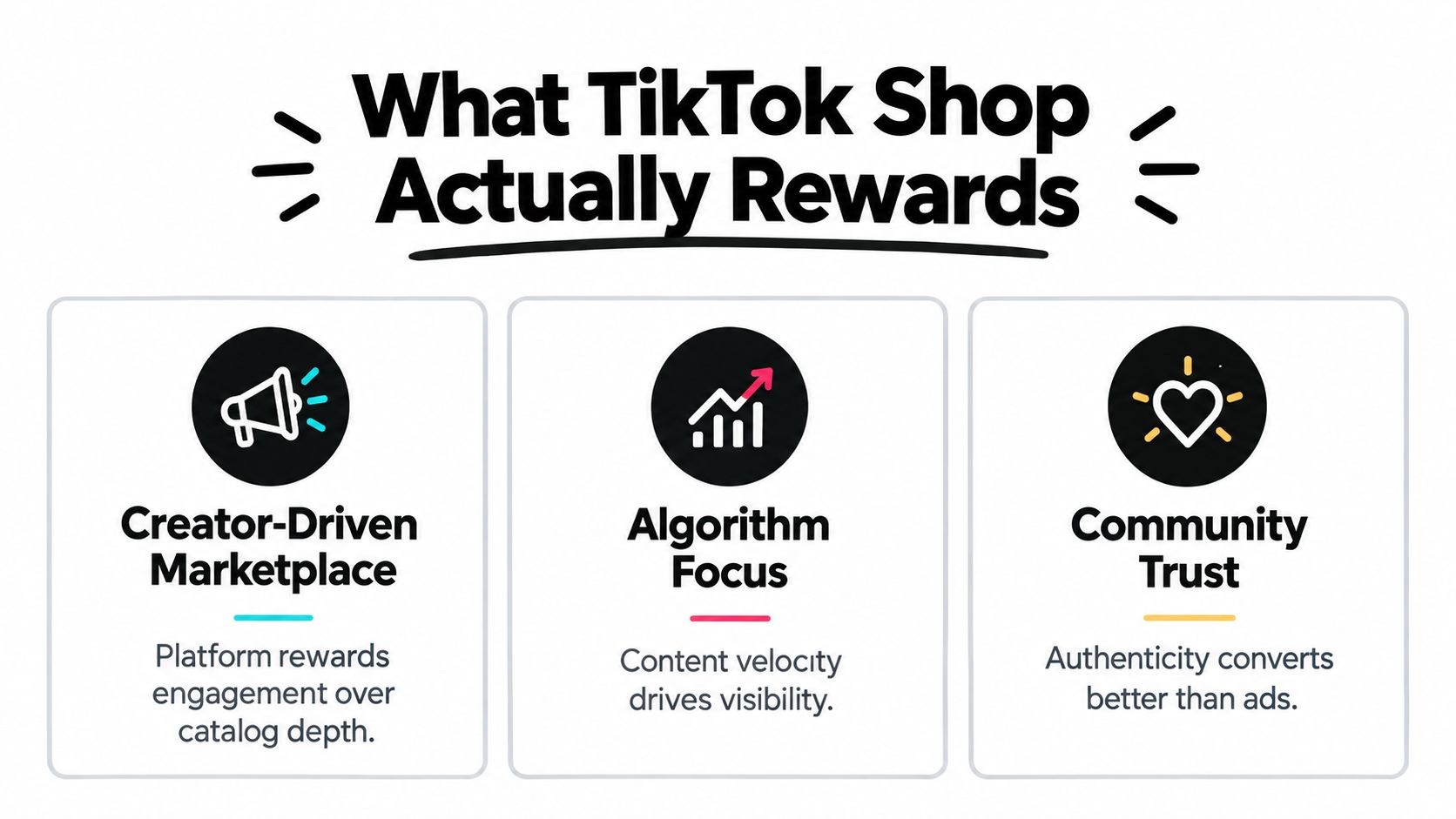
TikTok Shop is a creator-driven marketplace where discovery content can turn attention into an in-app purchase. It differs from a catalog channel built mainly for shoppers who already know what they want. Organic videos, livestreams, affiliate content, storefront activity, and paid distribution may all drive sales for one product, while carrying different costs and refund patterns.
Why GMV creates false confidence
TikTok Shop's market growth makes top-line performance tempting to celebrate. The headline figures describe market size, not the margin available to an individual seller. The operating question is how much revenue survives after commissions, creator payouts, discounts, advertising, fulfillment, refunds, returns, and product costs. The global and U.S. GMV overview provides context for the channel's scale, but scale alone cannot show whether a SKU is profitable.
A product can have a healthy selling price and still produce weak contribution margin. Expensive creator distribution, paid amplification, high-cost fulfillment, or frequent refunds can consume the amount left after product costs. A blended shop report may also hide the difference between a SKU that supports a campaign and one that absorbs spend without enough realized revenue.
Practical rule: Treat GMV as the starting point for reconciliation, not the final performance metric.
Ask a narrower question: “What did this product contribute after every variable cost?” Connect order-level sales with COGS, platform fees, affiliate payouts, ad spend, discounts, shipping, refunds, and returns. Review the settlement after refunds and deductions have posted. An attributed order is not automatically realized profit.
The dashboard mindset
A profit-first operator reads TikTok Shop through three lenses:
- Contribution margin: What remains after the costs directly tied to selling and delivering the product?
- Product attribution: Which SKU generated the revenue, and which SKU absorbed the cost?
- Settlement timing: When did refunds, deductions, and payouts change the cash position?
This approach changes content evaluation. A video with strong reach has value only when its attributed sales survive the cost structure. A creator with impressive GMV may contribute less than a smaller partner whose orders deliver repeatable, refund-adjusted contribution.
The same test applies to paid distribution. Keep spending behind products with known product-level economics, then check whether additional volume preserves contribution rather than merely increasing activity. For a practical examination of why GMV is a vanity metric on TikTok Shop, compare sales volume with the costs and adjustments that determine realized profit.
Scale products that produce contribution, not products that merely produce activity.
Commerce Models and Fee Mechanics
TikTok Shop combines several routes to purchase. A seller can generate demand through its own videos, receive distribution from affiliate creators, and use paid campaigns to amplify products or authorized content. The same SKU may appear in all three routes, which is useful for reach but dangerous for reporting if the seller evaluates only blended revenue.
The operating choice should depend on how much control and margin visibility the seller needs.
| Model | Who Drives Sales | Margin Visibility | Best For |
|---|---|---|---|
| Seller-owned content | The seller's content team and storefront | Relatively clear, if content and ad costs are tracked separately | Products with a strong demonstration or brand story |
| Affiliate distribution | Independent creators using videos or livestreams | More complex because creator payouts, samples, and attribution must be reconciled | Products that benefit from trusted demonstrations and varied audiences |
| Paid amplification | TikTok campaign delivery using selected products and creatives | Blended reporting can conceal SKU-level cost differences | Proven products with controlled contribution margin and sufficient inventory |
Seller-owned content
This model provides the clearest creative control. The seller chooses the product angle, demonstration, offer, and publishing cadence. It also creates a cleaner starting point for measuring whether the product can convert without an additional affiliate payout.
That doesn't mean organic content is free. Production time, samples, editing, promotional discounts, and inventory risk still affect the product's economics. A seller should assign those costs where possible, rather than assuming that unpaid distribution has no cost.
Affiliate-driven sales
Affiliate distribution adds reach and social proof, but it creates another layer of variable expense. The seller needs to connect creator attribution to product-level revenue, then subtract commission, samples, returns, and any paid amplification attached to that content.
A broad campaign may show impressive GMV while hiding creators who generate low-quality orders or high refund rates. The relevant comparison isn't “which creator sold the most?” It's “which creator produced the strongest refund-adjusted contribution after their full cost?”
Paid campaigns
Paid distribution can accelerate a product that already converts, but it won't repair weak unit economics. If the product needs deep discounting and costly traffic to make a sale, more spend can just increase the speed of the loss.
Fee mechanics make simple percentage calculations unreliable. In the UK, TikTok Shop calculates seller commission using net sales, customer-paid shipping, and platform discounts, subtracting net-sales refunds and platform-discount refunds before applying the 9% commission rate, as set out in TikTok Shop's UK commission formula. Affiliate commission is calculated separately using the product price after seller and platform discounts.
For sellers building a margin model, the important point is that commission isn't necessarily calculated from the advertised product price alone. Shipping and platform-funded discounts can affect the fee base, while refunds can reduce it. A useful TikTok Shop fee breakdown should therefore be translated into SKU-level settlement logic, not copied into a generic spreadsheet percentage.
Seller Onboarding and Eligibility Rules
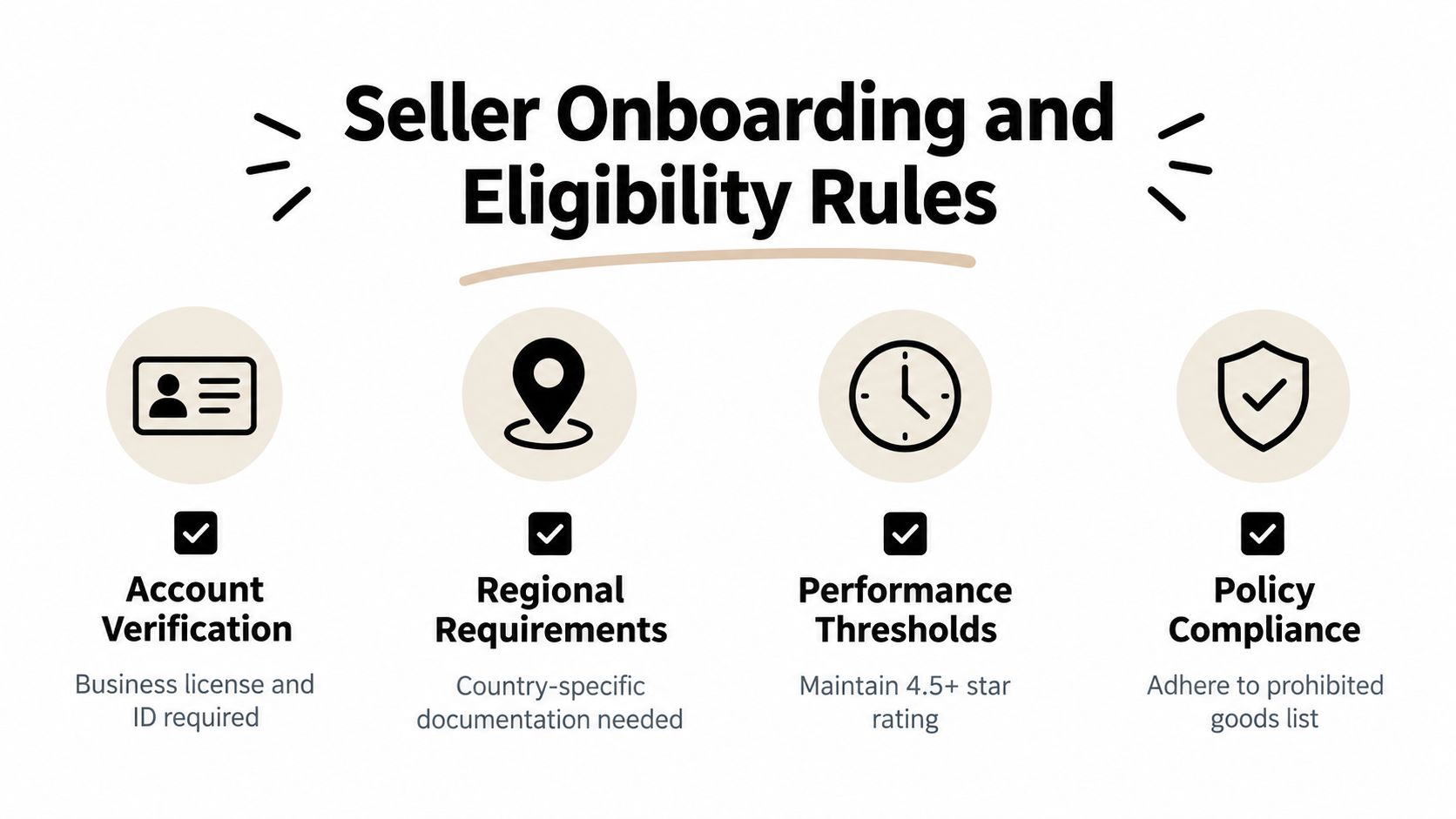
TikTok Shop onboarding isn't complete when a seller uploads products. The shop must keep meeting operational requirements after launch, and those requirements can affect the ability to sell, advertise, and retain customer trust.
For a seller moving from another marketplace, the practical sequence is:
- Verify the selling entity. Prepare business and identity documentation appropriate to the market, then confirm payout and shop details.
- Configure fulfillment before promotion. Set inventory, shipping rules, carriers, tracking, and return processes before sending traffic to product pages.
- Audit listing and product compliance. Check product claims, category requirements, restricted goods rules, and customer-facing information.
- Monitor shop health continuously. Review dispatch, delivery, cancellations, refunds, and customer issues at shop and SKU level.
The U.S. operating thresholds
TikTok Shop's U.S. policy requires regular orders to be dispatched within two business days after entering “Awaiting Shipment.” The policy identifies enforcement risk when Late Dispatch Rate exceeds 10%, and states eligibility criteria including a Shop Performance Score of at least 3.5, an On-Time Delivery Rate of at least 80% over the previous 30 days, and a Seller Fault Cancellation Rate of no more than 5% over the previous 30 days, according to TikTok Shop's U.S. seller-performance policy.
These aren't administrative details. Late dispatch and seller-fault cancellations can waste paid traffic, create refunds, and damage the conversion environment around a product. A seller that scales demand before confirming inventory and fulfillment capacity can turn a successful content push into an operational failure.
A readiness check before scaling
Before increasing content or ad spend, verify that:
- Inventory is synchronized: Stock levels can support promoted demand without avoidable cancellations.
- Dispatch ownership is clear: Someone reviews new orders and exceptions every business day.
- Refund reasons are coded: The team can distinguish product dissatisfaction, delivery failure, listing confusion, and customer error.
- Profit reporting includes operations: The dashboard connects cancellations, refunds, fulfillment costs, and product margin.
The same discipline applies in the UK, where commission and settlement fields must be reconciled rather than inferred from the displayed selling price. A practical TikTok Shop seller requirements checklist should be treated as an operating control, not a one-time onboarding document.
Creator Economics and Paid Growth
Creator distribution can produce rapid demand, but creator volume is a poor substitute for creator economics. A seller may send samples to many people, receive plenty of activity, and still struggle to identify which relationships generate profitable, repeatable orders.
An independent 2025 report estimated approximately 803,500 registered U.S. stores, with more than half recording zero sales. The same report estimated that only 2,143 stores exceeded $1 million in GMV, while just 291 active affiliates generated more than $1 million in sales, as reported by independent coverage of TikTok Shop seller concentration.
Concentration changes the decision
These figures show why outreach volume isn't a reliable growth strategy. A seller should rank creators using attributable GMV, conversion behavior, refund-adjusted revenue, posting reliability, compliance health, and contribution margin. A creator who produces fewer orders may be more valuable if those orders remain profitable after commission and returns.
Emerging creators can still be useful, but their economics need a separate test. Track whether a sample becomes content, whether the content arrives on time, whether the product is represented accurately, and whether the resulting orders convert without excessive refunds. The operational cost of chasing undelivered content belongs in the decision, even when it doesn't appear as a direct platform fee.
Measurement standard: A creator earns more budget by producing incremental contribution, not by producing attributed GMV alone.
A portfolio approach is safer than relying on one successful creator or pursuing a large undifferentiated pool. Proven creators can support predictable distribution, while carefully selected tests reveal new product and audience fit. Neither group should be evaluated without product-level cost data.
GMV Max needs SKU-level controls
Starting in July 2025, GMV Max became the default and only supported campaign type for TikTok Shop Ads when TikTok Shop is the sales destination. TikTok states that sellers can no longer create, edit, or duplicate the former campaign types in the same way, while existing campaigns can transition to GMV Max, as described in TikTok's GMV Max transition guidance.
GMV Max can combine products, seller-account creatives, and authorized affiliate videos within one Promote campaign. That convenience creates a reporting risk. Blended campaign ROI may look acceptable because a strong SKU compensates for another product with high ad cost, weak margin, or high refund exposure.
Use a decision matrix before increasing spend:
| Situation | Primary Decision | Required Evidence |
|---|---|---|
| Proven creator, strong product margin | Scale selectively | Refund-adjusted contribution and repeatable content |
| New creator, uncertain delivery | Run a controlled test | Sample cost, content delivery, conversion, and policy health |
| Strong blended campaign ROI | Inspect products separately | SKU-level spend, COGS, fees, discounts, and refunds |
| Rising sales with falling contribution | Pause or reprice | Order-level profit and return-rate trend |
For operators who want to separate creator performance from campaign-level noise, this guide to tracking creator-level profitability provides the right analytical frame.
Product-Level Profit Analytics with HiveHQ
A seller needs a single view that answers a narrower question than “How much did the shop sell?” The useful question is, “Which SKU and sales source produced realized contribution after deductions?”
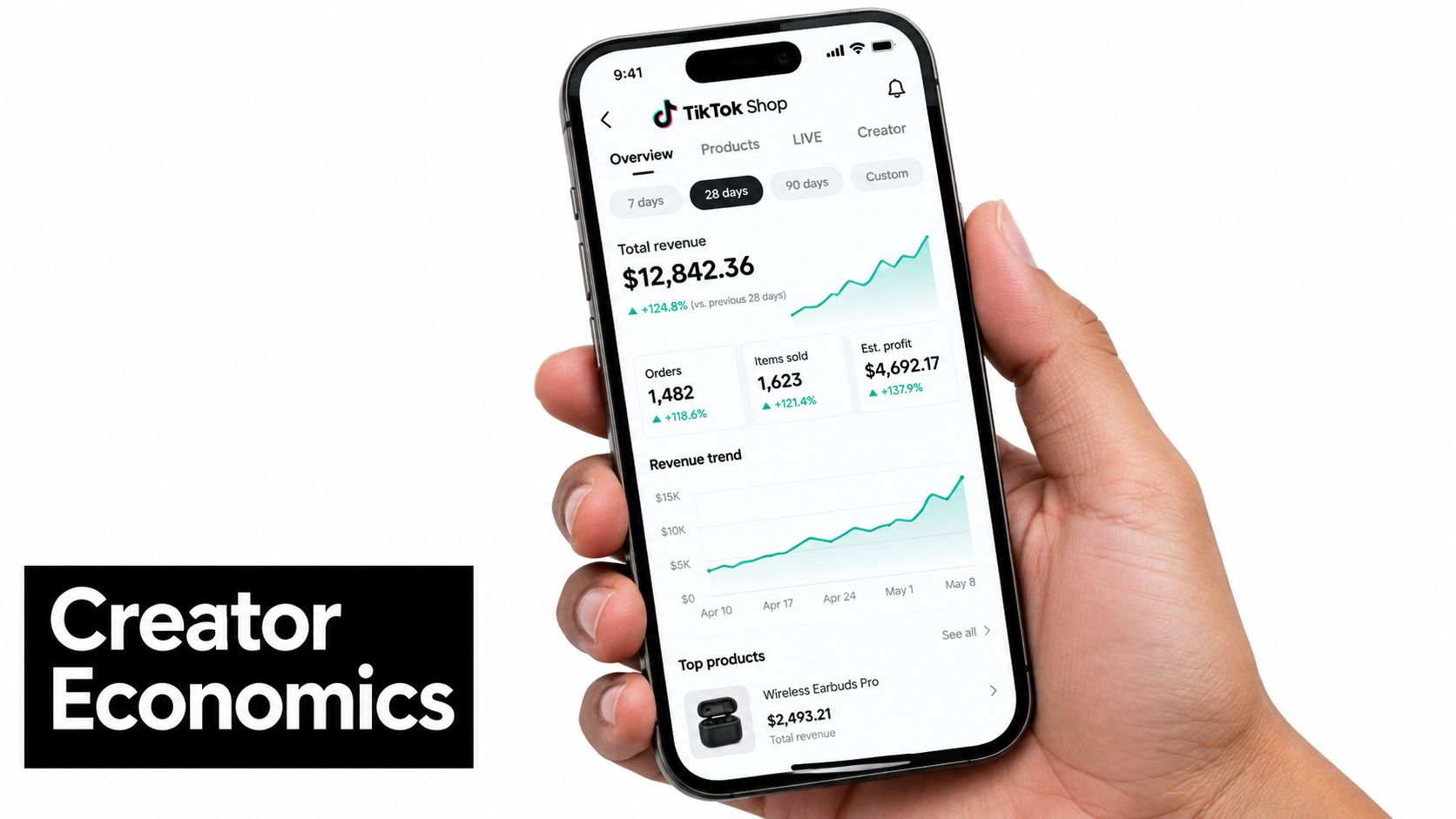
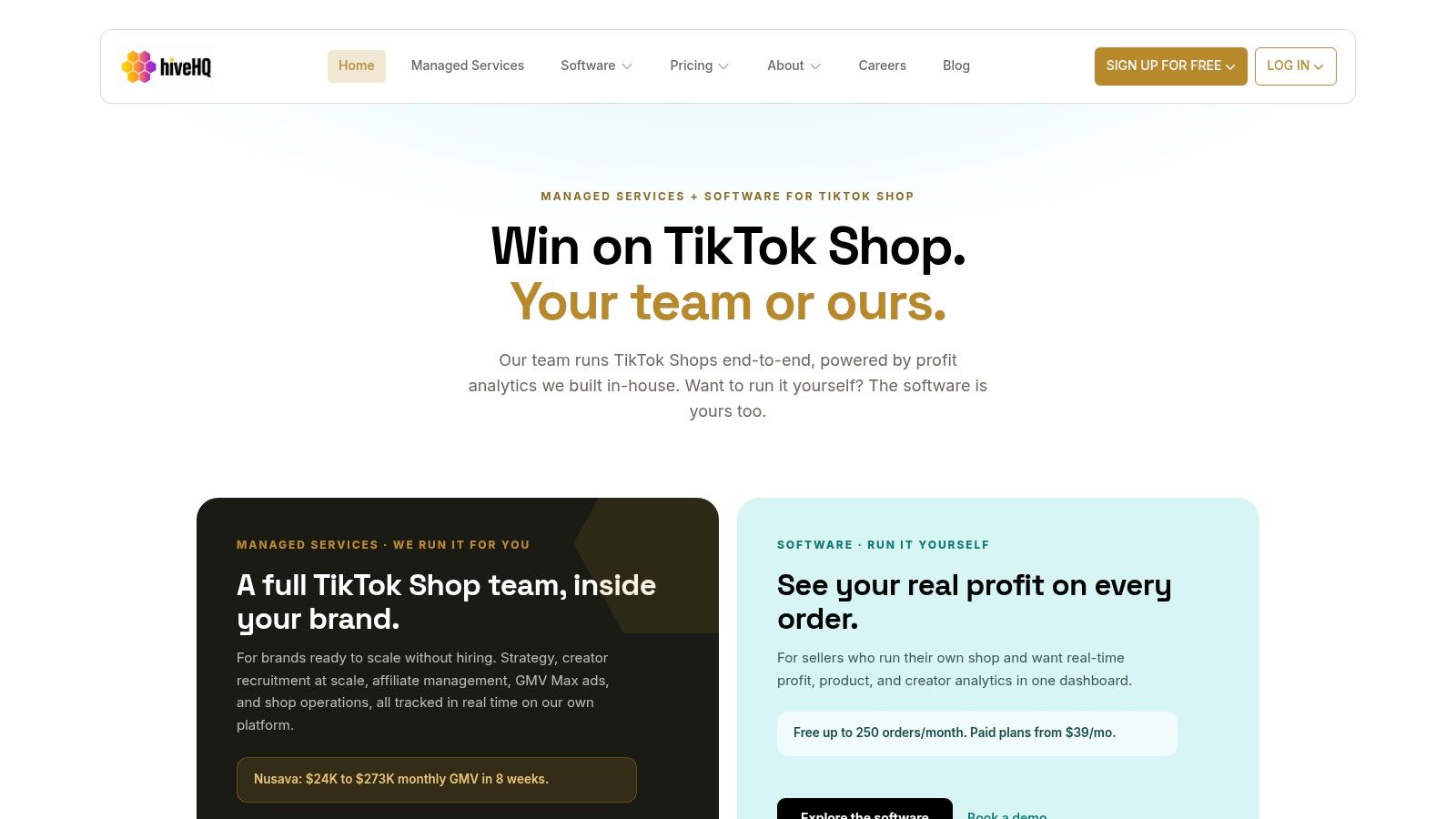
The HiveHQ Profit Dashboard is self-serve software for TikTok Shop sellers who want real-time net profit, product-level performance, and customer analytics without relying only on platform summaries. It surfaces the fields operators need to reconcile, including GMV, COGS, ad spend, commissions, and refunds.
What the dashboard should reveal
A useful profit view lets a seller compare products on realized contribution rather than headline revenue. For each SKU, look for:
- Sales and deductions: GMV, discounts, commissions, refunds, and settlement effects.
- Acquisition cost: Ad spend, affiliate payouts, samples, and paid amplification.
- Operational quality: Cancellations, delivery problems, return reasons, and customer behavior.
- Source performance: Organic content, affiliate content, livestream activity, and paid distribution.
That structure makes scaling decisions more precise. One product may deserve more traffic because it retains margin after creator and fulfillment costs. Another may need a price change, a tighter offer, or a pause even if it ranks highly in the shop's sales report.
Content production can also be evaluated as an operating input. Teams building repeatable product demonstrations may find a practical product video automation pipeline useful, but the resulting content should still be judged by SKU-level contribution rather than output volume.
The video below offers a visual introduction to the product experience.
For a deeper implementation approach, TikTok Shop COGS tracking should include landed product costs, fulfillment, refunds, and the timing of returns. Without those fields, net profit remains an estimate that becomes less reliable as the shop scales.
Common Pitfalls and Next Steps
TikTok Shop sellers usually don't fail because they lack another GMV report. They fail because the report doesn't connect sales to the costs that made those sales possible.
- Treating GMV as profit: Reconcile every SKU against COGS, commissions, discounts, ads, creator payouts, fulfillment, and refunds.
- Sending samples without a control system: Track sample shipment, content delivery, attributable orders, returns, and net contribution.
- Trusting blended campaign ROI: Inspect product-level spend before adding products to a scaling campaign.
- Ignoring shop health: Monitor dispatch, delivery, cancellations, and refunds alongside revenue.
- Waiting for month-end analysis: Review sales and settlement movement frequently enough to catch margin drift while you can still act.
A practical operating rhythm is straightforward. Reconcile GMV and deductions daily, review creator and content performance weekly, and analyze product-level net margin monthly after refunds and returns have had time to appear. Use those reviews to decide which SKUs to scale, pause, reprice, or remove from paid distribution.
Top-line growth matters only when it creates durable contribution. The sellers who build that discipline early are better positioned to use TikTok Shop's discovery engine without allowing fees, policy failures, or uncontrolled acquisition costs to consume the business.
HiveHQ offers a self-serve Profit Dashboard for real-time net profit, product-level performance, and customer analytics across TikTok Shop sales. Visit HiveHQ to test a profit-first reporting workflow, then talk to the HiveHQ team about applying it to your products, campaigns, and settlements.